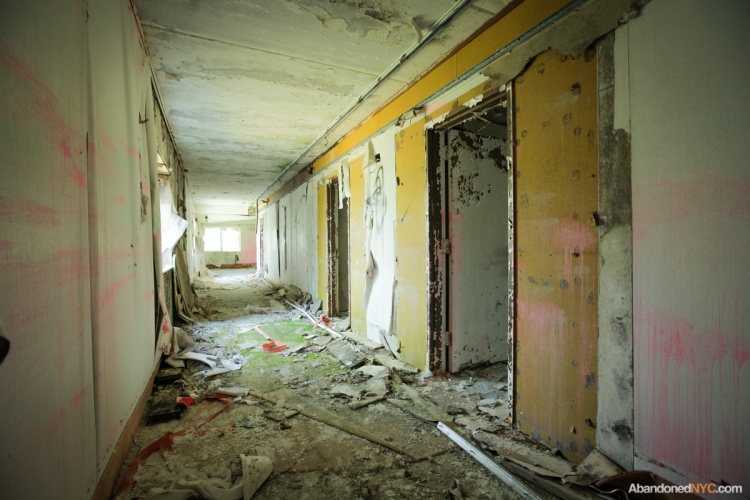
The ransacked Paul G. hotel, showing the hallmarks of a recent paintball game.
Past a deserted security desk, waist-high grasses choke back the yawning entrance to the Jennie G. Hotel, whose toppled fence serves more as an invitation than a barrier. Here in the sleepy town of Liberty, NY, this derelict hilltop lodge is not only a destination for the curious, it’s a daily reminder of the town’s old eminence, an emblem of a dead industry, visible from miles around.
In its time, Grossinger’s Catskills Resort was a fantasy realized, where wealthy businessmen, celebrity entertainers, and star athletes gathered to mingle with those that they liked and were like, to see and be seen, and to enjoy, rightly so, the things they enjoyed. As the slogan goes—Grossinger’s has Everything for the Kind of Person who Likes to Come to Grossinger’s.

Flowers left by a former guest, or a prop from an old photo shoot.
If you’re the kind of person that’s inclined to spend their vacation somewhere dark, dusty, and dangerous, the motto still rings true today, and you’re not coming for the five-star kosher kitchen. For just as quickly as the resort prospered into a world-class institution, it’s descended into a swift decay. Explorers frequent the grounds, armed with cameras in an attempt to capture the beauty in its devastation, sifting through the artifacts—a broken lounge chair, old reservation records—piecing together a lost age of tourism.
A generation ago, this region of the Catskills was known as the Borscht Belt, a tongue-in-cheek designation for a string of hotels and resorts that catered to a predominantly Jewish customer base in a time when discrimination against Jews at mainstream resorts was widespread. In popular culture, the most notable representation of this time and place is Dirty Dancing, which was supposedly inspired by a summer at Grossinger’s. The unexpected success of its film adaptation had little effect on the long-struggling resort—in 1986, a year before the film was released, Grossinger’s ended its 70 year legacy.
The story of Grossinger’s is, at its root, an American story. The Grossingers were Austrian immigrants, who after some early years of struggle in New York City, and a failed farming venture, opened a small farmhouse to boarders in 1914, without plumbing or electricity. They quickly gained a reputation for their exceptional hospitality and incredible kosher cooking and outgrew the ramshackle farmhouse, purchasing the property that the resort still occupies today.
Grossinger’s rise to prominence is largely attributed to the couple’s daughter Jennie, who worked there as a hostess in its early years. Later, Jennie’s legendary leadership would transform the resort from its humble beginnings to a massive 35-building complex (with its own zip code and airstrip), attracting over 150,000 guests a year, and establishing a new type of travel destination that renounced the quiet charms of country living for a fast-paced, action-packed social experience that met the expectations of its sophisticated New York clientele.

Remnants of an attempt to burn down the Jennie G.
Every sport of leisure had its own arena, with state of the art facilities for handball, tennis, skiing, ice skating, barrel jumping, and tobogganing, along with a championship golf course. In 1952, the resort earned a place in history by being the first to use artificial snow. Its famous training establishment for boxers hosted seven world champions. Its stages launched the careers of countless well-known singers and comedians. In its day spas and beauty salons, ballrooms and auditoriums, guests were offered a level of luxury that even the wealthiest individuals couldn’t enjoy at home, earning Grossinger’s the nickname, “Waldorf in the Catskills.”
A daily missive called The Tattler identified notable guests and the business that made their respective fortunes. Weekly tabloids published on the grounds boasted the presence of celebrity athletes and entertainers. But for all the emphasis on earthly pleasures and material wealth, Jennie G. ensured that the Grossinger’s experience was warm and personal, always treating guests like one of the family, even when visitors reached well over 1,000 per week.
By the late sixties, the Grossinger’s model had started to fall out of favor as cheap air travel to tourist destinations around the world became readily available to a new generation. After the property was abandoned, several renovation attempts were aborted by a string of investors. Widespread demolition has greatly diminished the sprawl of the original resort, but several of the largest buildings remain. Most have been stripped of any vestige of opulence, and some structures are barely standing; no more so than the former Joy Cottage, whose floors might not withstand the footfalls of a field mouse.
Artifacts from the hotel’s glory days are few and far between, but Grossinger’s most recent batch of visitors has been quick to leave its mark. In a haunting hotel filled with empty rooms, some scenes are startlingly arranged, with collected mementos photogenically poised in the pursuit of a compelling shot. Despite these attempts to prettify Grossinger’s decline, the grounds retain an air of savage dilapidation, and an utter submission to nature.
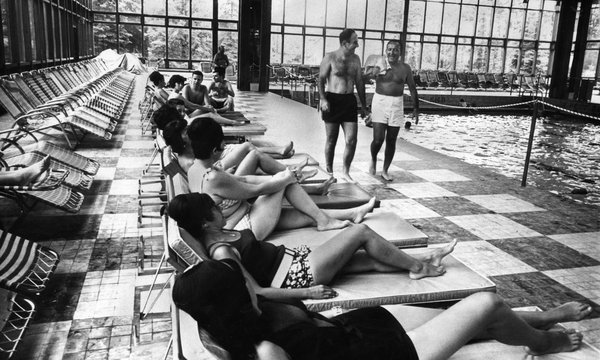
The Grossinger’s Hotel pool c. 1967.
An indoor swimming pool is Grossinger’s most enduring spectacle, and has become a favorite location of urban explorers near and far. Radiance remains in its terra-cotta tiles and its well-preserved space age light fixtures. Its dimensions continue to impress, as do the postcard views through its towering glass walls, all miraculously intact. It’s growth, not decay, that makes this pool so picturesque—the years have transformed this neglected natatorium into a flourishing greenhouse. Ferns prosper from a moss-caked poolside, unhindered by the tread of carefree vacationers, urged by a ceiling that constantly drips. Year-round scents of summer have bowed to a kind of perpetual spring, with the reek of chlorine and suntan lotion replaced by the heady odor of moss and mildew—it’s dank, green, and vibrantly alive.
Meanwhile, areas across the region that once relied on a thriving tourism industry have fallen into depression or emptied out. The Catskills is attempting to rebrand, updating its image and holding online contests to determine a new slogan. The winner? The Catskills, Always in Season.
Though it remains to be seen whether the coming seasons will bring new visitors, there’s no doubt they’re serving to erase the region’s outmoded reputation. With each passing year, in ruined hotels across the Catskills, the physical remnants of lost vacations dwindle. Indoors, snowdrifts weigh on aching floors; leaf litter collects to harbor the damp or fuel the fire. Vines claim what the rain leaves behind, compelling the constant progress of decay. Scattered in photo albums, hidden in bottom drawers, excerpted from yellowing newsprint, the memories will follow, clearing the way for new journeys. Before it’s forgotten, here’s one more look inside the celebrated resort.
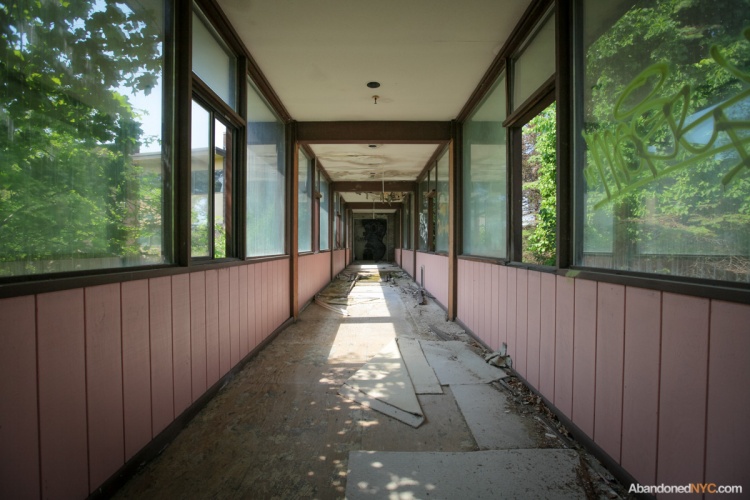
This catwalk ensured a comfortable commute from your suite at the Paul G. to the indoor pool year-round.
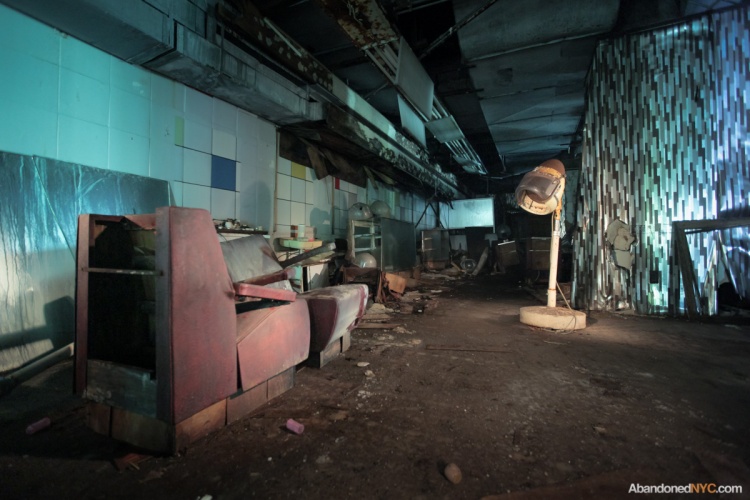
A pitch-black beauty salon lit with the aid of a flashlight.
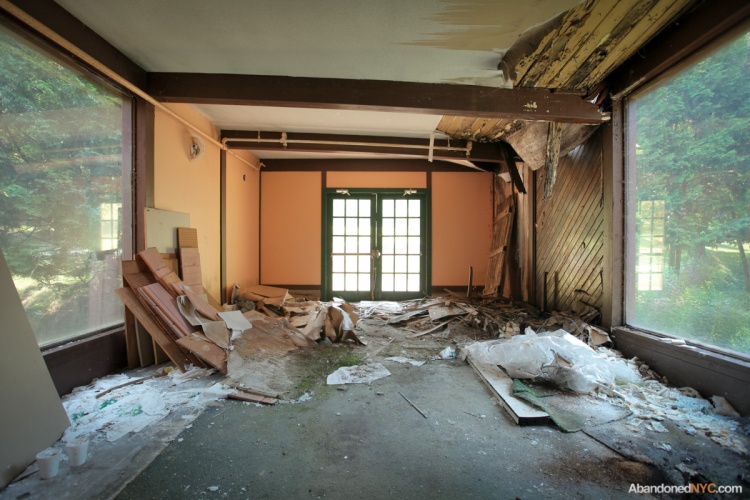
The ruined entrance to the hotel spa.
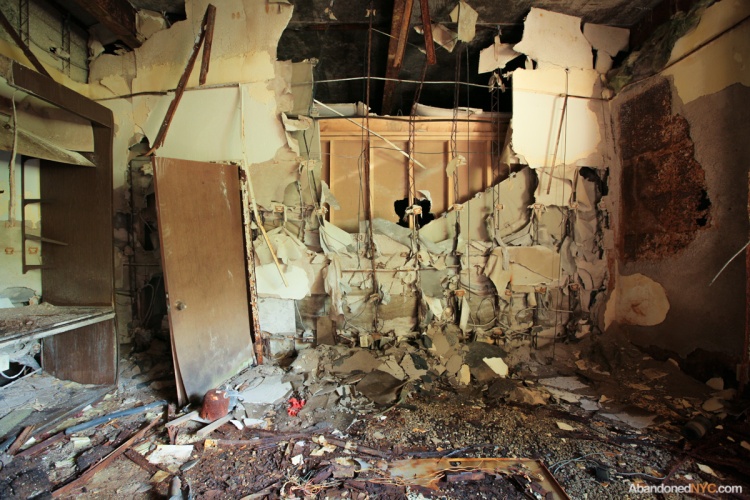
Office on the bottom floor of the Jennie G. Hotel.
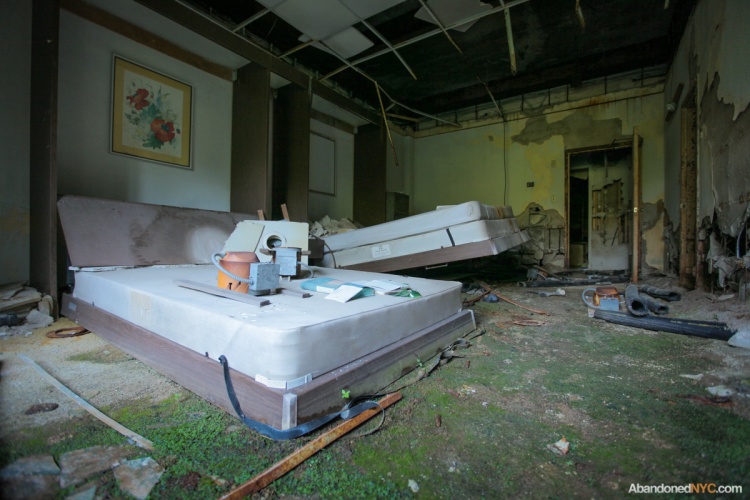
The best preserved room, with two murphy beds, and a carpet of moss.
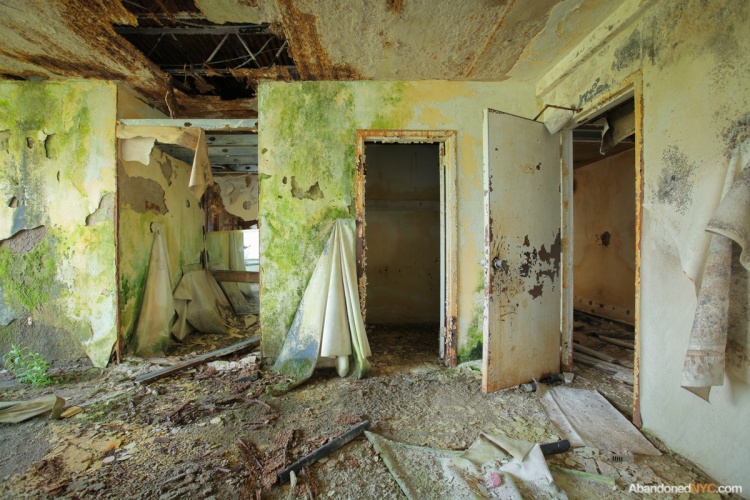
In most rooms, peeling wallpaper was all that remained.
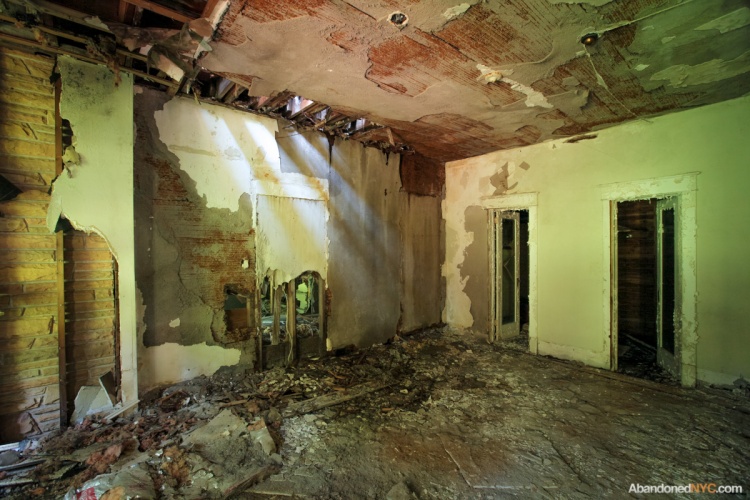
The ground floor of the management office, now on the verge of collapse.

Hotel records neatly arranged on a mattress, by a photographer, no doubt.



 AbandonedNYC
Fascinating!
LikeLike
Posted by ellis3000 | 11-12-12., 7:00 amwere is it?
LikeLike
Posted by debbie | 8-14-13., 6:54 pmthe Catskills !
LikeLike
Posted by surita | 12-1-13., 8:18 pmwas waiter and busboy for years. it helped put me through college. today an architectural sculptor. still love the country and all counties UPSTATE NEW YORK is as gorgeous as back then !~~ jennie G ended up in florida . would buy the property if at auction who knows info~
for the present OWNER?
LikeLike
Posted by donnie | 8-2-17., 5:47 pmThese are fantastic!
LikeLike
Posted by SoJejune | 11-12-12., 6:46 pmOne of those local places I have yet to get to (while it still stands). I was recently so sad to see the old Tamarack go up in flames. How tricky is it to not be spotted at old Grossinger’s?
LikeLike
Posted by bk | 11-18-12., 12:49 amI recently was there, the grounds are patrolled by employees. I wasn’t trying to be inconspicuous and parked my car right in front of the buildings(which is how they knew I was there). Once you’re in, its not hard to stay hidden inside the buildings, be careful moving outside near roads and keep an open ear for golfcarts and vehicles. If you are spotted, the police will likely be called, I came out to find a patrol car by my car. I was just courteous and he let my friend and I off with a stern warning. There is a No Trespassing sign when you come in but I told the officer that I didn’t see it(honestly didn’t).
LikeLiked by 1 person
Posted by D | 12-26-13., 12:02 pmThanks for the tips! Hopefully I get up that way before they demolish or repurpose the property.
LikeLike
Posted by bk | 1-22-14., 10:29 amI played with a lounge band one summer. An incredible Hotel. A great loss.
LikeLike
Posted by Bob Haft | 11-27-12., 5:25 pmThis makes me sad. I grew up right across the highway from grossingers and used to play there quite a bit. It had a ski lift, toboggan run, indoor basketball courts and of course the pools. Everything a kid could ever want
LikeLike
Posted by Michael Buery | 4-22-14., 10:49 amI grew up one half mile from the hotel. When I was in high school I worked at the ski lodge, caddied
at the golf course (just before golf carts) and was a bellhop. It is so sad to see these pictures.
LikeLike
Posted by Richard Pelsang | 3-24-18., 5:52 pm…”footfalls of a field mouse”! Your words are as spot on and haunting as your images.
LikeLike
Posted by lovelymrse | 12-1-12., 6:10 pmis it still up and can you get caught going to see it
LikeLike
Posted by jacob warner | 1-25-13., 7:56 amThis isn’t in NYC. What gives? It’s cool and all, but not a place I could go check out if I wanted.
LikeLike
Posted by Ian Dunham | 3-15-13., 10:33 amSorry to disappoint you, Ian. I like to include a few sites that are outside of the city, as long as they are relevant to NYC history–most of the people who came to Grossinger’s were New Yorkers.
LikeLike
Posted by abandonednyc | 3-15-13., 12:31 pmEXACTLY!! tats why im a bit mad
LikeLike
Posted by debbie | 8-14-13., 6:56 pmThanks for the post.
I remember seeing all those hotel billboards on route 17.I think there were 2-3 main hotels, the Tamarack rang a bell. My uncle worked at one of them but cannot remember the name. ALOT of red carpet on the floors. Does Grossinger’s still make the rye bread?
LikeLike
Posted by Old School in FLA | 5-9-13., 11:27 am> Does Grossinger’s still make the rye bread?
Perhaps you didn’t read this article. I don’t think so!
LikeLike
Posted by Barry | 6-23-13., 2:30 pmHi!
Awesome post and site. I just came back form the Yonkers “Gates to hell” site and loved it. I’m into urban photography and live in NYC. Can you recommend where I can go for some abandoned/urbex photography. I like remote places and roaming undisturbed.
cheers
LikeLike
Posted by Nook | 5-16-13., 2:00 pmIts so sad to see these pictures.I was born and raised in the catsklls.I remember when the hotels were alive.They were lit up like chrstmas trees at nght year round.Beautful gardens and mancured lawns ect. I live 3 mles from Grossngers and thnking about gettng some of my own pics. I can only imagine how it used to be back in the day.The old Browns Hotel Burned down,The chalet,pines hotel is gone,tamerack burned down .The nevelle will be openng agan soon.There s really nothing left in this county to bring tourists up other than bethel woods performing arts.I wish ths county could be brought back to life along with the many hotels that were lost!!
LikeLike
Posted by Gina O'Neil | 6-5-13., 11:29 pmsuch a total waste!!! why would someone “whoever” own it just not donate it to homeless vs letting it sit there for years and rot. shame on them and city for just letting it waste away.
LikeLike
Posted by christy | 6-6-13., 9:11 pmUm, who would take care of the place? The homeless people? Regardless of who lived there, someone would still have to pay the power, water, and gas bills, along with all the maintenance required to keep it up to code. Landscaping, painting, cleaning, etc, plus stocking it with food and supplies. Obviously the owners couldn’t afford to do all that or it’d still be running to this day. So, Christy, you’re an idiot.
LikeLike
Posted by R | 5-29-14., 5:08 pmI don’t think Christy meant wrong ahaha. There was no need to call her an idiot, but yes, you are right.
LikeLike
Posted by rebecca | 9-23-14., 11:45 amThanks for the pics & back story. Very interesting.
Why the heck should the just give property away to the homeless? So sick of someone whining about this on EVERY abandoned places post. Why don’t you donate your house to the homeless if you’re so damn worried.?
LikeLiked by 1 person
Posted by Alisa | 6-20-13., 12:46 amI really don’t understand why everyone is being so harsh to Christy! I think she means well. People who are naive must be educated, not bashed. Also I’m sure her home is of use to her, unlike these abandoned properties. So that would be missing her point completely.
LikeLike
Posted by rebecca | 9-23-14., 11:49 amCompletely agreed, Alisa. Urban decay is all over the world and some people actually enjoy seeing it. It’s a normal thing that happens everywhere. Thanks to the owner of this site and many others for their beautiful photography of old places being taken over by plant life.
So tired of seeing whining about these places “going to waste” or “wah wah, how sad, why wasn’t it converted into yet another strip mall or office park.” They are not going to waste for the thousands to enjoy to explore them and contemplate their historical significance. If you have a problem, buy the place and restore it yourself. If not, stop contaminating comment sections with useless “feedback.”
LikeLike
Posted by S | 4-27-18., 1:20 pmAlisa….dimwits like Christy only want to give away other people’s things….never their own.
LikeLike
Posted by Michael | 6-24-13., 10:08 amIf Christy was abandoning her belongings & going to let them rot, i’m sure she would. That was the point I think you missed.
LikeLike
Posted by grichecthwn | 10-18-13., 2:37 pmIt was a great hotel had a lot of fun working there and just hanging out , shame ,, damnshame. Thanks for the pics and the write up , I think this would flick the memory cells for the ones who have had the chance to see it in the prime times ,,
LikeLike
Posted by Charles Deck | 6-24-13., 3:47 pmid love to visit this place. Any chance I could get the address?
LikeLike
Posted by Anonymous | 3-9-15., 7:27 pmToo bad you didn’t mention the “kuch a leines” translation, do your own cooking, which for a nominal fee a family could rent a room or a bungalow for the” season “& enjoy the wonderful climate. These were really the heart of the “borsht belt” , & allowed you to escape the stifeling heat of the “city” ,without the glamour of the bg fancy hotels.
A wonderlul era has passed.
LikeLike
Posted by nat goldberg | 6-30-13., 7:39 pmGreat article and pictures! 🙂
LikeLike
Posted by Joe Lehman | 8-4-13., 9:55 amI used to work there as a Day Camp Counselor & in the Terrace Room. Seeing this both breaks my heart & brings back memories.
LikeLike
Posted by Gary | 8-5-13., 11:51 pmGrossinger’s is closed?? I’ve been going there every year for the past fifty years and I’ve noticed the service has been going downhill. Last year my bed linen looked as though it hadn’t been changed since the 80s. The entertainment is about the same, though.
LikeLike
Posted by Irving Schwartz | 10-21-13., 7:37 pmI love your comment; it gave me a good laugh! It reminded me of the kind of “Borscht Belt” humor we no longer hear and which I miss. Thank you Mr. Schwartz.
LikeLike
Posted by John Maher | 11-12-13., 3:11 pmBeen there. Walked around and took some very cool pics for about 3hrs. Then the cops came and kicked us out 🙂
LikeLike
Posted by Sentoria | 10-28-13., 8:33 pmAmazing pictures yet very sad….I enjoyed many a wonderful vacation with my parents to Grossinger’s as a child. I wish it were still around for me to have been able to take my own children.
LikeLike
Posted by Sharon Ellis | 12-19-13., 3:32 pmVery sad pictures, but thank you for bringing back some wonderful memories. My family was a true “Grossinger’s family” — we went there often and my late dad’s cousin (Hyman Hoffer) was the assistant maitre d’ there for some 30+ years. The synagogue I grew up in went to Grosinger’s every year like clockwork for a family weekend. I even have a room key from the old “main house” building that I have kept since 1969 (when we were teenagers, a trick we used for sneaking in to Catskill hotels to see the Saturday night show was to collect room keys from the major hotels — a room key was what the guard at the front gate usually demanded to allow a car onto the property!). The last time I was a guest at Grossinger’s was New year’s eve, 1980. No one had an inkling it would all end just 6 years afterwards.
Some have called the Borscht Belt days tacky, but the Catskills in the late 50’s and 1960’s was a magical place if you were young, Jewish, and from NYC. Good food, lots of sports (and lots of girls), and many of your friends were up there at the same time (if not working at or staying in area hotels, then working on staff at various Jewish sleep-away camps that dotted the area). Days playing basketball or swimming in the Neversink River, nights trying to corner that special young lady from Brooklyn (or wherever), hitching rides into Monticello for kosher pizza, or to Kutshers to see the annual Stokes basketball game — we didn’t think life could get better.
It’s all gone now, but for the memories. But ohh what memories. Thanks again.
LikeLike
Posted by Mark Hoffer | 1-7-14., 4:26 pmThanks for sharing you memories of Grossinger’s glory days, Mark. Sounds like a magical time.
LikeLike
Posted by Will Ellis | 1-7-14., 4:35 pmMy husband and his sisters used to go there with their parents in the summers of the 50’s and 60’s. They liked it because there was plenty of good food.
LikeLike
Posted by Jannie Woods | 3-17-14., 10:13 amOh my, what a memory of the past! I went to Grossinger’s when I was single numerous times as it was the crown jewel of the Catskills. It was the ultimate escape for the young Jewish and religious to have a hiatus from the reality of life and just be yourself amongst the phoniness of the opulence and impressing other singles. What memories that will never go away! The graveyard that is now Grossinger’s shall stay forever as a reminder to those who remember and know.
LikeLiked by 1 person
Posted by Grossinger's on my mind | 6-29-15., 3:08 amSo sad to see a wonderful and famous place as Grossinger’s inits current state!!! My memory is of a membr of the Grossinger Family was deaf.. A friend and I went to the resort to have lunch with that deaf person… Sorry I don’t recall his/her name, But the family were so warmly hospital; they insisted my friend and I stay there for dinner.
The Grossinger stories and picture were greatly apprecuated and it is really sad to see this place has fallen apart…
Thanks for the memories ~~~
LikeLike
Posted by Adele Weiaman Podolsky | 2-21-16., 2:43 amI am coming to the catskills and would love a tour of this place. A offical legal tour….would even pay. If anyone knows any contact info or owners info….or such…we are coming all the way from Canada. Contact me at kayanddee@hotmail.com I also heard there was another abandoned 1970’s swingers resort in the catskills, interested in touring that one as well. Or even a chance walk around Susanna Place…if its empty. Any ideas? Can anyone help?
LikeLike
Posted by Dee | 3-14-16., 5:24 pmHey Dee! While I can’t help you with the tour, I might be of some help with the name of the hotel. Check out http://www.vanishingcatskills.com. There is a large catalog of abandoned hotels/bungalows/pools/camps in the Catskills. You may be able to find it there!
LikeLike
Posted by S | 4-27-18., 1:24 pmI am coming to the catskills with some girls and would love a offical legal tour of some of the grounds if anyone knows of any contact info. Willing to pay. Also interested in the abandonded swingers resort, or Susanna Place…..but no idea where to start. Can anyone help?
LikeLike
Posted by lifeofthelucky | 3-14-16., 5:25 pmNo pictures of the indoor pool as it was on the day you visited??
LikeLike
Posted by David | 7-25-17., 6:13 pmOh the memories. Spent part of several summers there late 70’s and early 80’s. Met my future wife there!!
had to imagine such a lively great place has been relegated to a junkyard dump.
LikeLike
Posted by Alan | 7-28-19., 3:29 pm