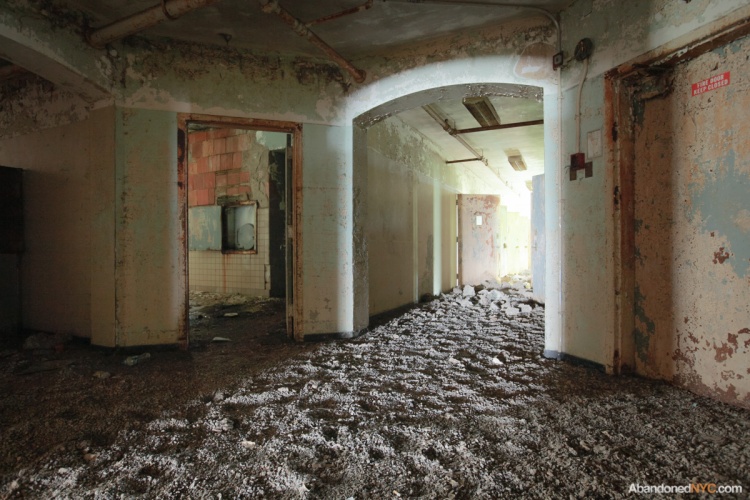
The first glimpse of Building 25’s fourth floor from the central stairwell. That’s not gravel.
In Queens Village, mere inches of brick and mortar separate the world we know from one of the strangest places in the city. Once a haven for New York’s cast-out mentally ill, Creedmoor Psychiatric Center’s Building 25 has undergone something of a transformation over its 40 years of neglect.
Creedmoor was founded in 1912 as the Farm Colony of Brooklyn State Hospital, one of hundreds of similar psychiatric wards established at the turn of the century to house and rehabilitate those who were ill equipped to function on their own. Rejected by mainstream society, hundreds of thousands of mentally disturbed individuals, many afflicted with psychosis and schizophrenia, were transferred from urban centers across the country to outlying pastoral areas where fresh air, closeness to nature, and the healing power of work was thought to be their best bet for rehabilitation.

A few articles of clothing were left behind.
As the 20th century progressed, asylums across the country became overrun with patients, and many institutions became desperately understaffed and dangerously underfunded. Living conditions at some psychiatric wards grew dire—patient abuse and neglect was not uncommon. Creedmoor State Hospital was habitually under scrutiny during this period, beginning in the 1940s with an outbreak of dysentery that resulted from unsanitary living conditions in the wards.
The hospital had spiraled completely out of control by 1974 when the state ordered an inquiry into an outbreak of crime on the Creedmoor campus. Within 20 months, three rapes were reported, 22 assaults, 52 fires, 130 burglaries, six instances of suicide, a shooting, a riot, and an attempted murder, prompting an investigation into all downstate mental hospitals. As late as 1984, the violent ward of Creedmoor Psychiatric Center was rocked with scandal following the death of a patient, who had been struck in the throat by a staff member while restrained in a straitjacket.
In the late 20th Century, the development of antipsychotic medications and new standards of treatment for the mentally ill accelerated a trend toward deinstitutionalization. A series of dramatic budget cuts and dwindling patient populations led to the closing of farm colonies across the United States, and a marked decline at Creedmoor. The campus continues to operate today, housing only a few hundred patients and providing outpatient services, leaving its turbulent past behind. Many of the buildings have been sold off to new tenants. Others, like Building 25, lie fallow.
The building was an active ward until some time in the 1970s, and retains many mementos from its days as a residence and treatment center for the mentally ill. With peeling paint, dusty furniture, and dark corridors, the lower floors are typical of a long-abandoned hospital, but upstairs, the effect of time has taken a grotesque turn.
The smell alone is enough to drive anyone to the verge of madness, but the visual is even more appalling. For 40 years, generations of pigeons have defecated on the fourth floor of Building 25, far removed from their dim-witted dealings with the human world, assembling a monument all their own. Guano accumulates in grey mounds under popular roosts, with the tallest columns reaching several feet in height. Like the myriad formations of a cavern, Buiding 25’s guano stalagmites are a work in progress—pigeons roost at every turn, and they’re awfully dubious of outsiders. Violent outbursts of flight punctuate an otherworldly soundscape of low, rumbling coos. The filth acts as an acoustic insulator, making every movement impossibly close.
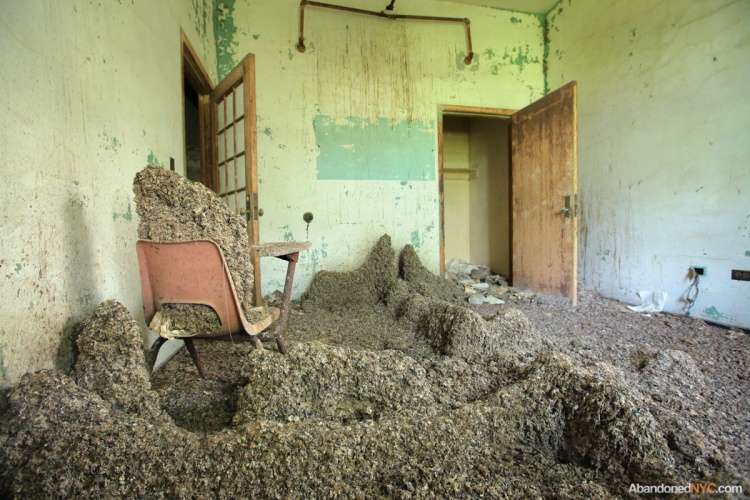
These dropping formations formed under the pipes of a sprinkler system the birds frequented. (Prints Available)
Two levels down and a world away from the top floor, a kitchen is filled with years’ worth of garbage intersected by narrow pathways. A living room, kept relatively tidy, features a sitting area with an array of chairs, including a homemade toilet. Loosely organized objects litter every surface—toiletries, clothing, hundreds of dead D batteries. Some of the belongings looked as if they hadn’t been touched for decades, but a newspaper dated to only a few weeks before confirmed my suspicion that someone was still living here.
I found him snoozing peacefully in a light-filled dayroom, surrounded by a series of patient murals. Once painted over, images of faraway lands, country gardens, and the Holy Mother are coming to light again as time peels back the layers. The image was surprising, unforgettably human, and imprudent to photograph. Declining to introduce myself, I passed once more through the dark, decaying halls of Building 25, leaving its charms, horrors, and mysteries for the birds. Back on solid ground, its impression wouldn’t fade for months—Building 25 has a way of recurring in dreams…

Overgrowth covered most of the windows, casting green light over much of the interior.
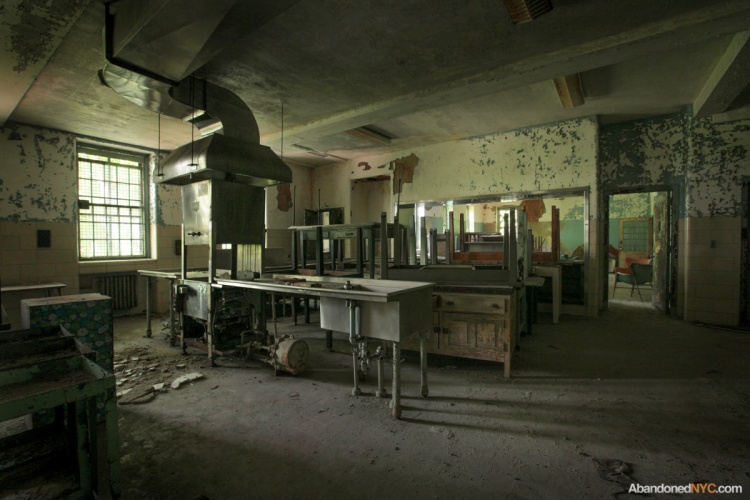
Furniture stacked in a cafeteria on Building 25’s third floor.
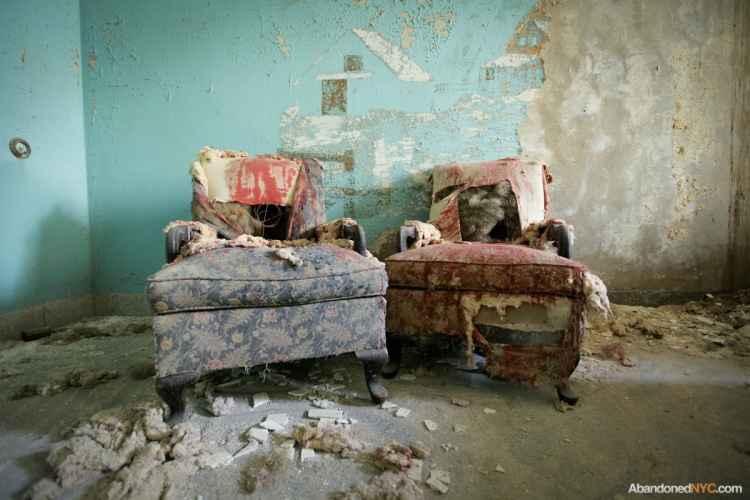
These chairs are popular with urban explorers, one went as far as covering the upholstery with fake blood.
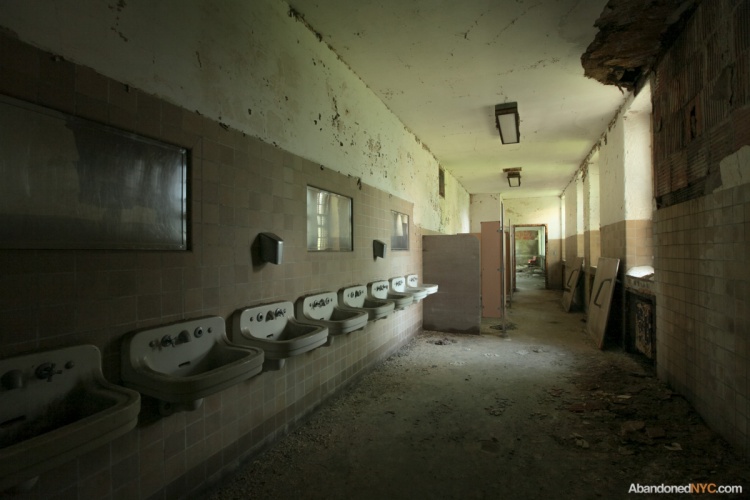
Metallic sheets are bolted to this bathroom wall in lieu of mirrors, which patients could use as a weapon.

A tiny toy collection arranged on a windowsill. (Prints Available)

Even in the 70s, this equipment was outdated, and left behind.

Did this mural prophesy the current condition of the top floor?
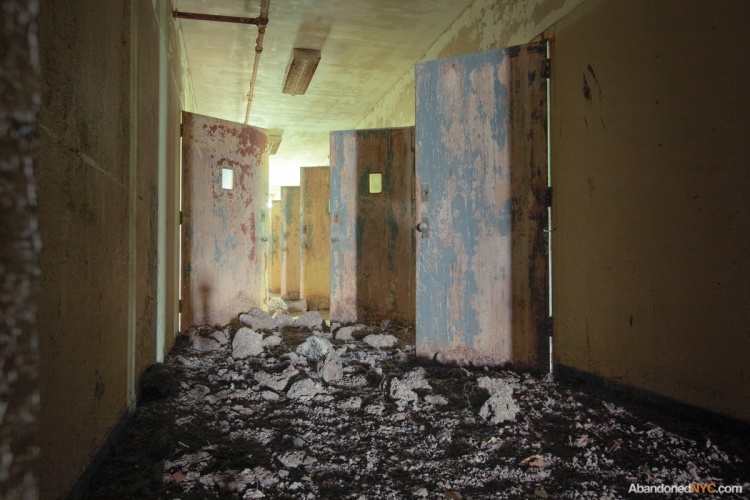
An uninviting hallway on Creedmoor’s fourth floor.
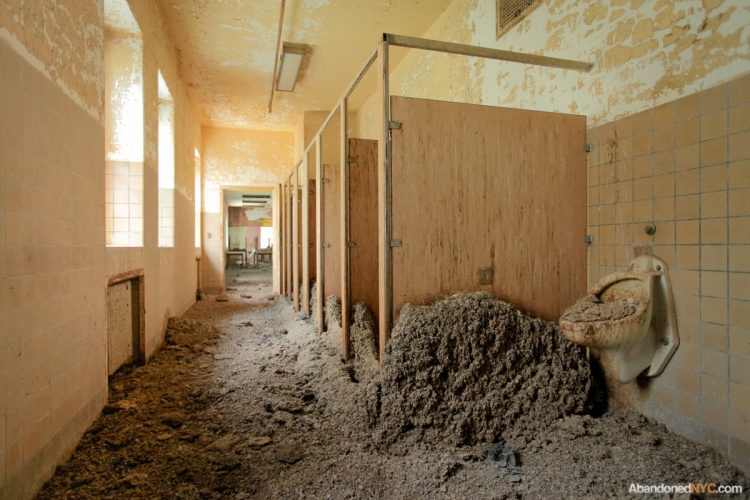
This bathroom held the largest volume of fecal matter. (Prints Available)

The guano gives some rooms the look of an indoor desert.

Anyone for musical chairs?

An incongruous Virgin emerges from an infested day room. (Prints Available)

A glimpse at the Creedmoor squat.




 AbandonedNYC
Incredible photos, but I hope the photographer wore a respirator or at least a dust mask while inside this joint. Histplasmosis is…er…nothing to sneeze at! The squatter is most likely dead man walking!
LikeLike
Posted by Robert | 5-31-12., 9:00 pmThanks for mentioning the histoplasmosis. I had never heard of it before and looked it up! The 4th Fl pictures are beyond what I could have imagined.
LikeLiked by 1 person
Posted by David Abbey | 10-2-12., 12:56 amI AGREE HOPE RESPIRATOR WHERE WORN
LikeLike
Posted by ANGIE | 6-24-13., 7:49 pmIf you look carefully at the bathroom with the mirrors, the mirror closest to you has a very pronounced face in it. Could this be a patient ?
LikeLiked by 1 person
Posted by Mary | 6-25-13., 3:26 pmSince ghosts don’t exist… no.
LikeLike
Posted by dandy@aol.com | 7-2-13., 9:44 pmI don’t see any face. What are you talking about? Very pronounced should be mean obvious not nonexistent.
LikeLike
Posted by Jesus Christ. | 12-27-13., 10:31 amIs the face reminiscent of the statues on Easter Island? I can just make out such an image.
LikeLike
Posted by frank | 1-7-14., 10:55 amReally Dandy? You must be an expert on what exists and what doesn’t! You are in denial!! Try spending a few hours in some of these places that are haunted..You tell me then..You would be running! And yes im an investigator who was a skeptic until I had an experience of my own!
LikeLike
Posted by Raven | 7-2-14., 7:53 amMary you are correct there is a face in the mirror, looks like someone put it there
LikeLike
Posted by Debbie | 8-6-14., 9:13 pmCreepy! I see it too!
LikeLike
Posted by Ann | 2-26-16., 4:59 pmI DEFINITELY see the face!!
LikeLike
Posted by Michael Higgins | 3-29-16., 6:12 pmwho ya gonna call !!
LikeLike
Posted by peter tumminello | 1-13-18., 3:00 pmMary who ya gonna call !!
LikeLike
Posted by peter tumminello | 1-13-18., 3:03 pmOh, WOW! I see it too! Looks like a Doctor!
LikeLike
Posted by Maura Anne Cusick | 4-26-20., 5:37 amWhat I truly find utterly disgusting is how an ALLEGED Western society could treat sick people so cruelly. What kind of animals and sadists do that?. It’s beyond me.
LikeLike
Posted by Glenn Reiner (@GlennReiner1) | 3-23-14., 10:27 pmI had an aunt who spent time at Creedmoor, this really HITs home a little too hard!
LikeLike
Posted by diane | 12-11-14., 8:52 amHow can any HUMAN society do things like that forget about it bn an ALLEGED western society!!!
LikeLike
Posted by Kp | 9-20-16., 3:26 amSee that’s the thing though; don’t misunderstand me I agree completely. Things in the past were horrible and the treatment the mentally ill received in far too many places was beyond deplorable. It sickens me to read about it and to think of someone already lost and ill, maybe only just deeply depressed, maybe only having a disease or condition easily reversed or cured or kept in check today…such people forced to endure inhuman drugging and isolation and electroshock, or worse mind-robbing surgery. HOWEVER: it was good people that kept digging away at this unholy system, pulling down the blackout curtains so to speak and letting in the sunlight of public examination and government investigation and oversight that led to monumental changes; sadly slow to unfold changes at times but nevertheless change and because of people who wouldn’t just give up and go away things are far far better today. We just cannot ever let our guard down again in making sure some of the most vulnerable citizens among us are properly cared for and treated with dignity.
LikeLike
Posted by Daniel Piper | 9-22-16., 1:57 amHow can society as a whole treat people like this , its not just western society!!!
LikeLike
Posted by Kp | 9-20-16., 3:31 amI’m so heart broken. My father uncle had mental illness in the 1930s. All he remember as a young man , his uncle Benjamin was sent to Creedmoore. Back in those days, black ppl was beyond poor and could not afford ANYTHING. He said no one ever spoke of his uncle ever again. To think of the cruelty I’m sure he faced, bring tears to my heart and eyes. I would love to see any records of patients back then. I’m sure a picture was attached to files. Of course I’m sure records were distorted or destroyed. Way too many years. So so sad.
LikeLike
Posted by Noreen Myrick | 10-24-19., 5:00 pmoh G-D i hope you all were wearing full hazmat gear!
LikeLike
Posted by soph | 10-17-14., 12:11 amMy mother had me sent here from January 1963 until June 1963 in the Adolescent Unit Bldg . 39 – Ward 11 . It was real dangerous place with some of the craziest teenage boys . I was severely beaten up in there and finally got out in June 1963 . I never forgave my mother for causing me to be in such a hell hole . It’s been 52 years now but I’ll always remember the the torture I went through in that snake pit .
LikeLike
Posted by Ronald Walter Klimmek | 2-10-15., 7:39 amWhat did you do to deserve to be sent there must be a reason your mother made the decision when you can admitted to your part in the situation maybe you can find forgiveness for your mother its never a easy decision for any parent to seek help for an out of control child who maybe a danger to themselves and others especially to third own mom speaking from a mother point of view
LikeLike
Posted by Carmen Flores | 10-16-16., 11:00 amSo very sorry that you spent any time there for any reason at all.
LikeLike
Posted by Anonymous | 2-19-19., 5:26 pmCan You tell me how to get access to this building. I want to explore it. Also I have been to that campus before looking for building 25 and I thought I found it. but In fact it was building 70. So please tell me how I can get in building 25. I already have everything I need to enter the building. like gloves. boots. and masks.
LikeLike
Posted by ALM | 10-6-15., 8:12 pmDid you ever figure out the best way to enter? If so, please email me, info@kaptivatephotography.com. I am planning to go this Saturday. Thanks!
LikeLike
Posted by Kunal Patel | 10-26-15., 8:18 pmYou’re sick.
LikeLike
Posted by Rafe | 6-26-20., 5:50 pmwhaaaat?!!!!
LikeLike
Posted by Anonymous | 6-26-20., 6:31 pminstead of praising this garbage close it up so
LikeLike
Posted by Rj Fernández | 10-12-19., 10:42 pmEeerie film set, you should do alternative tours to nyc…
LikeLike
Posted by Celia Peterson | 8-31-12., 2:10 ami bet this place is is haunted!!! i looove those old type-writers & the old cash register!!! antique road-show anyone??
LikeLike
Posted by Amy Mahoney | 6-25-13., 9:14 amI agree, I saw many objects, furniture etc. that could be recycled and returned to use in one way or the other. In these times of budget cutbacks and shortfalls you would htink that ever state would be scraping every cent out of abandoned properties like this. Even if it was done on a contract basis it would still generate much needed funding and not waste all the money spent building and equipping these facilities.
LikeLike
Posted by Don Greene | 6-25-13., 1:32 pmGorgeous photographs. Thanks for venturing into this eerie place so the rest of us can peer through your lens and avoid the bird droppings…
LikeLike
Posted by Butler | 9-7-12., 2:58 pmVery insightful. Thank you for sharing.
LikeLike
Posted by Beloved1! | 9-18-12., 10:52 amVery insightful. Thanks for sharing.
LikeLike
Posted by homeandhearthmagazine | 9-18-12., 10:53 amMy mother used to work here, and has told me very scary stories about when it was in business, even scarier now…
LikeLike
Posted by MaggieP | 10-8-12., 9:10 pmI had two uncles who spent approximately 15 years each there. They were deaf and could not speak, but nothing else about them would have caused they to die one week or each other except an unfortunate incident of beating, etc. The were only I there 40’s. They were there from 1946 to approximately 1960.
I don’t think they were in building 25, but one of those buildings. My mother and I visited them once a month via a train from New Jersey….. Very sad…….
LikeLike
Posted by Monica Burry | 6-24-13., 7:11 pmMonica, I am so sorry for your family’s loss. There is no excuse for their mistreatments. You should look into starting a case action lawsuit, if you can find a few more people to join your cause.
LikeLike
Posted by dixie | 6-25-13., 2:17 amI am so sorry for your uncles. I had a grandmother who lived there but I do not know the number of her building. I was a very small child when my Dad used to get her every other weekend. I remember seeing her with burn marks on either side of her head. Mom said it was from the shock treatment. She was a wonderful woman and I wish the family was more aware of how things were in there. Her mental illness made it impossible to live with us. I remember her screaming and crying and then the ambulance coming to take her away. Mom would take us for a walk until the ambulance was gone.
LikeLike
Posted by Donna T. Tomchik | 2-2-14., 5:58 pmPlaces like Creedmoor absolutely captivate me; the thought of how much emotion was expended within the walls of places like this. I can’t help but feel old mental institutions, sanitariums, hospitals, whatever they were called, as well as prisons, vibrate with the deep emotions, the sorrows and fears and terrors, the passions of wounded people caught up by society and locked deep in their walls, away from sunlight and positive emotion, how these old places retain something of what passed before within their corridors and rooms. A kind of negative energy, even a haunting of sorts if you will. I can spend hours just walking the halls, pausing in the small closed claustrophobic places, wondering what happened a century before, right where I now stood…I hate the thought of them being torn down, with nothing left but an empty lot littered with pieces of brick, mortar and plaster the only indication something once stood on that site. But reading of someone’s relatives, of real people with real names, with someone who can testify right here on the internet that this was a REAL place that caused real pain among their blood relations; reading that makes me feel an outsider with no right to wish them held onto.
LikeLike
Posted by Daniel Piper | 2-2-14., 11:25 pmHow horrendous for your uncles, being left in such a place. One can only hope that they had each other as comfort. Unable to speak or hear, it must’ve been insanity for them. Many people who had simple handicaps such as deafness and muteness were dumped in places like this, as many families could not spare the expense of personally caring for them.
LikeLiked by 1 person
Posted by Jules | 8-8-15., 4:56 pmMy great uncle was there in the 30s or 40s. He was a mute that had retardation. No one ever spoke of him once he was sent there
LikeLike
Posted by Noreen Myrick | 10-24-19., 5:08 pmI was the secretary in Building M in 1964 for Dr. Pike and two other psychiatrists. It was my first job after graduating from high school in Pennsy. I only stayed there a year; just to get the experience I needed to get another job. Eventually, I left NY to return to Pennsy. I sometimes think about some of the patients. I remember they asked me to teach a class to some young people who weren’t mentally ill. They got in trouble in one way or another and were put in with the psychotic patients. How sad.
LikeLike
Posted by rosalie | 6-24-13., 7:26 pmRosalie,
I hope you can write a book about your experiences there. The truth should come out finally. You need to be heard! Your voice needs to be heard about that place after all
these years.
LikeLike
Posted by dixie | 6-25-13., 2:32 amMy Grandmother Violet Tomchik was there as a patient for many, many years. Sometimes she would stay with us on weekends. Grandma said that some of the staff should have been the patients. It was a very sad part of her life.
LikeLike
Posted by Donna T. Tomchik | 2-2-14., 5:30 pmMy great grandmother – Constance (Lena) Marzano was institutionalized at Creedmoor – potentially around the time you worked there. Doubtful you recall names, since there were probably thousands of patients at that time. I’ve always felt a heartache for her, and to this day don’t know why she was put there by her own husband. Its so heartbreaking to imagine being put in a place like that.
LikeLike
Posted by Anonymous | 10-26-24., 6:37 pmI JUST HOPE THE PT’S WHERE WELL CARED FOR
LikeLike
Posted by ANGIE | 6-24-13., 7:50 pmthe patients were not cared for in the manner in which they should. I do not live in NYC, but I do live in Michigan and the stories of the state homes are all the same. Abuse and neglect more than you can imagine. People put in a room for hours on end defecating and urinating on themselves. They had to fight for food, because patients would steal. They really were the worst of conditions imaginable. It is sad to think that those humans were being treated as animals essentially.
LikeLike
Posted by Jo-Lee | 6-24-13., 11:44 pmmy grandmother used to work there and i also have some stories she told she was head nurse 5th floor.
LikeLike
Posted by patrick | 6-24-13., 8:40 pmHi Patrick,
I am interested in your grandmother’s stories. Is there anyway to share them, please? My name is Liz, I am also a psychiatric nurse and love history.
Thanks so much for your consideration.
Liz
LikeLike
Posted by Liz Wood | 6-24-13., 11:50 pmPatrick,
I hope you will help your GrandMom write her memories down or at least record them on a recorder before the memories are lost. These things need to be documented & written about. I hope you will write a book about this place one day.
LikeLike
Posted by dixie | 6-25-13., 2:35 amPatrick: I worked in Building M. I’m curious about Building 25. I don’t remember hearing about it when i worked there. Building M had a head nurse who ran a tight ship. It was a little scary; after all, I was only 18 years old but it wasn’t horrible or I wouldn’t have lasted even one year. I was glad to find a normal job though.
LikeLike
Posted by rosalie | 6-25-13., 11:50 amso you believe that in basically UNSUPERVIZED group homes the menally ill,autistics etc are better off ?
THINK AGAIN.
they’re in a smaller setting and that’s about ALL.
sure there are great groups managing their homes and there’s waiting lists YEARS long and if one has a chroniclly ill
unstable family member that winds up via THE COURTS into a hospital 1st THEN transferred to whatever is available.you’d understand immediately that having them in a psych facility ,where a nursing supervisor walked those halls with that clipboard at a minimum of three times a day–you’d have more confidence THERE.
Slamming the doors shut on these facilities did not alleviate anything and has led to the FACTS on less treatment,less availability of “beds” for those needing IMMEDIATE intensive treatment and observations and more set backs for the ill.
as for crimes on that campus ?
crime continues in secluded areas and within group homes the same.
LikeLike
Posted by surita | 12-2-13., 8:10 amMy mother, aunt and father all worked there. I know this place well.
LikeLike
Posted by Anonymous | 11-8-17., 6:17 pmMaggie, You should help your mom write a book about these things. At least get a recorder and have her talk about these things as part of your family history.
LikeLike
Posted by dixie | 6-25-13., 2:19 amMaggie,
I hope you can help your Mom write a book about these things, at least get a recorder and have her talk about it. You will have it as part of your family history & maybe you could write about it yourself one day. It might help better the world we live in.
LikeLike
Posted by dixie | 6-25-13., 2:26 amHi my name iis Myra Johnson and I was there from 1992-95
I am trying to get my records so that in could but everything behind
Me can you help
owensfamily67 @gmail.com
Myra Johnson
LikeLike
Posted by Myra Johnson | 8-14-16., 7:02 pmI worked in the children’s building # 39, but I had not visited many other buildings on the grounds; I was astonished to see this one. It was very frightening to view, and certainly not anything like the children’s side.
LikeLike
Posted by Anonymous | 5-21-15., 2:49 pmWhich years did you work there?
LikeLike
Posted by Laurie | 5-21-15., 3:06 pmThis is right by my house. it makes me even more curious to go inside.
LikeLike
Posted by laura | 11-6-12., 1:16 pmI would not venture into this building if I were you. Many of the abandoned buildings are not structurally sound on the inside. The large amount of bird droppings cannot be too healthy.
LikeLike
Posted by Jerry | 12-30-12., 9:52 amInteresting. How did you obtain access?
LikeLike
Posted by LaNell | 1-16-13., 12:13 pmSick set Will.
LikeLike
Posted by asf73 | 2-12-13., 9:13 pmI’d like to blog this on Boing Boing (boingboing.net). May I reproduce one or two of the photos, please? Thanks.
LikeLike
Posted by Cory Doctorow (@doctorow) | 3-11-13., 10:57 pmWhere is this located? Cross street?
LikeLike
Posted by Zoë Lkjsdhf | 5-5-13., 11:18 amThe Main Creedmoor building is at union tpke an Winchester blvd in Eastern Queens. I don’t know where the actual Bldng 25 is.
LikeLike
Posted by David Abbey | 5-5-13., 3:13 pm240th Street & 83rd Avenue.
LikeLike
Posted by Muzzlehatch | 6-20-13., 1:37 pmIT’S LOCATED ON HILLSIDE AVE. (NORTH SIDE) A FEW BLOCKS WEST OF THE CROSS ISLAND PARKWAY, AND EAST OF WINCHESTER BLVD. PASSED IT EVERY DAY ON MY WAY TO MVB HIGH SCHOOL (9/1965 THROUGH 6/1969) A FEW BLOCKS WEST OF IT.
LikeLike
Posted by LYNDA | 6-24-13., 7:19 pmFound this map of the whole Creedmoor campus. Building 25 is marked on the left side of the image.
http://www.omh.ny.gov/omhweb/facilities/crpc/visitor_guide.htm
LikeLike
Posted by BelleroseBoy | 12-26-13., 2:15 pmI spent my adolescent years inside of this institution. This brought tears and memories. Nice photos!
LikeLike
Posted by Maryann | 6-8-13., 2:27 pmThank God you got out of there alive. I had two uncles (deaf) that spent most of their lives at Creedmore.
Not sure what building. We would visit them once a month until we were notified that they died. They were healthy except for being deaf and not able to speak – they lived there from approximately 1946 to their death around 1960. I truly believe they met an unfortunate incident – they died one week from each other.
I tried to get some information regarding a death certificate or where they could be buried. My mother never shared any of this with me.
LikeLike
Posted by Monica Burry | 6-24-13., 7:08 pmwhy didn’t anyone advocate for the release of a relative ?
LikeLike
Posted by surita | 12-2-13., 8:12 amSurita, you don’t seem to understand that that was a VERY different time. There was no such thing as “advocating”. In most cases, once someone entered a psychiatric facility, they remained there until they died.
LikeLike
Posted by Sara | 1-6-14., 12:12 amHi Mary Ann,
I’m so sorry you had to spend time in a hospital. I am a psychiatric nurse, mental health client, and historian. If you would be willing to share, I am interested in learning about your experience in this hospital. I know this is a strange request and apologize if this is uncomfortable or upsetting.
Thank you for your consideration,
Liz Wood, RN
LikeLike
Posted by Liz Wood | 6-24-13., 11:56 pmI will talk to you about my experiences as a teen. How can I contact you?
LikeLike
Posted by E G | 6-25-13., 5:19 ami do not want my name use i live in manhattan i was there 1960 to 1964 horror is the name for that place call me robert middle name call me at 13474303496 and take no pictures of me i am sure you understand
LikeLike
Posted by norman steinberg | 3-19-14., 10:41 amSurita and Sara, The times weren’t so different, after all. Back then, not many families were able to or wanted to take a mentally ill family member into the family home. Nothing has changed, really. How many families nowadays would take a mental ill patient into the home? Not many…barely any. What has changed is that the patients are out on the streets instead of inside an institution.
LikeLike
Posted by Laurie | 10-19-14., 11:16 pmMaryann, My prayers go up for you now. You should look into getting a lawyer to represent you, this is not acceptable treatment for any of you there.
LikeLike
Posted by dixie | 6-25-13., 2:21 amBeautiful. I absolutely love these haunting photos. Amazing work.
LikeLike
Posted by Ashley Wardlow Colburn | 6-20-13., 10:39 amIncredible shots and place. I’m happy places like this have been closed. No real care for patients. Only a way to ignore and hide the issues of insane people.
LikeLike
Posted by seagullf | 6-20-13., 5:12 pmThe fourth picture reminds me the set from The Exorcist, where Father Karras encounters his hospitalized mother.
Maybe it was shot here?
LikeLike
Posted by mario | 6-20-13., 10:17 pmGuano is the excrement of seabirds or bats only. What you have here is simply bird poop.
LikeLike
Posted by Wuffle Spring | 6-24-13., 5:39 pmHey, lets not get technical. Poop is poop. This must have been a horrible place to be confined in. I can not imagine how one human being can treat another human being in this manner. I hope those that suffered are in a better place. God will take care of the rest. May they all rest in peace. There were are probably are still places like this in my state, further south.
LikeLike
Posted by Jane DeBord | 6-24-13., 10:51 pmStay “technical” WUFFLE SPRING!
Using language carefully and with clarity is good. Generally getting the idea across isn’t so bad, just not as good.
LikeLike
Posted by Poop (NOT Poop) | 6-25-13., 3:37 pmI tend to agree, but decided to stretch the meaning of the word in this case. Couldn’t bring myself to use the word “poop.” Hope you’ll forgive me!
LikeLike
Posted by abandonednyc | 6-25-13., 8:54 pmI thought I saw some seagull droppings in one of the photos…
LikeLike
Posted by D J | 12-30-13., 2:54 pmThis place must be haunted. A good place for brave ghost hunters!
LikeLike
Posted by Gary Hatter | 6-24-13., 7:02 pmThis eerily reminds me of the Emerson Rose Asylum!
LikeLike
Posted by tcnalley | 6-24-13., 7:07 pmThis eerily reminds me of the Emerson Rose Asylum I wrote of in LETTERS FROM THE LOONEY BIN. Its surreal to see these images that were in my mind are actual photos!
LikeLike
Posted by tcnalley | 6-24-13., 7:09 pmGo promote yourself somewhere else.
LikeLike
Posted by Al de Baran | 5-6-16., 8:20 pmI made this video over a yr. ago depicting abandoned asylums…turn up the volume when you watch because the music just makes the video! Creepy
LikeLiked by 1 person
Posted by Kim | 6-24-13., 7:09 pmI am interested in knowing which hospital this is. I have been in Psychiatric hospitals in California, and the old Northampton State Hospital; the conditions here are better than I have seen. Although much bad has happened in these hospitals, I am told by many former patients that some good was also done.
LikeLike
Posted by Robin Paradis Stern | 6-25-13., 12:10 pmthat was very moving
LikeLike
Posted by kk | 6-25-13., 1:40 pmThat was very interesting. Great job. Thanks for posting.
LikeLike
Posted by Julie | 6-25-13., 2:32 pmHOLY CRAP DEMOLISH THIS BUILDING!!! WTH …disease spreads fast with stuff like that..wouldn’t want to live near that one
LikeLike
Posted by Cindy | 6-24-13., 7:26 pmBurn it down! Schizoids find that quite an appealing place!
LikeLike
Posted by Patricia Peters | 6-24-13., 9:59 pmI agree all those places should be torn down and level the land, so sad keep photos and writings but destroy the buildings!!!
LikeLike
Posted by Penny | 6-24-13., 10:36 pmThe biggest risk of disease would come about during demolition. Can you imagine the amount of dust that would come out of this place?
LikeLike
Posted by abandonednyc | 6-25-13., 9:33 pmQuite impressive. The Virgin Mary is a mural of when she appeared in Fátima (Portugal) to 3 shepperds over a Holm oak. The date was the 13th May 1917. If you are interested can read more about it here: http://en.wikipedia.org/wiki/Our_Lady_of_F%C3%A1tima
LikeLike
Posted by Marta M. | 6-24-13., 7:35 pmI am interested! Thanks for sharing.
LikeLike
Posted by abandonednyc | 6-25-13., 9:32 pmLooks like Joanie Mitchell was wrong. THERE IS a good time to pave paradise and put up a parking lot!
LikeLike
Posted by Don Bodell | 6-24-13., 7:53 pmThe irony is that life continued (the birds) where many would find only desolation and abandonment. Mama Nature seems to continue even where were leave both memory and history behind. And it is in this abandonment that the photography captures the art even in decay. Composition melds with decomposition.
LikeLike
Posted by Me | 6-24-13., 8:10 pmWell said. It’s amazing how quickly nature reclaims the places we leave behind.
LikeLike
Posted by abandonednyc | 6-25-13., 9:30 pmsimply amazing is it for sale??
LikeLike
Posted by nate | 6-24-13., 8:26 pmGod rest the souls that were lost there.
LikeLike
Posted by me2 | 6-24-13., 9:15 pmLooking at these pictures makes me wonder why these buildings are still standing? I suppose they are not only full of bird poo, but lead paint and asbestos too. Clean-up costs would be out of this world. I sure in the hell wouldn’t want to live anywhere near any of these buildings. Erie photo’s for sure. I almost expected to see McMurphy and the Chief come running out of one of the rooms chased by Nurse Ratched (One Flew Over the CooCoo’s Nest).
LikeLike
Posted by Dave N. | 6-24-13., 9:27 pmGreat photographs. Thank you for sharing this experience.
LikeLike
Posted by Nikole | 6-24-13., 9:29 pmAwesome!
LikeLike
Posted by AM | 6-24-13., 9:35 pmWeird ny magazine would this
LikeLike
Posted by Fred Storms | 6-24-13., 10:57 pmI would like to know if people on the outside can go in to take pictures or invesyigate any hauntings here?? Charlene Chase
LikeLike
Posted by Charlene Chase | 6-25-13., 12:32 amThe building is closed to the public and is no longer accessible as far as I know.
LikeLike
Posted by abandonednyc | 6-25-13., 8:58 pmIt’s a shame that mental people had to go through all of that. I think people are still going through bad experiences in some mental wards in todays world. This is really sad!!!!.
LikeLike
Posted by suzzanna | 6-25-13., 2:30 amThis is nothing but Disrespect for all of the patients involved. How could you Will Ellis? There is absolutely no need to put mental illness in the same sentence as pigeon excrement. No relative sense. It is only an abandoned building that was neglected so a whole lot of pigeons flew in and lived there. Pigeons shit. Pigeons shit in abandoned buildings a lot. Will Ellis, what is your reason for using pigeon shit as a means for, “shock value” as to catch peoples eye so they look at your photos. Pigeon shit occurs in abandon buildings. Why do you feel the need, or at least, why have you taken pictures of a center, that is now an abandoned building and wish to bank off of the fact that it was once an institution for the ill? Pigeons shit Will, why wouldn’t they?
LikeLike
Posted by Suzanne Marie O'Donnell | 6-25-13., 2:51 amSuzanne Marie O’Donnell, HERE IS YOUR SIGN YOU JUST DON’T GET IT DO YOU.. Go back and read the comments about, there is life after death. There was a movie, broadway play, etc. about this PHENOMENON! IT IS CALLED THE CIRCLE OF LIFE. And it is pigeon poop, not sh%@. Clean up your language, children may be reading this.
Are you afraid of the truth?? Did you work there??? Were you confined there for some reason?????
Wake up and smell the roses lady. It happened and should not be ignored. If we don’t deal with the past and try and make a change, history will repeat itself. Look what happened in the concentration camps!!!
Think you for maybe listening to reason.
LikeLike
Posted by Jane DeBord | 6-25-13., 11:29 amThe mural is Our Lady of Fatima. Just FYI.
LikeLike
Posted by Paul | 6-25-13., 10:27 am40.733438,-73.728885 is the location of this building, or I believe it is at least, looks sad from outside…
LikeLike
Posted by christina | 6-25-13., 10:51 amThere is a woman ghost in the chair photo. If you save the chair photo to on your computer, then open up Microsoft Office, click on Edit picture tab, Choose color (slide to red and play around with the saturation and amount), then go to back to Edit picture tab and select Brightness and play around with that, you will see on the right of the right chair, a woman sideways, the front woman is very defined and has her hair up in a bun and right hand on the chair arm. I am not sure if there is another woman behind her and there might be someone in the right chair but it could just be the way fabric and stuff falls, I think that is called natural matrixing. I will not post the pic because it might be copyrighted and I only do this for fun and for my own “ghost hunting” through pics.
LikeLike
Posted by V | 6-25-13., 11:34 amHi V,
Are you referring to the picture with the two large wing back chairs?
Thank you
Keri
LikeLike
Posted by Keri | 6-25-13., 1:22 pmYes. I actually looked back at the original pic (except enlarged more) and can see her without all the color changing.
LikeLike
Posted by V | 7-3-13., 10:45 amI see her!
LikeLike
Posted by abandonednyc | 6-25-13., 9:09 pmIs it possible to post this picture? I’m interested in seeing it but cannot seem to get the same results after editing the image.
Thanks
LikeLike
Posted by Keri | 6-26-13., 9:48 amI see her on my iPhone. Just keep pulling the picture in.
LikeLike
Posted by Laura Sullivan | 1-26-17., 9:23 pmThese photos are what the whitehouse looks like now, after 4-1/2 years of boons living in it.
LikeLike
Posted by Thomas Thomas | 6-25-13., 11:40 amA real life “Night of the Living Dead” photo-encounter. . . why has this hellhole being left to simply stagnate, rust and decay? Disgusting, get rid of it why don’t ya! Obviously this building holds nothing but horrifying memories of society’s untouchables and events from its past. . . these photos have (no doubt) captured within them images of that terrible fact. Nearly too disturbing for words!!!!
LikeLike
Posted by fran | 6-25-13., 12:32 pmThanks for sharing. As for closing the institutions, yes there was abuse and neglect. But now the would be patients are still abused an neglected, but now we all call them homeless and walk by them with disregard and disdain. But that is OK because they are on the street and not in an institution?
LikeLiked by 1 person
Posted by Marlene | 6-25-13., 1:12 pmIf I had been born 40 years prior to my birth in 1986 I would have probably ended up at a place like this. I am mildly Autistic and have Bipolar Disorder with psychotic features. I also suffer from PTSD due to an abusive first marriage. Today with the medications we have I am able to live a normal life. I work as a school bus driver and volunteer with the local fire company. In 3 months I am going to marry a man who is career Air Force. I have a pretty normal life. I am actually going to school this winter to become an EMT.
This history needs to be documented because this should NEVER happen again.
LikeLike
Posted by Megan Kosciuszko | 6-25-13., 2:05 pmThanks for sharing, Megan, sounds like you’re in a really good place. We can all let out a sigh of relief knowing that these days are behind us.
LikeLike
Posted by abandonednyc | 6-25-13., 9:05 pmTragically, those days are not entirely behind us. Mental illness still has such a strong hold over so many and the mentally ill homeless are in as bad, or worse, situation than the institutionalized mentally ill were in. Still many stigmas to break and research to be done.
LikeLike
Posted by Laurie | 10-27-13., 11:57 pmWow, I have never come across an abandoned building with that much poo! Kudos to you for walking through, I hope wearing a ventilator!
LikeLike
Posted by Pattie Crider | 6-25-13., 4:00 pmThe place looks incredible! It is a place I will like to visit in the morning with a space suit! I hope that the photographer was careful when taking the pictures; I cannot imagine how many disease are there!
LikeLike
Posted by Jenifer | 6-25-13., 5:18 pmFabulous work! Thank you!
LikeLike
Posted by lsstuhler | 9-4-13., 9:50 pmReblogged this on The Inmates of Willard 1870 to 1900 / A Genealogy Resource.
LikeLike
Posted by lsstuhler | 9-4-13., 9:51 pmCan you go into these buildings to take pictures still? If yes, how? I am a amateur photographer and would love to go here and take some photographs!
LikeLike
Posted by aria | 9-14-13., 3:04 pmDear Sir/Madam
I am writing to you to thank you for this revealing article, but to also let you know that I was there. I experienced and witnessed the horrors of this place first hand, being that I was at the time considered a Ward Of The State, simply by continueing to
run away from an abusive foster home, I was placed in this hell hole. I remember the incidences, the people who ran the ward , who by the way were the crazy ones. If you are interested in hearing some of the truths regarding this place of torture, get in contact with me…..the saddest part about the history of this place,,,,,,,no one was ever convicted for thier abuses. I was there in 1974/1975 and the memories have the occasional tendancy to haunt my dreams. Sincerely, jlopez
LikeLike
Posted by j lopez | 9-21-13., 2:58 pmJLOPEZ I am so sorry to hear of the horrors you experienced while at Creedmore. No human should be placed in such a horrific environment. My name is Phil MacDonald and I am investigating a similar situation to what you experienced. I am an investigator at a law firm and would appreciate if you would reach out to me to discuss your experience.
LikeLike
Posted by Phil MacDonald | 4-29-21., 12:01 pmThe beatings,,,,I remember the beatings. I also remember the names of my abusers. The very first evening that I. arrived there, I refused to remove my clothes in front of all the girls peeking into the room at the new arrival. Mrs. White was her name…she was in charge of the night shift…..When I refused to remove my clothes, she immediately jumped on top of my chest and proceeded to strangle me. I have never felt that kind of pressure around my neck before, she nearly killed me, yet she released her hands from me, and I chokenly gasped for air……this was night one, of my hellish stay. Along with that strangulation came whippings from key chain larriottes, cold buckets of water to get us out of bed in the morning, our matresses flipped while still in them, being kicked, stomped, slapped, raped,verbally abused, locked up for days, drugged, quarter tied……and yes,,,,,I witnessed a possible death of my friend Caroline….we had windows that were sectioned into smaller window panes. After being picked on for so long, kicked and stomped on earlier by the attendant going by the name “Moochie” , and then more abuse later on that day, Caroline bashed her hands through about six of those window panes……I suddenly heard what sounded like a punctured tire , and then the blood flew out of her arm like a fountain into the air.I grabbed her arm , in order to apply pressure….. as she continued to scream out how she couldnt take it anymore. I as well screamed out for help , but the attendant, I think was Mrs White, ignored me. She was watching tv in the day room with us,. She eventually strolled over, as I cried out to hurry up, she cut her main vein. They eventually took Caroline into the main office, I just cried, as I am weeping now…..for it is my
first time sharing these details. THEY KEPT CAROLINE IN THAT OFFICE FOR TOO LONG!!!! I always wondered what happened to my friend Caroline,,,,, I heard the next day that she had lost nearly all her blood. People dont realize, that were not all mental,,, we were just kids placed in a facility that did
not match our needs. We were thrown from the boiler into the fryer. I for one am a survivor, well, and living a good and wholesome life….God is good, Sincerely, Jlopez
LikeLike
Posted by j lopez | 9-21-13., 4:02 pmI’m so sorry, Ms. Lopez.
LikeLike
Posted by Laurie | 10-27-13., 11:54 pmJ Lopez – I am very sorry for all that you have gone through. I am a psychotherapist in California and understand that what you have experienced as a patent there must have left a serious lifelong mark. Also by seeing these photos it may have brought many of your experiences back, just as the ones you mentioned in your writings above. I hope you have had the opportunity to work through any issues you have with a therapist and if not I want you to feel free to get in contact with me. I would also be happy to help you find a therapist local to you that may offer to see you at no cost. Please let me know how I can offer you assistance. This should have never happened. This is just an offer. If you don’t find the need I understand. I can be reached at LizMooreBirch@ msn.com.
LikeLike
Posted by Liz Birch, Licensed Psychotherapist | 10-30-13., 3:24 amThank god you survived … God bless you
LikeLike
Posted by MelBatista | 1-19-16., 8:43 pmIt is easy to let our minds be carried away into imagination, but really these photographs tell a terribly sad story of a piece of life on this earth. My great-aunt was institutionalized at Creedmoor from about 1919 until the mid-1950’s – so most of her adult life. My mother and sisters described my great-aunt, Bertha Goldman, as a gentle, kindly woman who just seemed very sad. The only “scary” thing about Creedmoor back then was how mistreated most patients were…the horrible stigma of mental illness must end.
LikeLike
Posted by Laurie | 10-27-13., 11:53 pmanyone remember hanging out in the parking lot ? rows of cars,music blasting,making-out getting high, looking up at that hospital and wondering what was going on in their? the lot was in the woods a little below the place, people came from all over….shh[drugs everywhere] oh such good times their hanging out!!!!!!!!!!!!!!!! in a passed lifetime of experiences!!!!!!! love the sight,,from new jersery
LikeLike
Posted by elaine | 11-24-13., 2:18 amThere is a huge complex of abandoned buildings on hundreds of acres that made up the state mental hospital in the heart of Columbia, SC. This place was originally opened, as I understand it, in the 19th century. Last I heard the land these buildings sit on was under contract to be purchased for urban housing, apartments or condos or whatever. Some of the buildings are to be left intact as they are historical. I am absolutely itching to go there and explore this campus but I don’t know what to expect. I hear the area is off limits and is supposedly patrolled by the police although I doubt they worry to much about urban explorers as long as they don’t make themselves too obvious. Anyone out there know anything about this place from experience?
LikeLike
Posted by Daniel Piper | 12-27-13., 7:13 amI would like to visit it someday……
LikeLike
Posted by peter X | 12-31-13., 4:19 pmI guess I’m in the minority, but I hate to see buildings such as these torn down. They are a part of history, be that history good or bad. Too many people want to ignore the bad and pretend the world is made up of sunshine and butterflies.
LikeLike
Posted by Sara | 1-6-14., 12:22 amWell if you are then I’m right there with you. I absolutely hate it when these places get bulldozed. I guess I can understand it sometimes; land can be valuable and life goes on but with some of these places, the ones with historical value that are able to tell a story we should do all we can to preserve them for the future. We in America are especially great about destroying places of great value. I think of some of the buildings in Virginia that are related to great Civil War battles that are an island of history in the middle of traffic lights, gas stations, Wal Marts and assorted tacky, dirty businesses. We are too quick to destroy our roots and our heritage in this country.
LikeLike
Posted by Daniel Piper | 1-6-14., 1:06 amIt’s a shame you don’t have a donate button! I’d without
a doubt donate to this brilliant blog! I guess for now i’ll settle for
bookmarking and adding your RSS feed to my Google account.
I look forward to brand new updates and will share
this website with my Facebook group. Chat soon!
LikeLike
Posted by league of legends nidalee | 1-20-14., 6:16 amYou say the last big scandle in the building was in 1984? Then you say 40 years of bird shit? Which one is it? Doubt they let birds take over a whole floor for ten years before it was shut down? Ive broken in the building myself. And also north brother island. Didnt know I could of asked permission
LikeLike
Posted by Cliff Charpentier | 2-7-14., 1:32 pmBuilding 25 was closed in the 70s, but most of the institution was still operating, including the ward where the 84 scandal took place.
LikeLike
Posted by Will Ellis | 2-7-14., 2:04 pmMixing Invisibles
The scene opens
Down a long hall
Dark green walls
Under a bare bulb
Dead men shuffle
On the left, a shaky table
Lucky Strikes, a portable radio
The attendant bends
Drops his head
Between her legs
She crosses over
In this asylum
Light falls on the father
Bone sorrow
Mixing invisibles
Mumbling metaphysicals
She waits, as if back stage
While he lectures
To an empty room
The attendant shouts, “pop
Say hello to your daughter”
Agony clocks in
Between the bringing and
Taking him back
To the den
With the other dead men
And all those details
Pea soup nails
The jingle
The way a steel door locks
The way the scene opens
Down a long hall
Dark green walls
Under a bare bulb
Dead men shuffle
breindel lieba kasher
LikeLike
Posted by breindie | 3-20-14., 1:01 amWow that was odd. I just wrote an really long comment but after I clicked submit my comment didn’t show up.
Grrrr… well I’m not writing all that over again. Anyways,
just wanted to say wonderful blog!
LikeLike
Posted by test3 | 5-17-14., 1:26 pmWe deplore what happened in the asylums but now that places like this are closed and the patients are on medications instead. Many of them end up on the streets now instead of in hospitals. There must be some state of care in between the depravity of the hospital depicted here and the state of denial and lack of real care. What that in-between state might be I have no idea. But surely someone can work out a better system.
LikeLike
Posted by Sally Scheer | 6-1-14., 8:57 pmYes, you are correct. This problem has been going on for the past 30 years and the politicians continue to ignore the issue, even though, tragedies caused by untreated mentally ill people are on the increase today.
.
LikeLike
Posted by TJ | 6-17-14., 11:01 pmA very bad place. It all started with the Germans who durring WWII killed hundreds of thousands of mentally sick people as a part of their politics of cleaning the new world out of the sick, the weak etc. We have such an abandoned psychiatric hospital in Owinska in Poland with a dramatic history. There were 1100 patients there in 1939 that were killed on the premises including mentally disturbed children that were killed on 11 Nov 1939 with the use of gas in the hospital;basements and burried in surronding woods. If you want to see whats left of it today http://www.urb-ex.pl/galeria-2007_11_10_Owinska. Best regards from Poland.for all of you and Will of course for wonderfull ( and usually sad) job.
LikeLiked by 1 person
Posted by Łukasz Wilewski | 7-25-14., 4:21 pmKeep up the great piece of work, I read few blog posts on this web site and I believe
that your site is really interesting and has lots of great information.
LikeLike
Posted by 176.58.96.134 | 8-18-14., 9:40 amI understand that child welfare agencies assigned children and teenagers to Creedmore simply because they could not find foster homes for them. The children could not refuse to go snd had to remain there until they turned twenty-one. Is this true?
LikeLike
Posted by peggy | 9-13-14., 8:51 pmHi Peggy, So much of Creedmoor’s history has been erased. In all my years of searchings I have come to believe that the admins of Creedmoor are exceedingly opposed to allowing people to know much about the history of the place. Just try to find out about a relative who was a resident of C-moor – you won’t get very far. “Records have been lost” and such…I’ve never believed it. I suppose the current C-moor admins do not want to risk anyone bringing a lawsuit against the institution…surely the “mystery of Creedmoor’s history” has to do with someone(s) protecting financial assets. I believe the C-moor administration would like to sever C-moor from certain realities that occurred in the institution prior to 1980 or so. As for your question, I have not read or heard anything specifically about foster children being assigned to Creedmoor, but it would not surprise me at all. Especially if a child had behavioral issues or was in any way impaired it seems highly likely that Creedmoor would have been the perfect dumping-ground for such children.
LikeLike
Posted by Laurie | 9-13-14., 11:03 pmJUST SAD!
LikeLike
Posted by diane | 12-11-14., 8:56 amHad an Aunt that spent many years there, came to our house on weekends. It’s makes me sick to think of this….What is wrong w/ humanity?
LikeLike
Posted by diane | 12-11-14., 8:57 amI was one of those foster children assigned to Creedmore. And yes, I still can recall quite a bit. I was not suffering from any mental illness, I did have some behavioral problems regarding running away from my abusive foster parents, so there is where I renained locked up and torturted for close to two years. Read my commentary above…I am J Lopez
LikeLike
Posted by j lopez | 6-14-15., 8:30 amI have read your so sad story, J Lopez. It is as I suspected…foster or troubled kids being dumped. It’s happening today, only the kids are left to live on our streets. Either way, we are neglecting too many of our children for too long.
LikeLike
Posted by Laurie | 6-17-15., 12:13 amI agree Laurie. When I tried recently to get information pertaining to my grandmother who had electric shock treatment and died soon after at 40 years old, I was told info was lost in a fire..
LikeLike
Posted by Malinda | 8-7-15., 4:24 pmI was just in one of the other buildings in July. There are medical files and records littered all over the hospital rooms! Not saying all are there but literally there was thousands littering the floors. They just left them there! I found a Binder still full and in perfect condition with over 30 patients records from 1932-1962. I do know that over the years they have told people that they don’t have access to them or that they burned in a fire which could be partially true. But I’ve been in the building and can tell you for sure that there are tons of medical records that they just left there with all the other items.
LikeLike
Posted by Rhonda Spetich | 8-9-19., 9:42 amHmm it appears like your site ate my first comment (it
was extremel long) so I guess I’ll just summ it up what I submitted and say, I’m thoroughly enjoying your blog.
I as well am an aspiring blog writer bbut I’m stjll neew to
everything. Do you have any suggestions for first-time blog writers?
I’d definitely appreciate it.
LikeLike
Posted by Nora | 12-28-14., 6:36 pmGreat article.
LikeLike
Posted by Essie | 1-17-15., 6:12 pmThe memory of Creedmoor was a haunting. I was in elementary school when my mother was committed to this hospital. The experience of losing my mother to mental illness and the feelings of abandonment continue to linger today. She was exposed to electroconvulsive therapy and powerful neuroleptics which caused facial dystonias which were socially embarassing for the family but was served to my mother as a social pariah. The memories of family visits behind tall, chainlink fences, and the ghostly appearances of my mother dressed in hospital whites and caked facial makeup had a chilling effect on our future relationship. She just wasn’t my mother. This was during the 1950’s with the dynamics of the northern migration of Afro-Americans from the south; my parents were from Mississippi. Searing memories of the hospital and her mental illness is a haunting.
LikeLiked by 1 person
Posted by Alex | 4-5-15., 5:52 pmMy grandmother had electric shock treatments there and died. Tried to get info but they said info lost in fire..Sorry about your mom 😦
LikeLike
Posted by Malinda | 8-7-15., 4:22 pmHi Malinda, When I tried to find records of my great-aunt’s years at C-moor I was also told that the old records had been lost in a fire. Very suspicious.
LikeLike
Posted by Laurie Beth | 8-7-15., 8:12 pmJust found out that my husband’s grandfather was in this institution (no way to know which building) from at least 1930 until he died in 1942. Can’t imagine what he went through in that time in our history. So sad. Thanks for sharing these photos.
LikeLike
Posted by Eyevea | 4-22-15., 10:18 amImage 6 was taken at Taunton State Hospital. See here:
http://www.mymodernmet.com/profiles/blogs/25-bonechilling-photos-of
LikeLike
Posted by Steve Star | 5-9-15., 6:26 amAll of these were taken at Creedmoor–never been to Taunton. Content aggregators always get things wrong in captions.
LikeLike
Posted by Will Ellis | 5-9-15., 8:49 amWow…this totally struck me on many levels. I spent my teen years living in the shadow of Creedmoor (I’m a Glen Oaks Girl and MVB Class of ’88), spending much time across the street at Alley Pond (aka AP) and being sought out by residents on day passes when i worked at Genovese on the Turnpike. All of us who grew up around it had a curiosity about what its insides looked like and many urban legends were borne of that speculation. My curiosity might have run a bit deeper than that of my friends.
My father resided on that campus. Twice. Once as an adolescent in the late ’50s – early ’60s then again after his discharge from the Air Force during the Vietnam War. This added to the ever present mystery that was my father. I since found out that he was schizophrenic. Today in the 21st century we still know painfully little about mental illness and how it should be treated even though progress was made in relieving its stigma. I cannot imagine what my father and others like him endured during the mid-20th century first with the illness itself then with the shame it carried and finally with the archaic and often cruel treatments imposed upon the mentally ill.
I don’t know what building housed my father when he was there. Looking at the inside of long abandoned building 25 is satisfying a bit of my curiosity. And although it was not in this wretched, filthy condition when it was operational, i can’t help but believe that its present appearance more accurately depicts how it must’ve felt for my father and the others when they resided on the Creedmoor campus.
Let this be a reminder that we should treat all with compassion and humanity. The decay of the past is closer than you think.
LikeLiked by 1 person
Posted by Judy Cangemi | 8-7-15., 5:02 pmThese pictures are out of this world! I went to Creedmoor once for a finger printing test that I needed. It’s crazy that I’ve never actually went to explore here and it’s only 5 minutes from my house.
LikeLike
Posted by thewanderlustguru | 8-27-15., 9:45 pmI never seen so much poop in all my life. Great set.
LikeLike
Posted by UrbexJunkie | 11-4-15., 4:43 amI was a nursing student in 1965/6 and had my psychiatric experience at Creedmoor. The students traveled to Creedmoor in the evening and stayed in a “dormitory” which was staffed by former patients. It was a very creepy experience..we had a set of keys we wore on a rope around our waist which got us in and out of dorm rooms and wards. It was so unnerving that we all decided to travel out there early in the morning to avoid staying in the dorm. I have no idea what building we were in but I have sad memories of the two patients I was assigned. One I will call MB was catatonic schizophrenic. .I don’t remember his treatment but I believe he was wrapped in wet sheets for long periods.He just sat and stared with that haunting look and never spoke a word…I was never able to penetrate his lonely world! The second patient a young girl with schizophrenia I call CM I remember with much sadness. She endured Shock treatments and Insulin shock therapy the latter causing a stroke and continuous coma which caused her to be sent to another Hell in Bellevue Hospital where I was required to visit with her, When I finished my rotation she was still there with no improvement. I often think about that young lady and wonder what ever became of her. The pictures of Creedmmoor just brought me back there with a jolt .I remember the big sterile day rooms and all the locked doors and obvious misery there…once I forgot my keys and my instructor told me it was because I really didn’t want to be there. How right she was!! All those pigeon droppings seem like a fitting comment on the world that existed there!
LikeLike
Posted by Gail Lindstrom | 6-9-16., 9:41 amHi I meet a woman who actually lives there. There a a LOT of people living there. She told me that she wants to move because the police and ambulance are there all day, every day. She also shared that as long as she and the rest of her community takes there medication the function well. VEry Spooky place, where the ambiance is creepy. A lot of the building are abandoned and have foliage growing on them (i was told this is a sign of unsettled souls roaming around) Thank to the writer/photographer sharing these photos.
LikeLike
Posted by Cindy | 7-7-16., 5:10 pmMy Uncle was murdered there in 1980. Joseph Taggart( he had schizophrenia) , my family never received any closure on who killed him. My mom still gets choked up about him. It was big cover up. The coroner lost my uncles organs after his body was exhumed his name was Michael Baden. The witnesses supposedly disappeared including a nurse and other workers. Very disturbing. My poor grandparents died with a broken heart.
LikeLike
Posted by Kelly Guarino | 1-7-17., 8:01 pmI was a child in bldg 39 I think there has been a lot left out about what happened to the children.l got out 7/1/1964.I don’t think my wife believes me.
LikeLike
Posted by David Rosenzweig | 2-9-17., 11:50 pmI use to work on Creedmoor grounds about 20 years ago. Always wondered what the abandoned buidlings looked like on inside! Awesome pics!
LikeLike
Posted by Michael Cardenas | 3-15-17., 4:19 pmYou have NO idea AT ALL how DEADLY the airborne pathogens from pigeon droppings can be!!!! There must be FORTY FRICKIN’ YEARS of pigeon droppings in that old building!!!! One could never breathe that air safely wearing a goddamn air-tight SPACE SUIT!!!! Anybody that goes in there will get HORRIBLY sick!!! The place should be sterilized, cemented over, and then later incinerated by a professional Haz-Mat team!!!
LikeLike
Posted by Red | 4-8-17., 3:32 amI agree this building should be demolished to build something useful
LikeLike
Posted by Anonymous | 7-28-17., 12:21 amOur late mother, who my sister and I cared for at home, moving her in with us when she was 92..died two weeks ago, (nearly 95 years of age) from longtime mixed senile dementia. At peace, comfortably, safely in her clean bed with family surrounding her, on June 1st, 2017. But I still recall: when she was in her mid 40’s, HER mother, our grandma, had a major stroke, and after that required full time custodial care. Medicaid turned our family away, and so, simply for want of a damn bed anyplace else, grandmother, who had never suffered from any mental illness of any sort a day in her life.. ended up at Creedmoor. Drugged with Librium, strapped to a wheelchair, she spent her days semiconscious, keening, wailing and soiling herself. Mother went to visit her and never, ever forgot what she saw, what it smelled like, the staff, how wretchedly her mother was treated. My uncle Frank, who lived in Philadelphia, came and got grandma. They moved her to a nursing home in Penna, where she was cared for and died, about seven years later. Mom would always come home from the hellish interval in Creedmoor in tears, saying, “Promise me you will never put me in a place like that!!” But what was interesting was not only how the mentally ill were brutalized, and treated horrifically, people who did not even BELONG in a mental hospital were as well, shunted off there — there are comments here about someone who had relatives who were in fact deaf, and not even mentally ill at all? As my heart breaks, my stomach also churns, and my mind boggles.
LikeLiked by 1 person
Posted by Cindy Hawkins | 6-18-17., 10:03 amif land in new York is so expensive way doesn’t some body tear this dump down and build some new and useful
LikeLike
Posted by Anonymous | 7-28-17., 12:19 amWhen I was put their as a cold of 7 years old I remember there being bars on every window in that place called Creedmoor. I was also taken to some building were a EEG was performed on me and I remember being terrified when I noticed a werehouse full of body parts in big glass jars most were brains. I was abused horribly in that place I well never forget it.
LikeLike
Posted by Donna Malone | 4-24-18., 2:31 pmMy sister was sent there I never was able to find Joy Ann Fassett in 1969
LikeLike
Posted by Char | 10-20-18., 6:55 pmChamaduro@aol.com 240 549 4208
LikeLike
Posted by chamaduro | 10-20-18., 6:56 pmDid you find your sister? what happened? that’s horrible
LikeLike
Posted by Anonymous | 10-22-18., 12:24 pmThe other thing I think of is this: back in the day, the police were allowed to round up mentally ill people off the street, then cart them off, against their will, detaining them in what was then politely referred to as “the loony bin”. There, they would, if lucky, be medicated, cleaned up, housed, and maybe even…given some sort of treatment. Many on the right meds would stabilize after several weeks: become even tempered, clear headed, calm, goal-focused and productive.. like any ‘normal’ person. But there was almost no provision for temporary, or bridge housing, where they could live supervised and continue their meds, receive therapy, while they reclaimed their lives.. But instead they were discharged to the street, with nowhere to go. Lacking anyone to monitor them, they’d stop taking their meds, and within two weeks, be wandering the streets, yelling and acting out. This is horrific, heartbreakingly wasteful…yet is often the scenario, to this day. I talk to local law enforcement and they assure me, unless a person with a mental illness pushes someone in front of a bus, there will be no follow up, no intervention, nothing. And, although on the one hand preserving the civil rights of people with mental illness IS quite important, and those rights should be respected.. there are also very few resources in the way of remedies: neighborhood outreach services, temporary housing, walk in clinics (too little, often too late). I do not know what the answer is; Fountain House is in the forefront – has a powerful advocacy and does an excellent job helping people who daily, live with mental illness. There just (in 2018) still isn’t near enough of what people impacted by mental illness dearly need. And what a waste of potential: lives ruined, curtailed so tragically, often simply for want of help at these critical times – just, someone there, to step in, help, guide and mentor…
LikeLiked by 1 person
Posted by Cindy Hawkins-Legorreta | 10-22-18., 12:28 pmI’m not sure exactly which day you’re referring to with “back in the day” but the age of rounding up people with mental illness and warehousing them in institutions was mostly before the age of medications to treat said illnesses and most people who went into the institutions never came back out.
LikeLike
Posted by Sara | 10-22-18., 2:28 pmSad to say, I meant THE DAY, which was the late 1960’s (I myself am 70 now), I remember distinctly, the father of a good friend was a young lawyer at the time. While building his practice he did a lot of what was considered serious advocacy in behalf of the mentally ill. Often Dave was criticized and told he was wasting his time. Nevertheless, he was appalled to see the way those people were treated. And he did whatever he could, which in those days (because of the law), was not over-much. Some people, as you note, ‘disappeared’ and were never seen again. Others, whom he tried to help, were medicated in the most basic way – I remember clearly MILLTOWN (Lord help us), and before LIBREX..pure LIBRIUM. Anyone for a six hour crying jag? Horrific. And to this day, there is not enough help available for people in transition from mental health issues to the proactive management of them, in the most affirmative way. I hate to think of it, but I truly do speak from experience. BTW I’m old enough to have some bad memories – sufficient so as… not to need to invent any more!
LikeLike
Posted by Cindy Hawkins-Legorreta | 10-22-18., 2:50 pmOMG I remember miltown,etc! and librium. wow, havent heard that since another lifetime ago. Im about 5 yrs. younger than u r, but I remember what you are talking about. My MIL was in there and I heard all kinds of horror stories from her
LikeLike
Posted by Anonymous | 10-22-18., 3:06 pmThanks to the “privatization” or more accurately, destruction, of the mental health system in this country, there isn’t enough support or care for any mentally ill, aside from those with great insurance or really deep pockets.
My brother is wandering the streets mumbling about aliens and mind control when he isn’t busy threatening our mother or destroying her house.
As an RN, I’m way too familiar with the treatment the uninsured mentally ill get. They sit in the ER for days, weeks without any kind of treatment, until a bed is found in a facility. Then they might stay 48 to 72 hours and they’re released into the public to start the whole cycle again. It’s crazy.
LikeLike
Posted by Sara | 10-22-18., 8:14 pmYou are absolutely 100% correct. The “homeless” to a huge extent are people who, due to incapacitating mental illnesses, wander the streets of inner cities many times without access to medication that could allow some to function well enough to support themselves. I’m 60, old enough to remember when mental institutions were closing and very sick people who had no insurance or any family capable of taking care of them or money to pay someone else to were released to the street. This is a horribly cruel thing to do to someone with a loose grip on reality.
LikeLike
Posted by Orion58 | 10-30-18., 12:46 amI spent 30 years as a live in-super for a brownstone house here on Union Square. During those years I had occasion to call 911 more than once, in response to a mentally ill homeless person in crisis. Often the time it took for the cops to get here was excessive. Cop-speak calls them “EDP’s” (emotionally disturbed persons, ok?) Occasionally, law enforcement never even showed up.When they did however..they were sometimes indifferent, and not especially helpful. Even so far as refusing to take the person into custody, albeit when the person was unstable, confrontational, and desperately in need of being brought to safety. Once I asked the cops sarcastically, “Does the guy have to throw someone in front of a bus for y’all to even take action?” They looked shamefaced, and shrugged. A much publicized case like this about a mentally disturbed woman, who pushed a man off a subway platform; he was killed by a subway train. She ranted that “he looks Muslim.” My point is, it later developed that the woman’s family had pleaded for help/intervention with her as she spun out. Help never came. The question must be asked..if there had been assistance/monitoring available for someone whose illness was clearly worsening – would that incident have happened at all? Never mind treatment options..there is no interest in support, or even watchful medical caring. People with a mental illness are very often ignored, pushed out of ER’s back onto the street, as one commenter noted, or simply shunned. Dreadful.
LikeLike
Posted by Cindy Hawkins-Legorreta | 10-30-18., 9:39 amMy mother was a patient in that facility throughout the sixties and seventies.
LikeLike
Posted by Edward_Jones | 11-28-18., 7:42 pmHi Rosalie,
My great uncle was a patient here. Maybe you can tell me about this place. He passed away in 2000 there. Is here a way to get records from there?
LikeLike
Posted by Debbie | 4-29-19., 2:58 pmI was just here on July 3. I did not enter building 25. I am not sure what building number it was. I did have help getting in by some teen boys one whom was currently living there in building 21. But I did enter one of the other abandoned buildings. It was fascinating and very scary at the same time. It was a bit of a chore to be able to get in as they have guards driving around. But I went close to night time so I was successful in my endeavor. I took about 200 pictures. I also found an old Hispital binder that had about 30 patients care records still inside. They were patients from 1932-1962. All have passed I’m sure by now. They have left thousands of medical records all over the floors inside. It was very interesting. I love to Urban Explore.
LikeLike
Posted by Rhonda Spetich | 8-9-19., 9:36 amI would love to see the pics. Would you be willing to email them to me?
LikeLiked by 1 person
Posted by Sara Raxter | 5-7-20., 4:43 pmI too was wondering about the pictures.
LikeLike
Posted by Rob Stern | 5-8-20., 6:25 amHey I just saw this. I mean I have like over 100+ pictures it would take forever to email them plus I mean Im all good with people viewing them but I mean they are my personal pictures so I dont want to just give them to people hope you understand that. Are you a former employee, patient , or have a family member who lived here at some point?
LikeLike
Posted by Rhonda Connors Spetich | 5-9-20., 2:28 pmI had a grandma that was in Creedmoor from the late 50s to the early 70s. It was always a hush hush subject, never really got any definitive answers about her. Now reading this Article I can only imagine what she suffered through. It’s kind of heartbreaking. I don’t think many people knew how these people were handled in these hospitals for a long time.
LikeLike
Posted by Ed | 5-28-20., 1:43 pmWow…
LikeLike
Posted by Anonymous | 6-1-20., 1:34 pmWhere creedmore used to stand is now a high school football field
LikeLike
Posted by Anonymous | 8-5-20., 11:48 amIn 1966 I was a patient at Creedmoor ..I was 15 years old and since I Overdosed on drugs they decided to put me under observation for 30 days I lied about.: my age and I said I was 16 because I did not want to be put with the kids ..I wanted to be an ward with the grownups… I remember going in an elevator to my floor is very very clean and there was a huge room with 50 or 60 beds and everybody had their own bed it was kind of a cozy room but you weren’t allowed to go in it once you were awake and dressed but sometimes I would go in there and lay on my bed it was very sunny in there .. And then there was the day room where all the nuts spend the day and I’m telling you a lot of them were crazy nuts remember I’m 15 I have never seen crazy nutty people especially grown-ups before it was a Corredor of padded rooms no one was in them but are usedGo in and sit in one because it was sunny and very quiet and I would read my book.. the nurses treated me well because I was basically normal ..so Id talk to them a lot ..but was very hard to talk to all the crazies .. The day room was painted in ugly green ..there was a woman that used in March around The day room The day room and yell books not bullets books not bullets :. then she Stops by the water fountain take a drink and look at the clock and look at her watch and continue marching, it was one young girl there and during the day she was perfectly normal but once the sunset she stood near the gated window all night and hauntingly kept saying help me help me, And she wouldn’t see me or see anybody she was in her own world …was a whole bunch of more crazies but I’m not writing a book ..I remember breakfast was always these yellow squares that looked like non-clear yellow Jell-O but they were really eggs.. yuck then twice a week the psychiatrist would call me into a room and make me look at Ink blots ..And I would try to convince him that all I did was by mistake take too many drugs ::I was not trying to kill myself ..but they kept extending my stay and my mom had to go to court and get some kind of official document to get me out of there it was some experience also I noticed that I think I was there when Woody Guthrie was there in 1966 And my parents used to come and visit because they didn’t live too far away
LikeLike
Posted by Susan Meyer | 10-13-20., 11:37 pmWow. What an experience. I’m glad you got out of there! I’d love to hear more stories if you ever feel like it; I’m certain I’m not alone in that!
LikeLike
Posted by Danny | 10-25-20., 7:28 pmMy brother spent time there receiving shock treatments. Soon after I helped him to get out. The caretakers beat him and abused him. He was black and blue. He showed me his lunch of stale bread and liverwurst yuck.
LikeLike
Posted by Claudette Guy | 9-27-22., 3:13 pml was a boy of 12 years old l was in br.39 wan.16,it was all. boys the people working o the wr.16 would let the oldest boy have sex with the little boys, and if you try to tell anyone about it, you would get betting at night, by a worker or he would let the big boys get you, they would tell the Dr. You got into a fight and had to go to the sick ward, and if you told your mother, they would say you just having a little bad time with your medical, l got to go back home by the time l was 14yr.l was never the same, this was in the late 60,after seeing this, all l could do was cry,thanking about all the hell some of the little boy’s had to go through, and no one will ever no or believe them. I am now in my late years and I still sometimes find myself mad and just crying.
LikeLike
Posted by Anonymous | 7-14-24., 5:23 amso much happened to me at this hell hold ,not only by some of the biggest boys, but by the night workers, and if you told someone like your mother, she was told, no one saw anything, and telling the M.D.only got you more medical and and you would pay at night, whit bring sex or bet up ,and all was said you got into a fight, but it was stopped, it was the damage workers doing bad things to you, l was only 12and l am now in my 70, and l sill sometimes get out of bed crying, l hope the one’s that hurt me and hit me are still alive and getting Hell and the other are in Hell,l was one of the kids in 39 ward 16 in the 60,if you’re are still living God will get you back.
LikeLike
Posted by Anonymous | 2-15-25., 6:51 amDr Delbarto was very nice and gave me grounds privileges and extra Halcion on building 25.
LikeLike
Posted by Anonymous | 6-30-25., 10:37 pm