Inside The Harlem Renaissance Ballroom
The dance floor of the Harlem Renaissance Ballroom sprouts mushrooms today, but 80 years ago it quaked with the frenzied rhythms of the Lindy Hop.
The Ballroom was completed in 1924 as part of a larger entertainment hub that included a bustling casino and 900-seat theatre. Built and operated by black businessmen, the “Rennie” was the only upscale reception hall available to African Americans at the time. Prize fights, concerts, dance marathons, film screenings, and stage acts were held at the Renaissance, along with elegant parties and meetings of the most influential social clubs and political organizations in Harlem. The community’s elite gathered to dance the Charleston and the Black Bottom to live entertainment by the most renowned jazz musicians of the age.
The nightspot even played host to the nation’s first all-black professional basketball team, also called the Harlem Renaissance, considered by some to be the best in the world in their day. On game nights, portable hoops were erected on the dance floor, converting the ballroom into a stadium. Following each game, almost invariably a victory for the Rens, a dance was held where players would mingle and jive with the choicest ladies of Harlem. The team barnstormed in towns across the country, playing exhibition games in which coveted matches with white teams drew the largest crowds. In their best season, the Renns set a record with 88 consecutive wins that has yet to be broken.

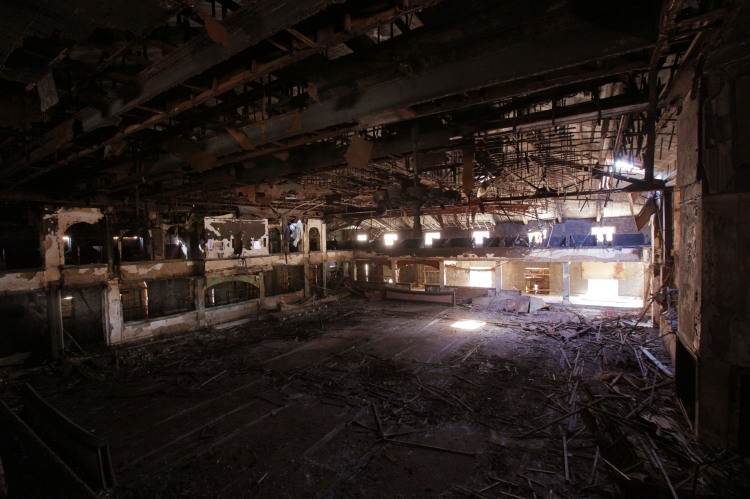
View of the ballroom’s ruined interior from the bandstand.
A year before construction on the ballroom was completed, the institution that would one day demolish the Renaissance Casino moved in next door. The Abyssinian Baptist Church was once the largest Protestant congregation in the country, and continues to prosper today, both as a religious institution and a driving force of change in the surrounding neighborhood. Established in 1989, its nonprofit arm, the Abyssinian Development Corporation, has invested over $500 million in community development, becoming the most influential social service and housing provider in Harlem.
The corporation currently rents all of its 1,200 units of housing to low-income families, is responsible for constructing Harlem’s first new high school in 50 years, and has attracted numerous supermarkets, department stores, and national retail chains to aid in the development of the neighborhood. Despite their success, Abyssinian’s dealings have brought controversy in recent years. Many of their low-income tenants accuse the organization of neglect, pointing to hundreds of standing violations in their residential buildings. Their vision of the “New Harlem” seems at odds with some long-term community members, who call their “progress” gentrification.
The ADC purchased the Renaissance property in 1991 with plans to renovate the site back to its historical role as a social hall and community space. In the intervening years, they introduced a new plan that diverges sharply from their traditional housing ventures. While a portion of the property will be utilized as a community center, only 20% of the residential units will be “affordable,” the rest of the 19-story construction will be set aside for luxury condominiums. In a Times quote, Executive Director Sheena Wright cites the necessity of bringing “diverse income levels” to the neighborhood as justification for the project; she asserts, convincingly, that “one should not relegate Harlem to housing just for the poor.”
The first stage of development involves the demolition of the theatre structure. Plans call for the preservation of the ballroom’s facade, but the interior is coming down. The project almost hit a roadblock in 2006 when the structure was pegged for a Landmarks Commission review, but the ADC exerted its political muscle to block the designation, enlisting big name supporters like former Mayor Dave Dinkins, Manhattan Borough President Scott Stringer, and the New York Landmarks Conservancy to voice their opposition. In the five years that have passed since the ADC overcame this obstacle, a bleak economic climate has forced them to put the project on hold. Abyssinian is currently pursuing investors for the project.

A spotlight falls on the ballroom once again.
The site of the former theatre is now an empty lot harboring a few disused construction vehicles, but contrary to some reports, the Renaissance Ballroom still stands, for now.
Most of the windows are boarded up, but light finds its way through a caved-in ceiling, exposing the diaphanous remnants of a golden age—colored light bulbs still lodged in the nightclub’s chandeliers, seat numbers pinned in the balcony. Ghostly images of jazz singers and blasting trombones barely cling to the proscenium of the ballroom’s weathered stage, once graced by Duke Ellington, Count Basie, and Ella Fitzgerald. The sense of history here is palpable, and the deterioration absolute. Reduced to mulch, the dance floor supports a thriving green fungal colony. Little points to the existence of a casino on the lower floor, but a coatroom remains largely intact. The rest gives the impression of a war zone—feral cats tread freely over piles of rubble that once delineated rooms. It’s easy to see why Spike Lee used this location as a nightmare crack den in Jungle Fever.
Langston Hughes had the Rennie in mind when he described “a golden girl, in a golden gown, in a melody night, in Harlem town.” It’s been decades since the “mellow magic of dancing sound” has reverberated here, but the Ballroom remains significant through its connection to the cultural and intellectual movement it nurtured.

The floor of the ballroom was significantly decayed.

One of the larger mushroom patches.

Can you spot the face beaming on these faded signs?

Box seats in the balcony of the Harlem Renaissance Ballroom.

Another view from the stage.

Walls collapse in the downstairs lobby.

A dark hallway on the first floor.

The Coat Room


 AbandonedNYC
Thank you for the detailed photo journey of a once beautiful dance hall. Those wood floor were once gleaming, the box seats upstairs gave a birds eyed view of all the happenings on the dance floor. You were able to dance in the space between the box seats and the windows that were opened during the summer months as the music flowed out onto 7th Ave. The band stand held some of the most dynamic bands, they kept you dancing. I tried to imagine where the bar was located from the photots. If I remember correctly it was to the left of the stage, there you would get a “set up”. The “set up” included a bucket of ice, cups, and soda, Ginger Ale, Club soda etc. all served on around tray. Taking a short cut back to your table via the dance floor was fun. My brother & I got in trouble numerous times when we did this. But we just danced and dodged the folks on the crowded dance floor holding the trays. In the late 1960’s when my family attended the “set up” costed a dollar. My memories will always be of what was, and not of the disturbing photos of a dance hall that did’nt deserve to die from abandonment.
LikeLike
Posted by Adrian Irene Allen | 6-2-12., 8:43 pmAdrian, that was beautiful. Thanks for sharing your memories. I only wish I could’ve seen it with my own eyes.
LikeLike
Posted by Chia Lynn Kwa | 9-30-12., 2:31 amAdrian, I would be very interested in contacting you about the Renaissance Ballroom. I am writing an essay about the ballroom and would very much like to learn what it was like in the 60s and 70s and why it closed down. Even if you don’t have all of this info, any firsthand account would be wonderful. Please email me at mjs0594@yahoo.com.
LikeLike
Posted by Matthew Speck | 4-25-13., 10:01 pmThank you for sharing. I was so sad to see the Rennie in its present condition. I spent so much time there dancing the night away. It was my favorite spot.
LikeLike
Posted by Gerda Wright | 3-12-14., 3:53 pmi loved reading this post. this is great information! i’ve learned a lot……
LikeLike
Posted by Crista | 8-31-12., 7:22 amAnother huge loss to the swing community, and African-American heritage. Thanks for sharing these tragic and yet beautiful pictures.
LikeLike
Posted by rikomatic | 8-31-12., 3:03 pmAmazing acknowledgement of the Phenomenal ”HARLEM RENAISSANCE BALLROOM” history.
I’ve had a chance many years ago to actual go inside and take some breath taking photos of art
work that was still somewhat intact painted on the walls. Which I’ll be using for our 3rd Annual
Harlem Renaissance Celebration in Providence,RI at Cafe S.O.U.L. . I will be sharing this information
as well with our patrons, great read and sad at the same time…truly amazing history and culture
gone..Janne’t
LikeLike
Posted by JANNE'T | 11-3-12., 2:43 pmis there any chance anyone could visit this place? It seems like such an iconic part of history I missed out on!
LikeLike
Posted by Vickelle Remmer | 2-11-13., 12:47 amAs a child growing up in the 60’s I remember “mama” getting ready all day to go out later that night to the Renny. The social club that she belonged to used to have dances there all the time and she started dragging me to them at an early age around three or four years old.
What you don’t see in the pictures,as I remember it clearly is that on each side of the stage there were box seats were a party of two could sit and be on display all night by the entire room. That was my aunt Janey’s favorite seat whenever we partied there.
I also remember the set-ups as well as b-y-o-b-b……..bring your own brown bag, which meant bring your own liquor. My aunts and uncles would “bop and sway” to the music while moving between tables to laugh and drink from each others set-ups.My god how I miss those days.
LikeLike
Posted by Terence Taitt | 3-27-13., 12:11 amThanks for sharing your memories, Terence!
LikeLike
Posted by abandonednyc | 3-30-13., 1:40 pmTerence, I am writing an essay on the ballroom, would you be willing to do either a phone or email interview?
LikeLike
Posted by Matthew Speck | 4-29-13., 9:53 pmCross street near location please.
LikeLike
Posted by Zoë Lkjsdhf | 5-5-13., 11:25 amI’d like to know about he chandeller. Can it be restored?
LikeLike
Posted by Sam Brown | 7-24-13., 10:37 amIs this place open to the public of photographing/filming?
LikeLike
Posted by Liria Portes | 8-15-13., 3:54 amStunning pictures, thank you. A sad loss, second only to the Savoy Ballroom.
LikeLike
Posted by Stuart Denyer | 10-15-13., 11:19 pmA lot of regret but so little action . This is the greatest tragedy of African American culture .
LikeLike
Posted by Gordon | 12-20-13., 6:34 amIN 1978-81..pioneer of .HIP HOP MOVED INTO THE RENNY
DJ Donald D..B Fats..Bill Blast…AJ scratch Love bug Starski
….we entered for only $1…..is was majestic…everything was in place then…
emcee RC LaROCK ..i performed there once….”rocked the mic”
thank you for this post ..sad happy emotions
LikeLike
Posted by Rc LaRock | 1-8-14., 3:31 amWho owns this property. Does anyone know I want to purchase it.
LikeLike
Posted by De Marcus Brewster | 3-5-14., 8:33 amRev. Dr. Calvin Butts and his church own it, and he was to restore it, but change his mind.
LikeLike
Posted by Alvin Reed | 3-13-14., 4:33 amSteven Able have a wealth of history of the Rennie, He call himself the “Harlem Renaissance Man”. I’m 74 and have danced there many times in the 50’s & 60’s and I rate it Harlem’s best dance hall. The “Exclusive Eight” S.C.,
which I was a member of, gave a dance there on Friday April 13, 1962 which we called the “Black Cat Dance”. The live bands consisted of KING “Soul Twist” CURTIS, and FATS GREEN. The price was $2.50 advance, and $2.75 at the door, I still have a ticket. On Sept.9, 1978 “Cousins 13” who are all of 13 nieces and nephews, gave a dance there to raise funds to travel to Columbia S.C. for a family reunion. D.J. HOLLYWOOD was king than, and the big hit was “A’INT NO STOPPING US NOW ” He played it over and over at the request of everyone. We new that night
that it would become I’ll RALLYING CALL.
P.S. If you want Steven Able email address let me know?
LikeLike
Posted by Alvin Reed | 3-10-14., 2:30 amyes very intresrted in Renaissance Harlem with my investor who own..bbkingblues.com and thehowardtheater.com bluenotejazz.com..highlineballroom.com..
LikeLike
Posted by sparkie martin | 4-20-14., 12:37 pmHello Sparkie Martin, My name is Janne’t and many years ago, I was blessed too been able to take some pictures of some of the remaining art work on the walls..even though due to the neglect of this phenomenal historical
property,there was much damage to the artwork. I was able though, get some very quality shots that are
amazing. If your interested in inquiring please contact at jbrown.coocafeoul2009@gmail.com. I definitely would
love to be part of the restoration, if your able to inquire the property from the church. I looked forward to hearing from you soon. Sincerely, Janne’t
LikeLike
Posted by Janne't | 11-6-14., 3:10 pmwe are intrested in having conversation with Steve Abel..Sparkie Martin @ 404-207-8834..swado2@aol.com
LikeLike
Posted by sparkie martin | 4-20-14., 12:39 pmUnfortunately this building no longer standing =[ they have taken it down. beautiful pictures btw!
i wish was able see it in person
LikeLike
Posted by Yaz Ansa | 5-18-15., 10:35 amI’m surprised I haven’t heard anything about the demo–is there anything left on the lot?
LikeLike
Posted by Will Ellis | 5-20-15., 9:11 pmis currently under new construction Aug 2015….
LikeLike
Posted by Anonymous | 8-31-15., 11:11 amI have a picture of myself and my two sisters sitting with my father upstairs in the balcony at one of my grandfathers lodge dances, I remember seeing all the adults every year getting dressed up for that dance and finally I was old enough to go myself, great memories…sorry to see it in such an abandoned state.
LikeLike
Posted by janice stevenson | 5-29-16., 7:14 pm