AbandonedNYC
Abandoned
Green Thumbing Through the Boyce Thompson Institute
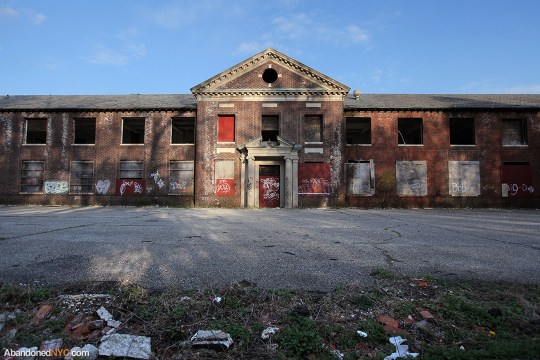
The abandoned Boyce Thompson Institute in Yonkers.
In 1925, Dr. William Crocker spoke eloquently on the nature of botany: “The dependence of man upon plants is intimate and many sided. No science is more fundamental to life and more immediately and multifariously practical than plant science. We have here around us enough unsolved riddles to tax the best scientific genius for centuries to come.”
As the director of the Boyce Thompson Institute in Yonkers, Crocker was charged with leading teams of botanists, chemists, protozoologists, and entomologists in tackling the greatest mysteries of the botanical world, focusing on cures for plant diseases and tactics to increase agricultural yields. The facility was opened in 1924 as the most well equipped botanical laboratory in the world, with a system of eight greenhouses and indoor facilities for “nature faking”—growing plants in artificial conditions with precise control over light, temperature, humidity, and carbon dioxide levels.
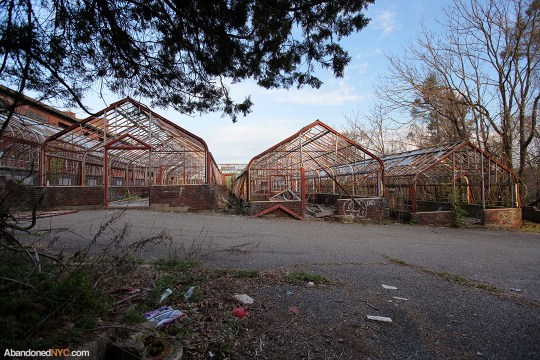
The sun sets on the greenhouses of the Boyce Thompson Institute.
The institution had been founded by Col. William Boyce Thompson, a wealthy mining mogul who became interested in the study of plants after witnessing starvation while being stationed in Russia, (although an alternate history claims he just loved his garden.) Recognizing the rapid rate of population growth worldwide, he sought to establish a research facility with an eye toward increasing the world’s food supply, “to study why and how plants grow, why they languish or thrive, how their diseases may be conquered and how their development may be stimulated.”
By 1974, the Institute had gained an international reputation for its contributions to plant research, but was beginning to set its sights on a new building. The location had originally been chosen due to its close proximity to Col. Thompson’s 67-room mansion Alder Manor, but property values had risen sharply as the area became widely developed. Soaring air pollution in Yonkers enabled several important experiments at the institute, but hindered most. With a dwindling endowment, the BTI moved to a new location at Cornell University in Ithaca, and continues to dedicate itself to quality research in plant science.

Most of the interiors had a near-complete lack of architectural ornament, but the entryway was built to impress.
The city purchased the property in 1999 hoping to establish an alternative school, but ended up putting the site on the market instead. A developer attempted to buy it in 2005 with plans to knock down the historic structures and build a wellness center, prompting a landmarking effort that was eventually shot down by the city council. The developer ultimately backed out, and the buildings were once again allowed to decay. Last November, the City of Yonkers issued a request for proposals for the site, favoring adaptive reuse of the existing facilities. Paperwork is due in January.
Until then, the grounds achieve a kind of poetic symmetry in warmer months, when wild vegetation consumes the empty greenhouses, encroaching on the ruins of this venerable botanical institute…
-Will Ellis
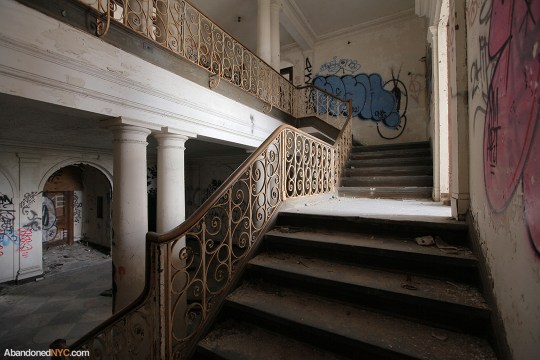
Ornate balusters made this staircase the most attractive area of the laboratory.
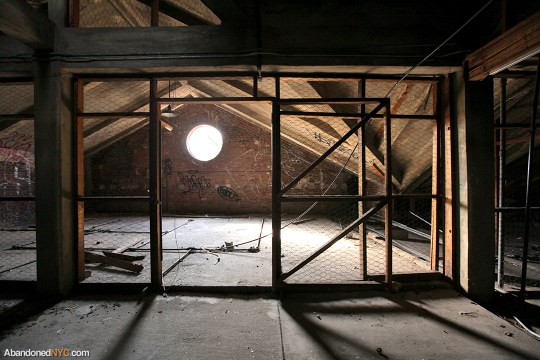
A central oculus leads to this mysterious pen in the attic.
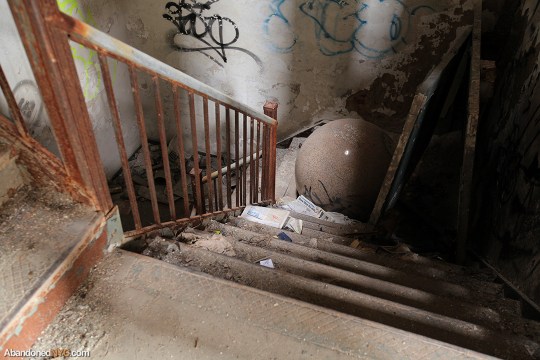
This stone sphere had been the centerpiece of the back facade, until someone decided to push it down this staircase. See its original location here.

The city gave up on keeping the place secured long ago.

The north wing had been gutted at some point.
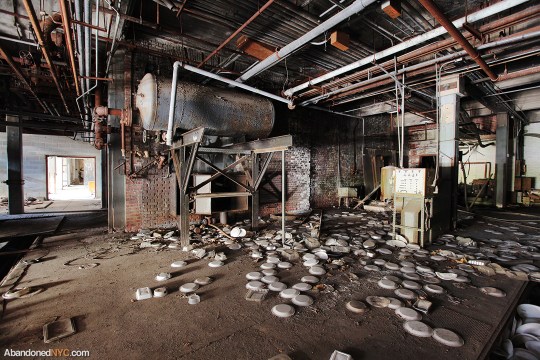
An interesting phenomenon in the basement–a population of feral cats had stockpiled decades worth of food containers left by well-meaning cat lovers.
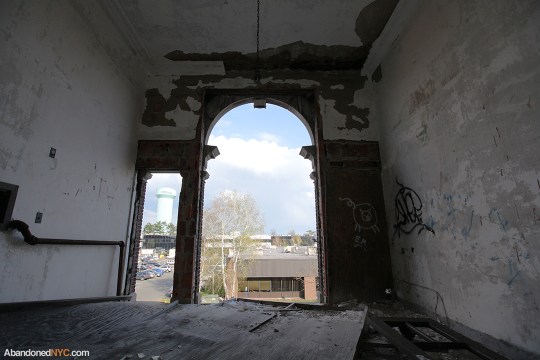
A view from the upstairs landing was mostly pastoral 75 years ago.
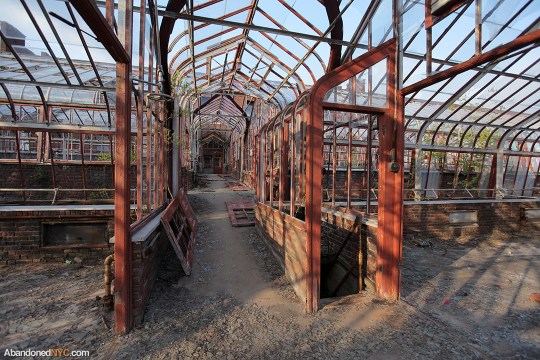
The main building connects to a network of intricate greenhouses.
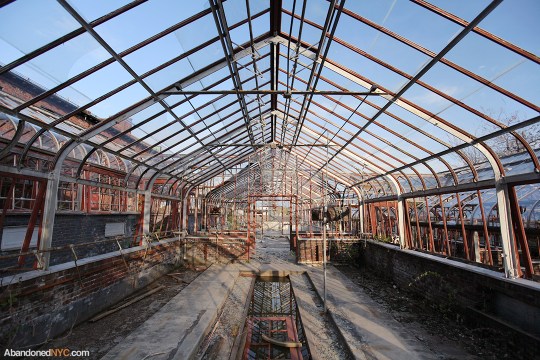
The interiors were covered with shattered glass, but still enchanting.
A Baseball Graveyard in Queens
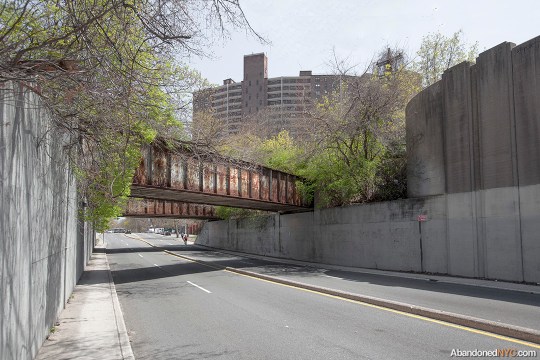
An overgrown overpass at Union Turnpike and Woodhaven Boulevard, part of the proposed Queensway project.
Abandoned for half a century, the old Rockaway Beach Branch of the Long Island Railroad is stirring debate today as opposing visions for its future emerge. Before it’s reactivated to serve beleaguered Queens commuters, or converted to the Queensway, (a linear park similar to Manhattan’s High Line), the track remains a 3.5 mile wilderness, with more than a few secrets scattered among the ruins.
At the northern edge of Forest Park, the rails terminate in a parking lot, where antiquated electrical towers have been adapted as streetlights. Across the Union Turnpike, there’s a plot of land that may be the most obscure section of the Rockaway Branch, a triangular junction wedged between a dilapidated warehouse and a complex of baseball diamonds. A well-trod path leading into the place quickly dissolves into a tangle of branches; the plant life is especially lush here, and difficult to navigate.
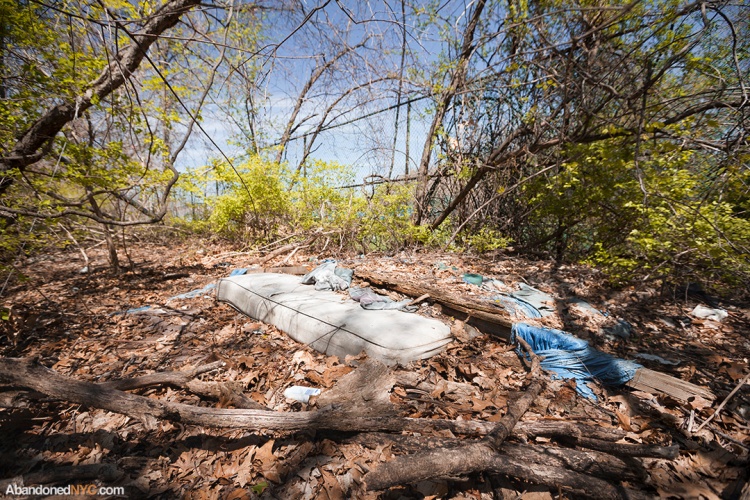
A soggy mattress clogs a sunlit clearing, marking a recent habitation…
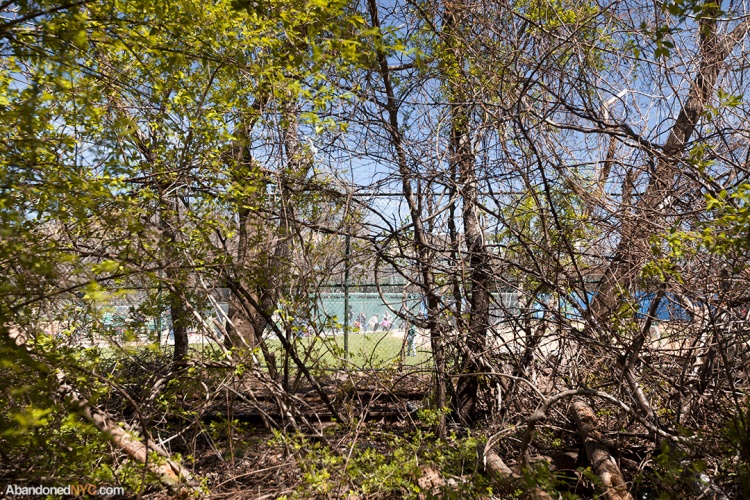
…just a few paces from a chain link fence that separates a packed field of cheering little leaguers.
Standing in the shadows just beyond the diamond’s edge, you’re practically invisible, in a world between worlds, and right at your feet, dozens of baseballs bloom from the earth like mushrooms…
This is the place the balls go where you can’t get them back, each a martyr and a monument to a home run that may have taken place decades ago or just this morning. Stripped of their leather casing, the older specimens reveal a second skin of frayed cotton yarn. The most ancient are unrecognizable, corrupted to a truffle-like core of black, scabrous rubber. Together, they linger in a bizarre kind of afterlife, populating the century-old tracks of a forgotten railroad—when a place is left alone, the past piles up.
Check out the gallery below for an education in baseball construction, and decay…
-Will Ellis


Ghosts of the West Side Highway

An abandoned 1950s diner on the West Side Highway.
New York City isn’t known for its roadside attractions or its motor inns, but along the West Side Highway, you can still find shades of the open road. What could be more emblematic of the highway state of mind than the diner, whose very contours suggest forward motion, gleaming like hubcaps across the American landscape? Abandoned between auto repair shops and a gentlemen’s club, the diner at 357 West Street fully commits to the mystery and isolation only hinted at in Edward Hopper’s Nighthawks, (which was based on a nearby diner in Greenwich Village.) Today, the only travelers this diner entertains are pedestrians who can’t resist taking a peek inside…
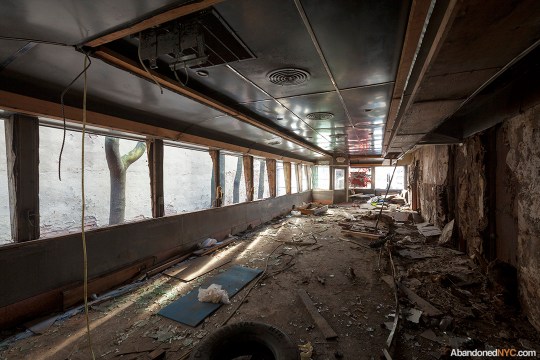
The wrecked interior of the “Lost Diner”
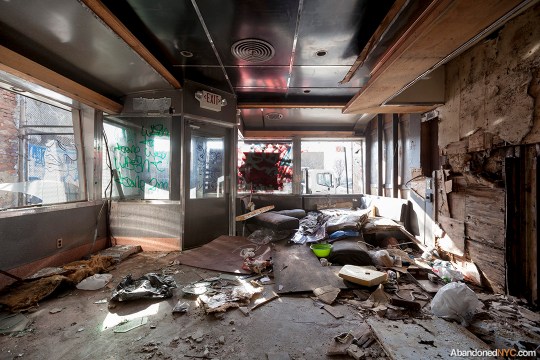
Garbage piled up near the front entrance.
The restaurant closed in 2006 after 50 years of operation, having gone through a steady succession of owners and names, including the Terminal Diner, the Lunchbox Diner, Rib, and perhaps most fittingly, the Lost Diner. Constructed by the New Jersey-based Kullman Diner Car Company, the structure is typical of the Art-Deco diner cars manufactured in the 40s and 50s, which have since become an iconic fixture of cities across America. Most of Manhattan’s once numerous diners have been demolished or moved in recent years; you can still visit Soho’s famous Moondance Diner—in Wyoming. The steep decline in the condition of the Lost Diner limits its chance of being relocated.

The walls have been stripped of valuable scrap metal by vandals.
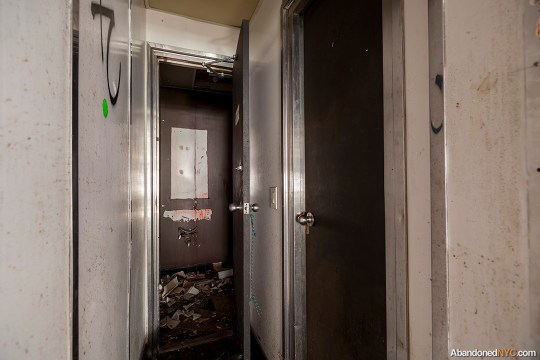
“Employees Must Wash Hands”

An empty pantry at the back of the diner car.
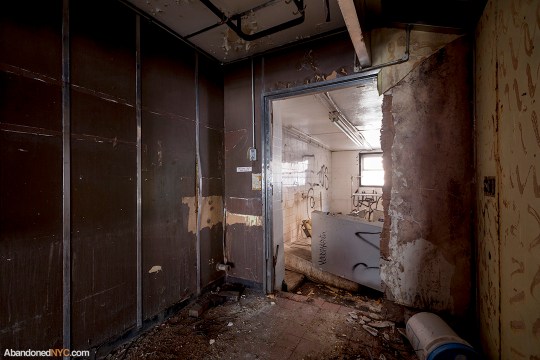
A kitchen hallway stripped of appliances.
Throughout the space, a steady rush of traffic fills the air in the absence of clinking silverware. Sunlight bounced from a passing windshield momentarily dazzles an aluminum ceiling. In the dining room, shattered glass joins a host of reflective surfaces, causing the room to glimmer with points of light in the evening. In the past year, the windows of the diner have been knocked out and the interior has been ravaged. Old mattresses, fresh garbage, and a homemade toilet point to a recent, if not ongoing habitation. Stacks of rotting food cartons fill an overturned refrigerator, covered with the husks of long-dead pests. In the former kitchen, a dry erase board lists celery seed, walnut oil, and Windex for a shopping trip that was doomed to be this diner’s last.
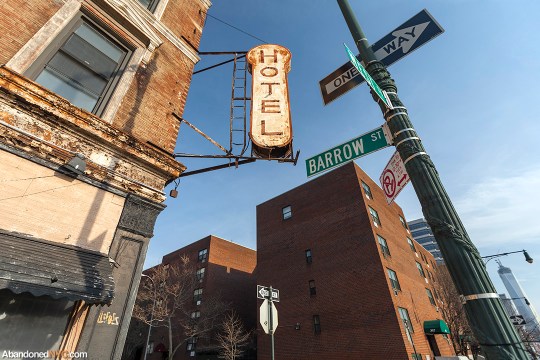
The Keller’s noteworthy “HOTEL” sign.
Down the road, the abandoned Keller Hotel makes a perfect counterpart to the Lost Diner, another vacant holdout in a neighborhood that’s quickly being overcome by luxury developments. The six story hotel was completed in 1898 as a lodging for travelers arriving from nearby ferries and cruise ships. By the 1930s, the area had become one of the most active sections of the port of New York, and the building became a flophouse for sailors. Later, the club downstairs catered to New York’s gay community as the oldest “leather bar” in the West Village. The Keller Hotel was landmarked in 2007, but has stood unoccupied for decades. When and if the building is renovated, here’s hoping the slightly sinister “HOTEL” sign will be saved.
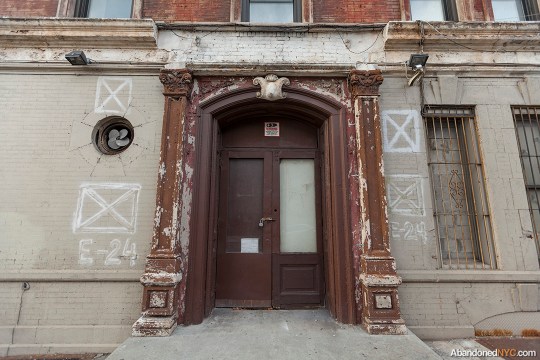
The south entrance, marked unsafe to enter.

The abandoned Keller Hotel.
Talking Trash in Dubos Point Wildlife Sanctuary

Yellowing remains of a small vessel permanently docked in Dubos Point.
Take the A train past JFK. You’ll be one of a handful of travelers left on a car that seemed well over capacity a moment ago; the babble of the crowd fades to the soft hum of an unimpeded machine. Nobody asks you for money, or directions. If you’ve made it this far, you know where you’re going.
Suddenly, the ground drops out and you’re gliding over the silver Jamaica Bay. The train runs just above sea level, skimming over a surface that teems visibly with diving cormorants. Clustered with skeletal boat frames, aged marinas jut from a neglected shoreline across the water, to the west, a row of painted houses stand on stilts. There’s no place like the Rockaways to experience New York as a city by the sea.
Head east at Hammels Wye, and a brief walk through the quiet neighborhood of Averne will lead you to a little known peninsula called Dubos Point, one of the last fragments of salt marsh left in a city that was once ringed with tidal wetlands. The marsh was filled with dredged materials in 1912 in preparation for an ill-fated real estate development, but over the last century, the area has reverted to its natural state. In 1988, the land was acquired by the Parks Department, deemed a wildlife sanctuary, and given an official name for the first time (Rene Dubos was a microbiologist and environmental activist who coined the phrase “Think Globally, Act Locally”).
Parks officials envisioned marked nature trails and boardwalks for community use, and planned to build nesting structures and employ part-time patrol staff to encourage wildlife and keep the place clean, but none of this came to be. The Audubon Society of New York maintained the grounds sporadically until 1999, but abandoned its post citing a lack of resources. Since then, the area has been largely neglected, leaving its care up to volunteers. Green Apple Corps and the Rockaway Waterfront Alliance have orchestrated several clean-up events over the years, but they’re facing an uphill battle.
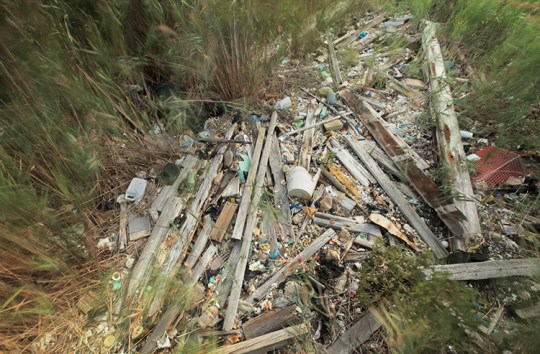
Garbage and driftwood piled up on the bank.
Every day, the shores of Dubos Point are bombarded with an onslaught of garbage, and it’s not coming from park visitors (the preserve is technically not open to the public). Most of the refuse is washed up from the bay, after a long journey through storm drains that began in the littered streets of New York City. Familiar objects are made strange, touched by a long encounter with an invisible world, caked with green algae, eroded with salt, barnacle-burdened and bleached by the sun. The entire peninsula resounds with the constant susurration of wind through grass. For all these reeds are hiding, perhaps they whisper secrets; mud-moored vessels, decaying toys, and saltbored furniture lay half-concealed in the tidal growth.

A boat moored in a reedy grave.
Standing water in old tires and plastic debris makes for a perfect breeding ground for the area’s most populous species. My first steps onto the grounds of Dubos Point seemed to disturb some ancient curse, as great swarms of mosquitoes rose from their stagnant hollows to draw my blood sacrifice. The Parks department has been criticized in the past for neglecting its duties at Dubos Point while mosquito infestation reached “plague proportions” in the late 90s, rendering backyards unusable from April to October. After years of complaints and little improvement, some residents resorted to building outdoor shelters for brown bats, a natural insect predator. Today, the only visible improvement made on the grounds of Dubos Point is a line of Mosquito Magnet kiosks, placed every 100 feet along the boundary of the preserve.
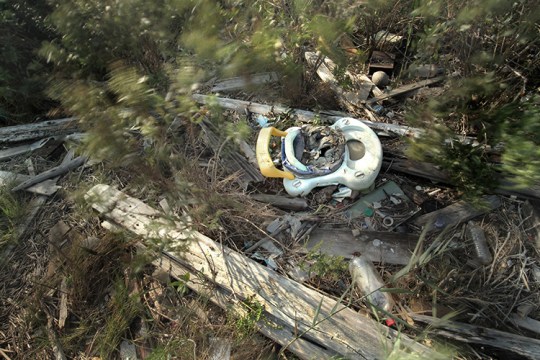
A toy car abandoned in the marsh
Despite decades of pollution, the Jamaica Bay harbors hundreds of species of wildlife, and the water is cleaner today than it was 100 years ago. As one of the last remaining pockets of undeveloped land in New York, the estuary supplies an essential resting place for migratory birds along the Atlantic Flyway; egrets, herons, and peregrine falcons are spotted here. Looking past the garbage, you can still make out the natural beauty of Dubos Point, and imagine what this whole region was like 400 years ago. Neck-high cordgrass is abundant, trapping bits of decayed organisms to fuel a thriving, though limited, ecosystem. Throngs of fiddler crabs crowd the soggy ground, scuttling sideways with one collective mind, crunching underfoot like eggshells. The breezy silence is only interrupted by an occasional splash from a jumping fish, or the roar of a plane, taking off from the crowded runways of JFK just across the water. Off the curling tip of Dubos Point, fishermen still cast their lines in the Sommerville Basin, affirming a bond we’ve all but lost.
12,000 of the original 16,000 acres of wetlands around the Jamaica Bay have already been filled in for development, and sources predict that the last of the saltwater marshes could disappear in the next 20 years. It’s a shame to see one of the few protected areas in this condition, when its potential for education and recreation is so apparent. New York needs to protect its wild spaces, and sometimes that means getting our hands dirty. To learn about volunteer opportunities with the Parks Department, visit their website. And check back for information on the next Dubos Point clean-up.

A decaying hull festers in the noonday sun.

A beach shelter built from salvaged garbage and tarps.
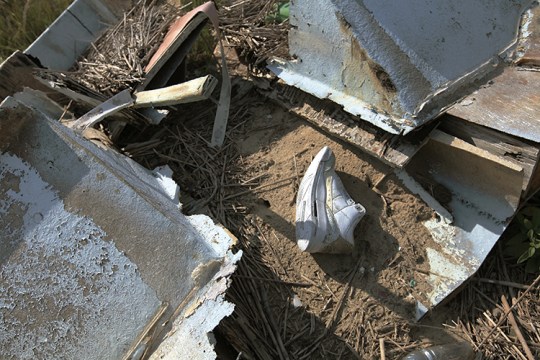
A single shoe stranded amid nautical debris.

Skeletal remains of a water vessel.

Rotting pilings point to an earlier use for the land.
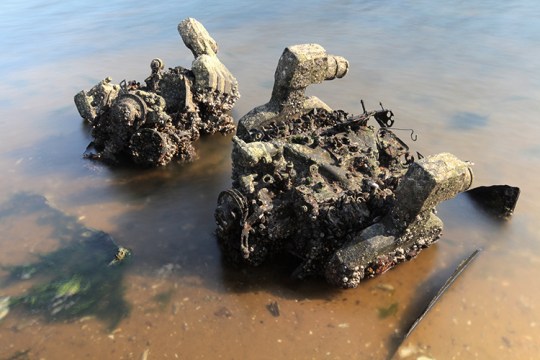
Barnacled motors stuck in the sand.
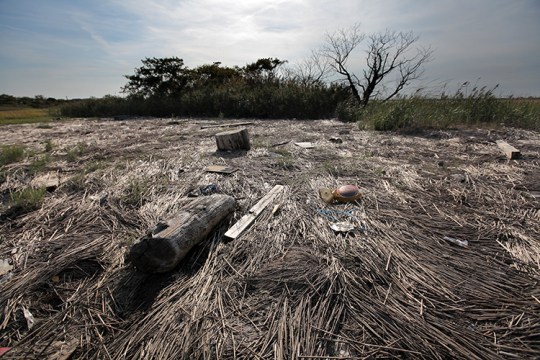
A desolate area of the marsh.
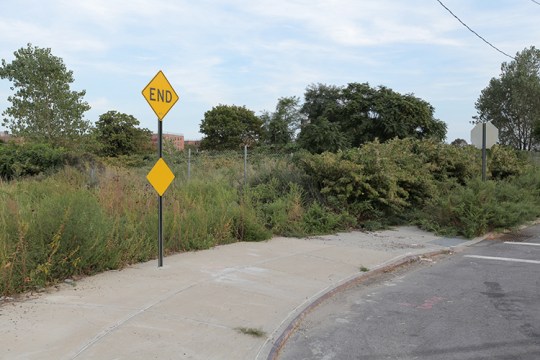
Dead ends abound where streets meet the Sommerville basin.
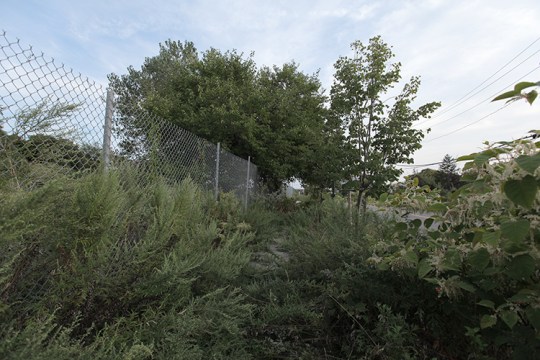
This may look like a wildlife sanctuary, but it’s actually a sidewalk.
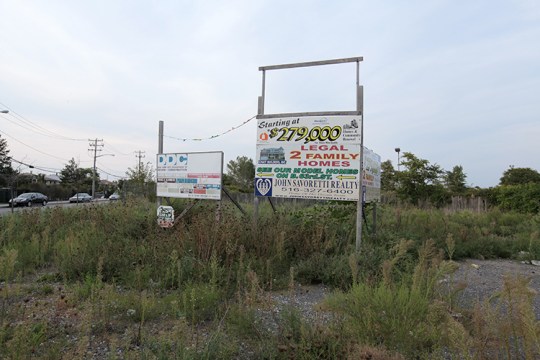
An overgrown lot advertising yet another housing development.
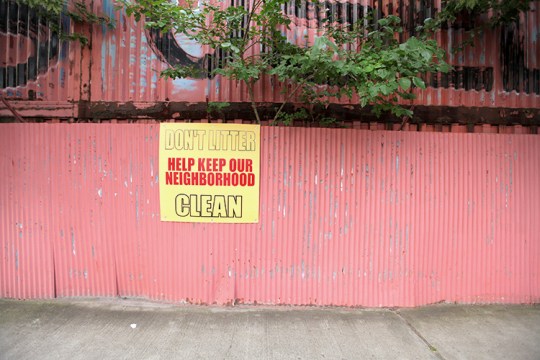
Don’t Litter.
Checking in to Grossinger’s Resort
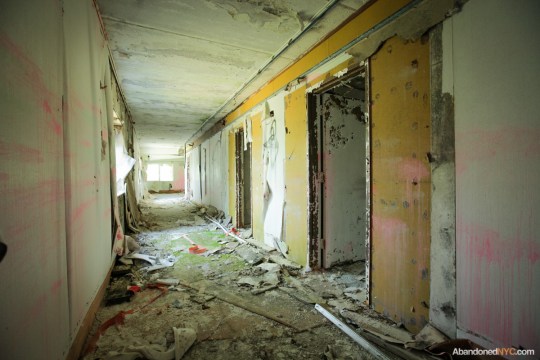
The ransacked Paul G. hotel, showing the hallmarks of a recent paintball game.
Past a deserted security desk, waist-high grasses choke back the yawning entrance to the Jennie G. Hotel, whose toppled fence serves more as an invitation than a barrier. Here in the sleepy town of Liberty, NY, this derelict hilltop lodge is not only a destination for the curious, it’s a daily reminder of the town’s old eminence, an emblem of a dead industry, visible from miles around.
In its time, Grossinger’s Catskills Resort was a fantasy realized, where wealthy businessmen, celebrity entertainers, and star athletes gathered to mingle with those that they liked and were like, to see and be seen, and to enjoy, rightly so, the things they enjoyed. As the slogan goes—Grossinger’s has Everything for the Kind of Person who Likes to Come to Grossinger’s.

Flowers left by a former guest, or a prop from an old photo shoot.
If you’re the kind of person that’s inclined to spend their vacation somewhere dark, dusty, and dangerous, the motto still rings true today, and you’re not coming for the five-star kosher kitchen. For just as quickly as the resort prospered into a world-class institution, it’s descended into a swift decay. Explorers frequent the grounds, armed with cameras in an attempt to capture the beauty in its devastation, sifting through the artifacts—a broken lounge chair, old reservation records—piecing together a lost age of tourism.
A generation ago, this region of the Catskills was known as the Borscht Belt, a tongue-in-cheek designation for a string of hotels and resorts that catered to a predominantly Jewish customer base in a time when discrimination against Jews at mainstream resorts was widespread. In popular culture, the most notable representation of this time and place is Dirty Dancing, which was supposedly inspired by a summer at Grossinger’s. The unexpected success of its film adaptation had little effect on the long-struggling resort—in 1986, a year before the film was released, Grossinger’s ended its 70 year legacy.
The story of Grossinger’s is, at its root, an American story. The Grossingers were Austrian immigrants, who after some early years of struggle in New York City, and a failed farming venture, opened a small farmhouse to boarders in 1914, without plumbing or electricity. They quickly gained a reputation for their exceptional hospitality and incredible kosher cooking and outgrew the ramshackle farmhouse, purchasing the property that the resort still occupies today.
Grossinger’s rise to prominence is largely attributed to the couple’s daughter Jennie, who worked there as a hostess in its early years. Later, Jennie’s legendary leadership would transform the resort from its humble beginnings to a massive 35-building complex (with its own zip code and airstrip), attracting over 150,000 guests a year, and establishing a new type of travel destination that renounced the quiet charms of country living for a fast-paced, action-packed social experience that met the expectations of its sophisticated New York clientele.

Remnants of an attempt to burn down the Jennie G.
Every sport of leisure had its own arena, with state of the art facilities for handball, tennis, skiing, ice skating, barrel jumping, and tobogganing, along with a championship golf course. In 1952, the resort earned a place in history by being the first to use artificial snow. Its famous training establishment for boxers hosted seven world champions. Its stages launched the careers of countless well-known singers and comedians. In its day spas and beauty salons, ballrooms and auditoriums, guests were offered a level of luxury that even the wealthiest individuals couldn’t enjoy at home, earning Grossinger’s the nickname, “Waldorf in the Catskills.”
A daily missive called The Tattler identified notable guests and the business that made their respective fortunes. Weekly tabloids published on the grounds boasted the presence of celebrity athletes and entertainers. But for all the emphasis on earthly pleasures and material wealth, Jennie G. ensured that the Grossinger’s experience was warm and personal, always treating guests like one of the family, even when visitors reached well over 1,000 per week.
By the late sixties, the Grossinger’s model had started to fall out of favor as cheap air travel to tourist destinations around the world became readily available to a new generation. After the property was abandoned, several renovation attempts were aborted by a string of investors. Widespread demolition has greatly diminished the sprawl of the original resort, but several of the largest buildings remain. Most have been stripped of any vestige of opulence, and some structures are barely standing; no more so than the former Joy Cottage, whose floors might not withstand the footfalls of a field mouse.
Artifacts from the hotel’s glory days are few and far between, but Grossinger’s most recent batch of visitors has been quick to leave its mark. In a haunting hotel filled with empty rooms, some scenes are startlingly arranged, with collected mementos photogenically poised in the pursuit of a compelling shot. Despite these attempts to prettify Grossinger’s decline, the grounds retain an air of savage dilapidation, and an utter submission to nature.
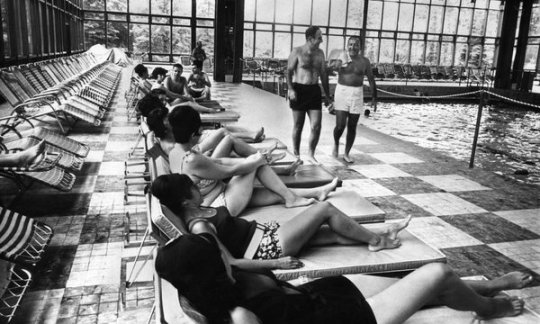
The Grossinger’s Hotel pool c. 1967.
An indoor swimming pool is Grossinger’s most enduring spectacle, and has become a favorite location of urban explorers near and far. Radiance remains in its terra-cotta tiles and its well-preserved space age light fixtures. Its dimensions continue to impress, as do the postcard views through its towering glass walls, all miraculously intact. It’s growth, not decay, that makes this pool so picturesque—the years have transformed this neglected natatorium into a flourishing greenhouse. Ferns prosper from a moss-caked poolside, unhindered by the tread of carefree vacationers, urged by a ceiling that constantly drips. Year-round scents of summer have bowed to a kind of perpetual spring, with the reek of chlorine and suntan lotion replaced by the heady odor of moss and mildew—it’s dank, green, and vibrantly alive.
Meanwhile, areas across the region that once relied on a thriving tourism industry have fallen into depression or emptied out. The Catskills is attempting to rebrand, updating its image and holding online contests to determine a new slogan. The winner? The Catskills, Always in Season.
Though it remains to be seen whether the coming seasons will bring new visitors, there’s no doubt they’re serving to erase the region’s outmoded reputation. With each passing year, in ruined hotels across the Catskills, the physical remnants of lost vacations dwindle. Indoors, snowdrifts weigh on aching floors; leaf litter collects to harbor the damp or fuel the fire. Vines claim what the rain leaves behind, compelling the constant progress of decay. Scattered in photo albums, hidden in bottom drawers, excerpted from yellowing newsprint, the memories will follow, clearing the way for new journeys. Before it’s forgotten, here’s one more look inside the celebrated resort.

This catwalk ensured a comfortable commute from your suite at the Paul G. to the indoor pool year-round.
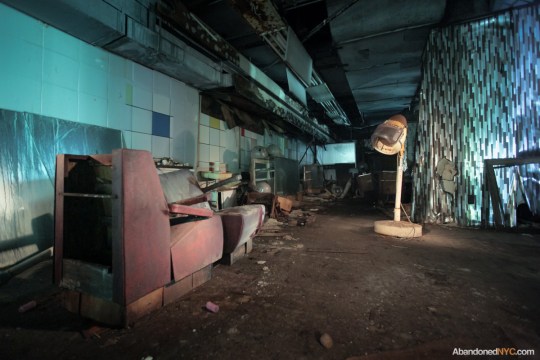
A pitch-black beauty salon lit with the aid of a flashlight.

The ruined entrance to the hotel spa.

Office on the bottom floor of the Jennie G. Hotel.
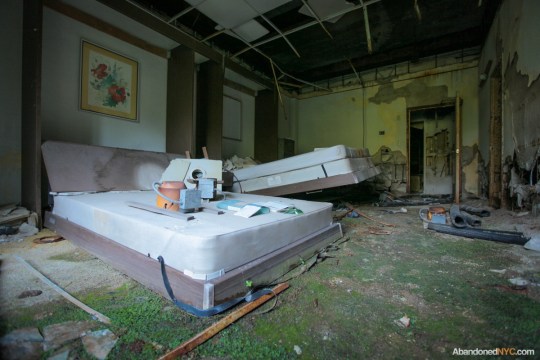
The best preserved room, with two murphy beds, and a carpet of moss.

In most rooms, peeling wallpaper was all that remained.
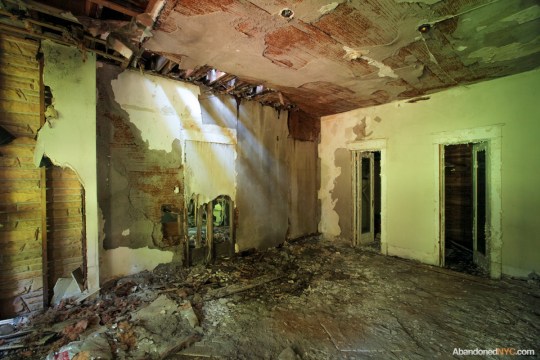
The ground floor of the management office, now on the verge of collapse.

Hotel records neatly arranged on a mattress, by a photographer, no doubt.
The Trapps Mountain Hamlet, Backwoods Ghost Town
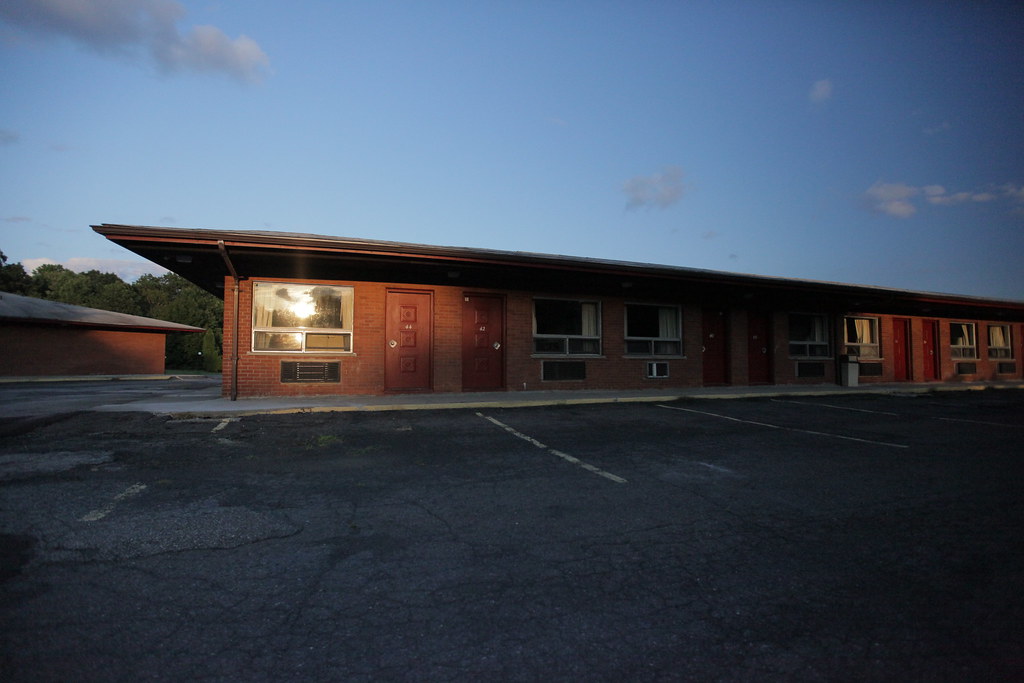
A night at the 87 Motel in New Paltz.
If you’re like me, city living can wear you down—sooner or later, you’re itching for the woods again. The sleepy college town of New Paltz offers a cheap motel and a short proximity to Mohonk Preserve, 5,000 acres of hiking trails, swimming holes, and rock scrambles nestled deep in the ancient Palisades. The world-worn hills of the Shawangunk Ridge evoke a pleasing sense of permanence to the weary New Yorker, it’s a lifetime away from the teeming avenues of Manhattan. Time seems to stand still around here, but out in these tall timbers, the ruins of a 19th century ghost town hint at a lost way of life.
The area is known for its landmark luxury resort, the Mohonk Mountain House, which has been run by the same family since it opened in 1869. True to its Quaker roots, the hotel originally banned liquor, dancing, and card playing; until 2006, it couldn’t claim a bar, and you still won’t find a TV or radio in any of the $700 a night lodgings. It may sound old-fashioned, but it’s part of a tradition in these parts—since they were first settled in the late 1700s, things have always been behind the times.
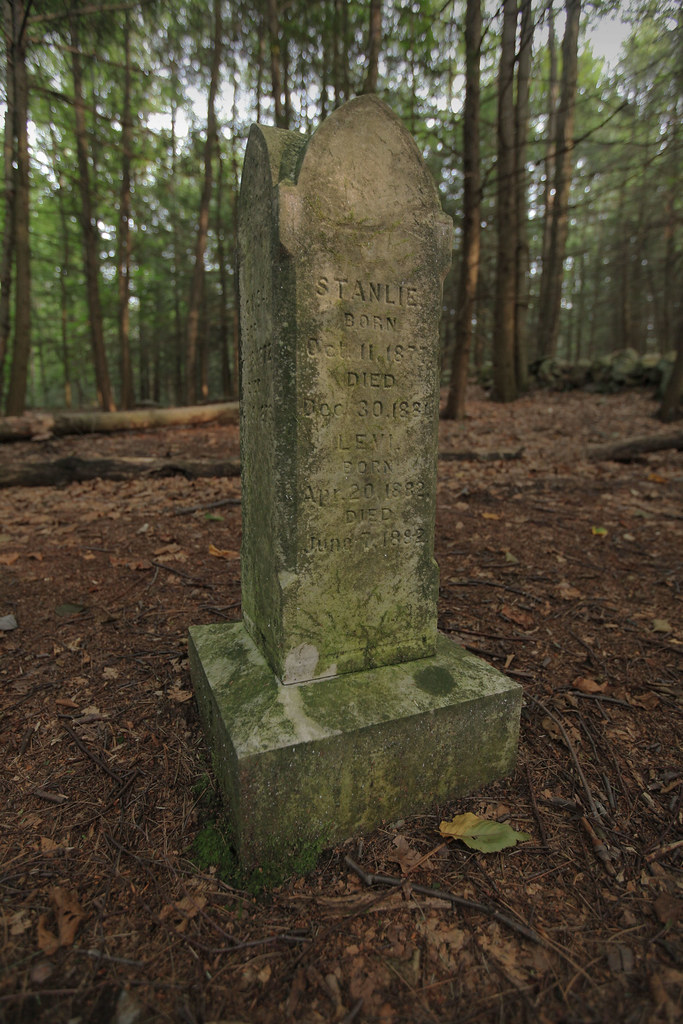
The Fowler Burial Ground.
Before the age of mountain tourism, a small subsistence community lived off this land, growing what little food the thin, rocky soil could support, raising a handful of livestock, drinking from the Coxing and Peter’s Kills. They scraped a living carving millstone out of native rock, shaving barrel hoops, and harvesting tree bark for leather tanning. In the summer, women and children joined in harvesting huckleberries, a seasonal cash crop in wild abundance at the time.
With a peak population of forty or fifty families, the settlement included a hotel, a store, a chapel, and a one room schoolhouse. Despite this progress, the population held to its old ways. So hopelessly and wonderfully at odds with the changing values of the outside world, this oldfangled hamlet didn’t stand a chance.
Starting in the late 1800s, advances in technology gradually replaced the small trades of the Trapps. Unable to sell their traditional wares, settlers found work in neighboring resorts, including the Mohonk Mountain House, building hotels and maintaining trails and carriage roads. In the late 20s, the construction of Route 44 created a short term boom in the town’s employment, but eventually led to its decline.
Many sold their property to resort owners and headed to nearby villages to find a better way of life, but one man called Eli Van Leuven stayed behind, living in a tiny plank house without running water or electricity until his death in 1956.
The Van Leuven Cabin has been lovingly restored, an unassuming monument to a largely forgotten community. Aside from this, the humble industries of the two score families that resided here have left little to mark them but shallow depressions in the ground, rubble stacked in odd arrangements, and leaf-littered tombstones. Only a settlement so bound to the earth could disappear so completely.
On the drive home, the first sighting of the Manhattan skyline elicits a kind of dull horror, signaling the inevitable return to a concrete-bound existence. As I’m plunged back into the 21st century, the scene is at once overstimulating and shockingly mundane. In that moment, I’d take an axe and a cool morning in a mountain hamlet over any day in the ad-plastered streets of midtown, but the daydreams invariably dissolve. Out of habit, obligation, or common sense, I’ll forget the plank house for the brownstone, the Coxing Kill for the coffee shop, as the stony ruins of a mountain town blanket themselves in moss.
-Will Ellis
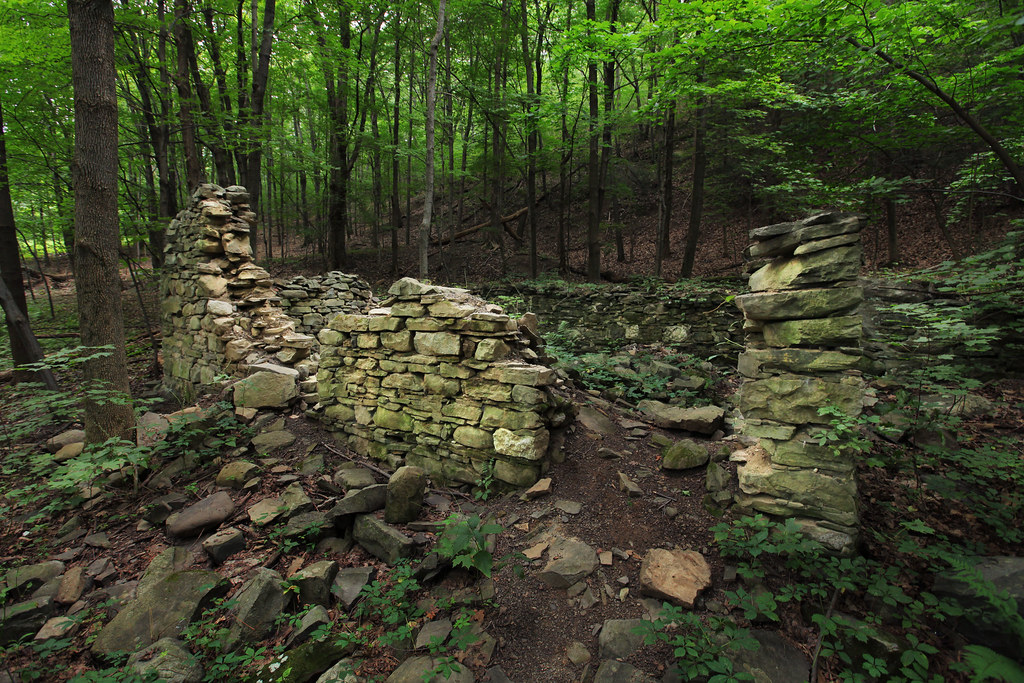
The Clearwater Ruins are some of the best preserved.
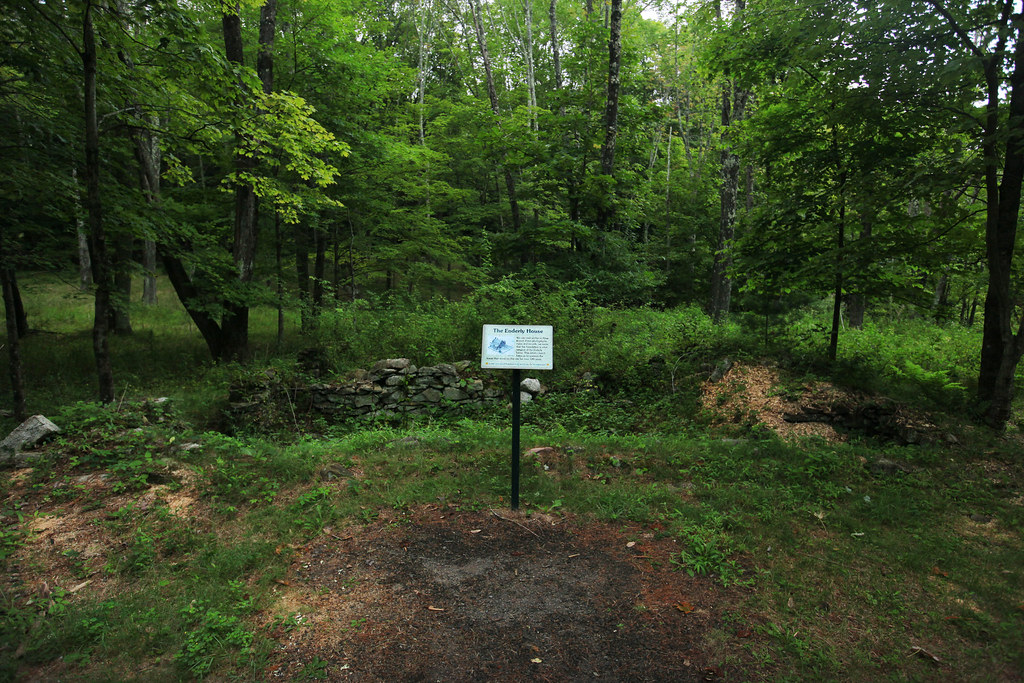
Former site of the Enderly House, most structures incorporated Native American techniques into their construction.
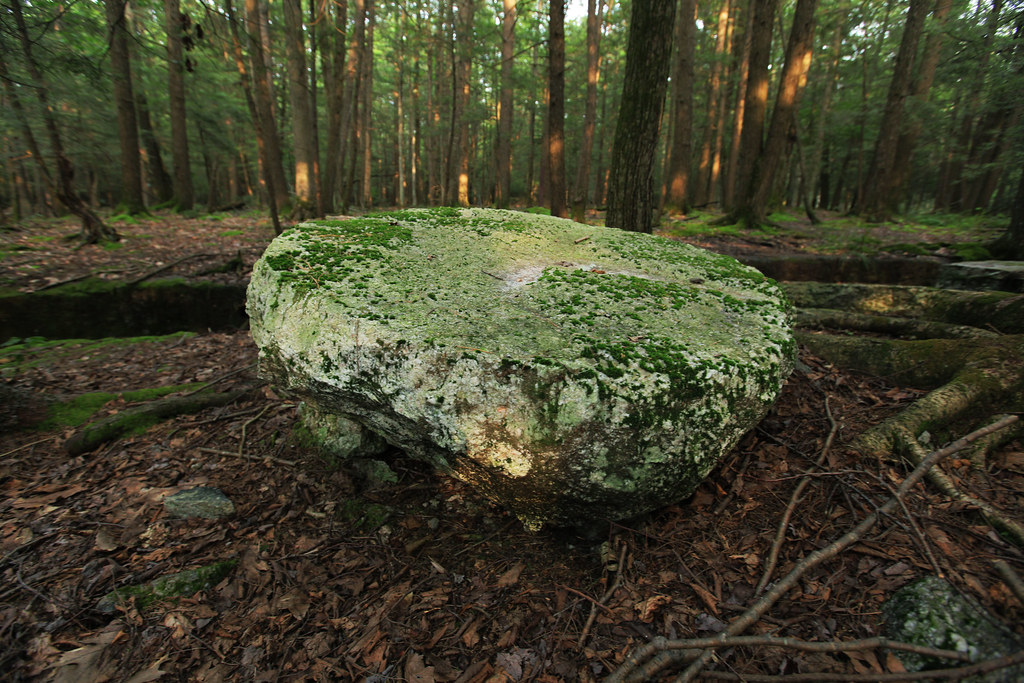
Unfinished work in the millstone quarry.

Path to the Van Leuven Cabin.
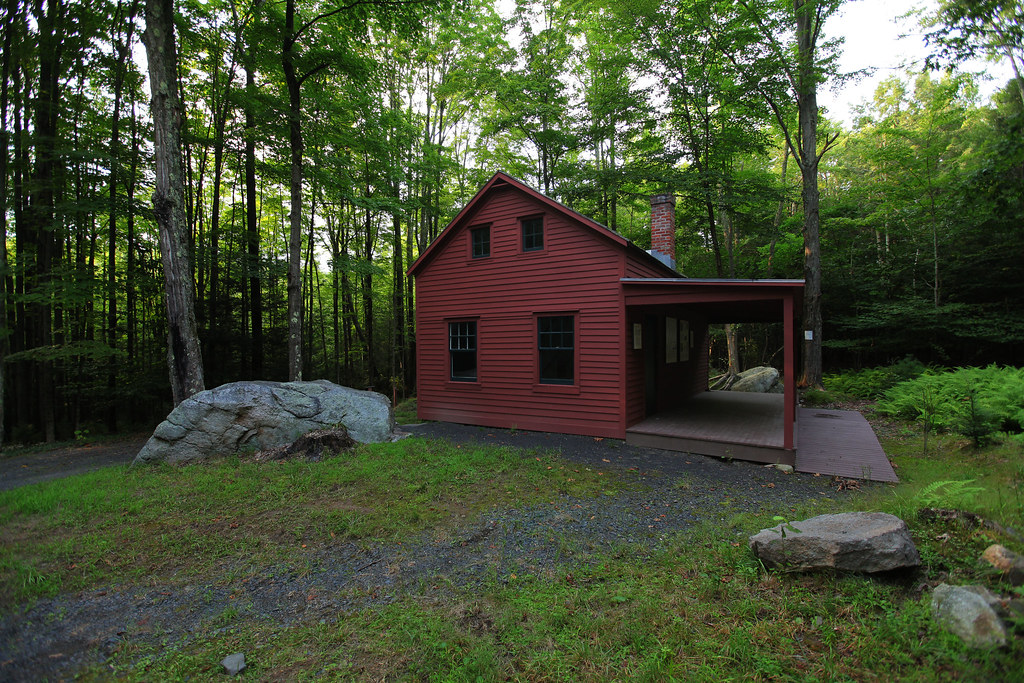
The fully restored cabin, constructed in 1889, is occasionally open for tour groups.
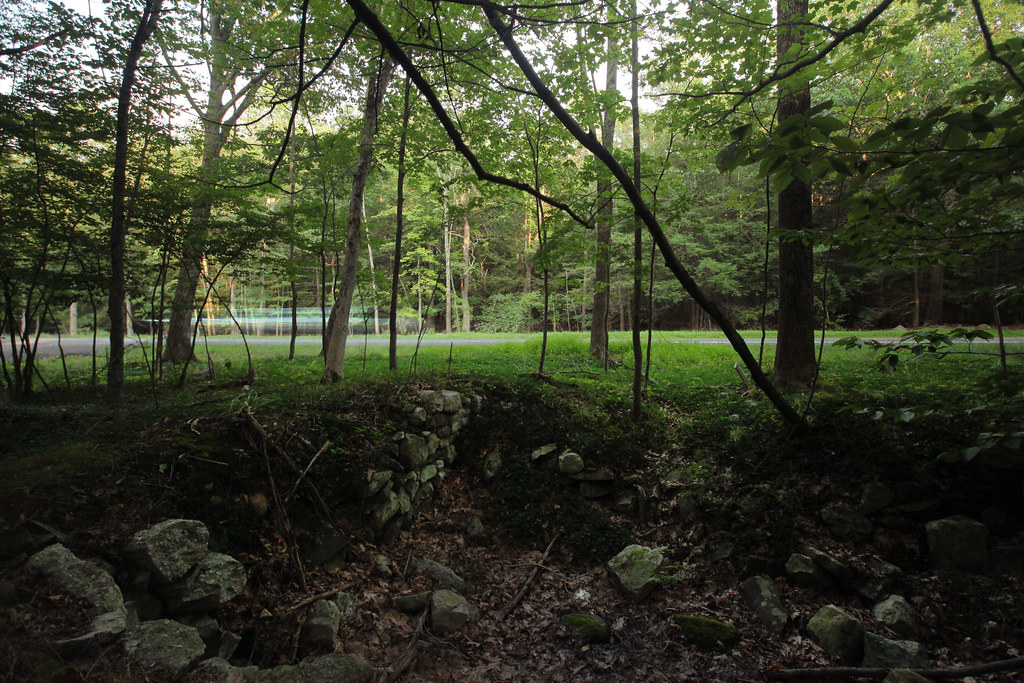
This road was built in large part by Trapps Hamlet residents. Today, it glides through the heart of the ghost town.
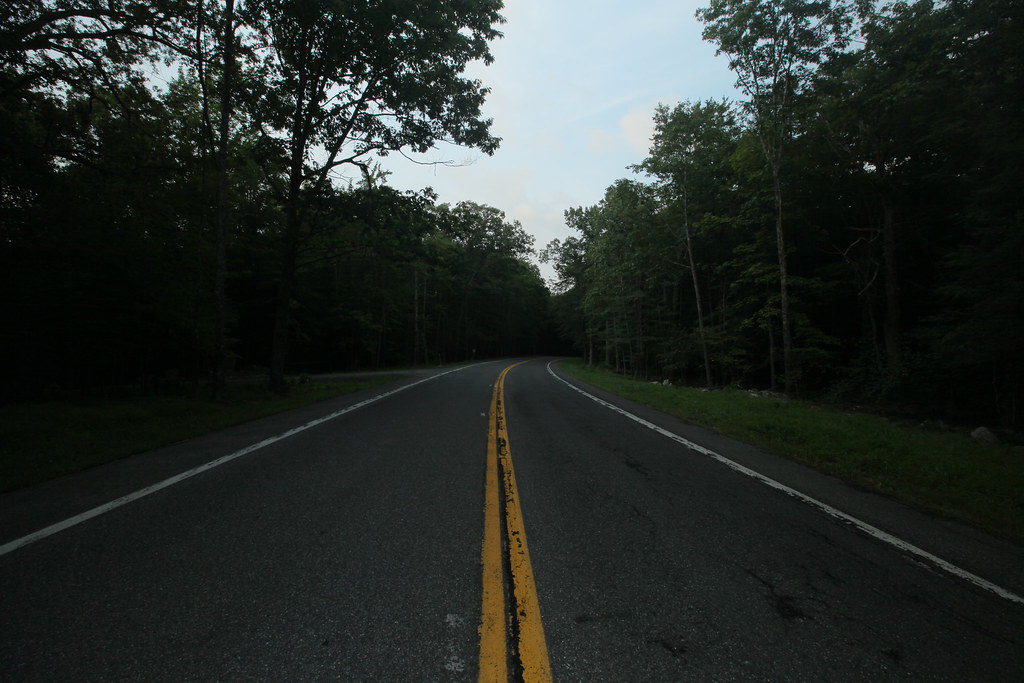
Route 44, the road to ruins.
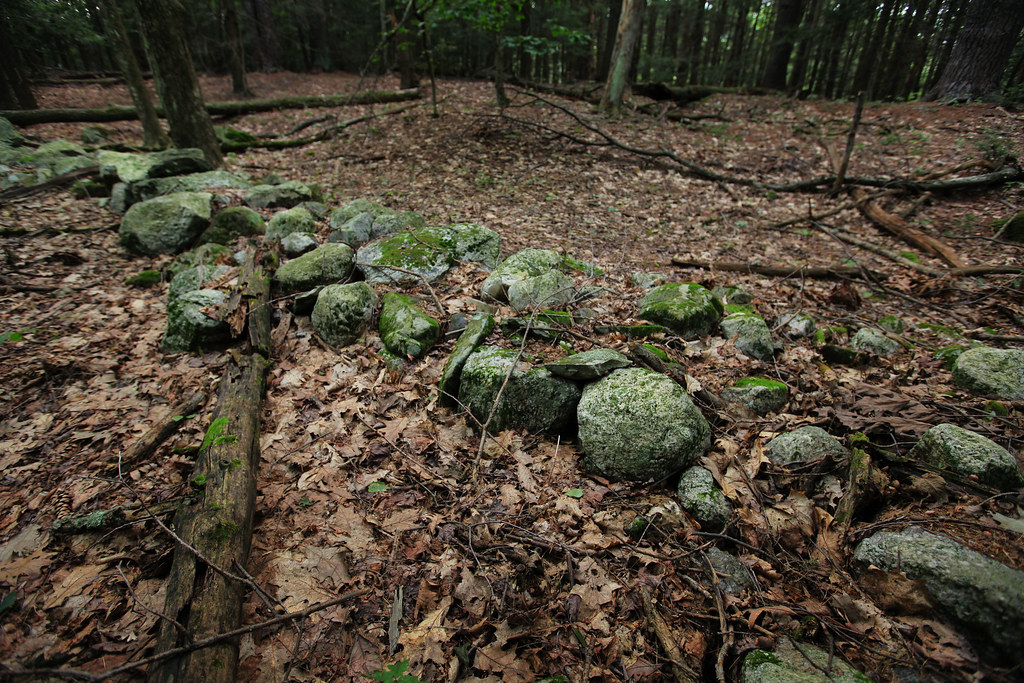
This boundary wall was used to delineate the property of Benjamin Fowler, who owned 150 acres for farming, livestock, and family use.
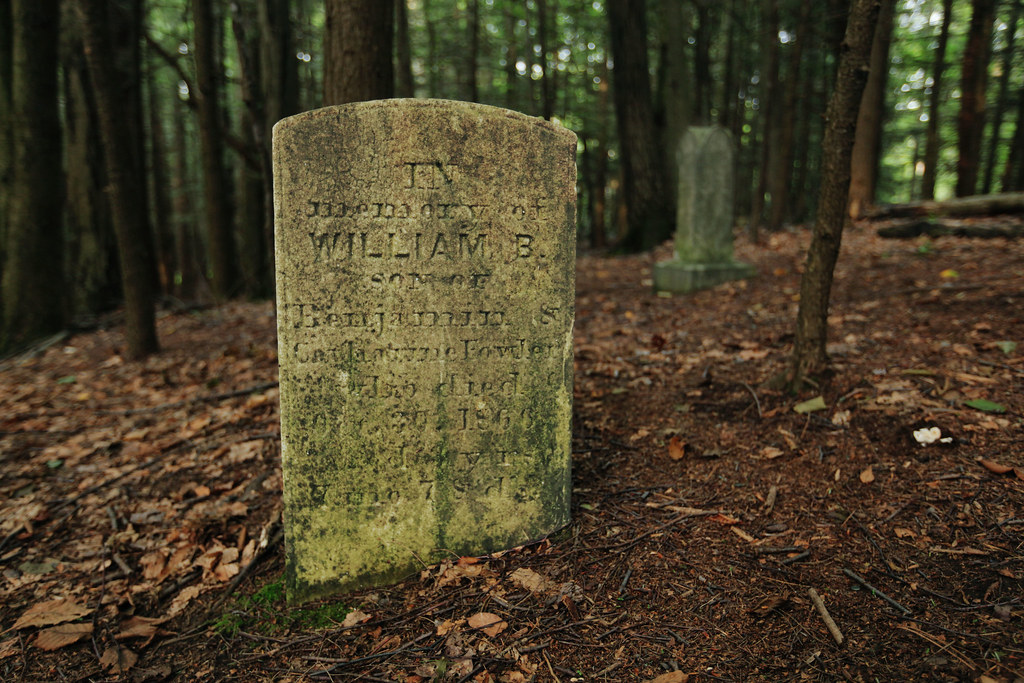
Many of Benjamin’s young children are buried in this forest plot. This grave for his son William is the earliest, dating to 1866.

The motel pond by night.
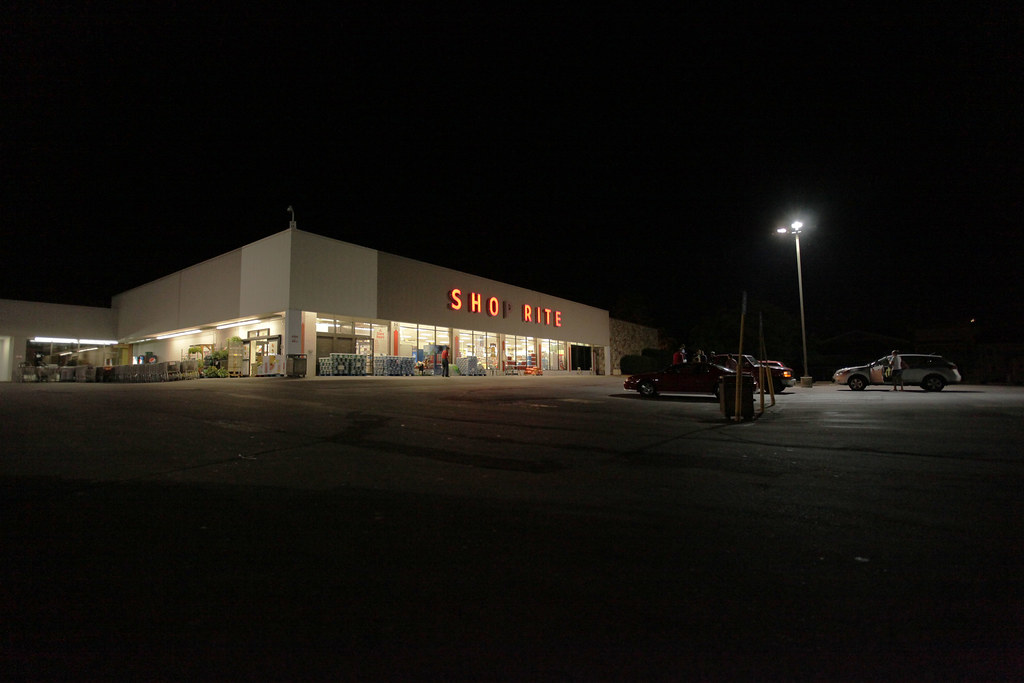
Stadium proportions of a New Paltz grocery, a far cry from the corner bodega.

At Split Rock swimming hole.
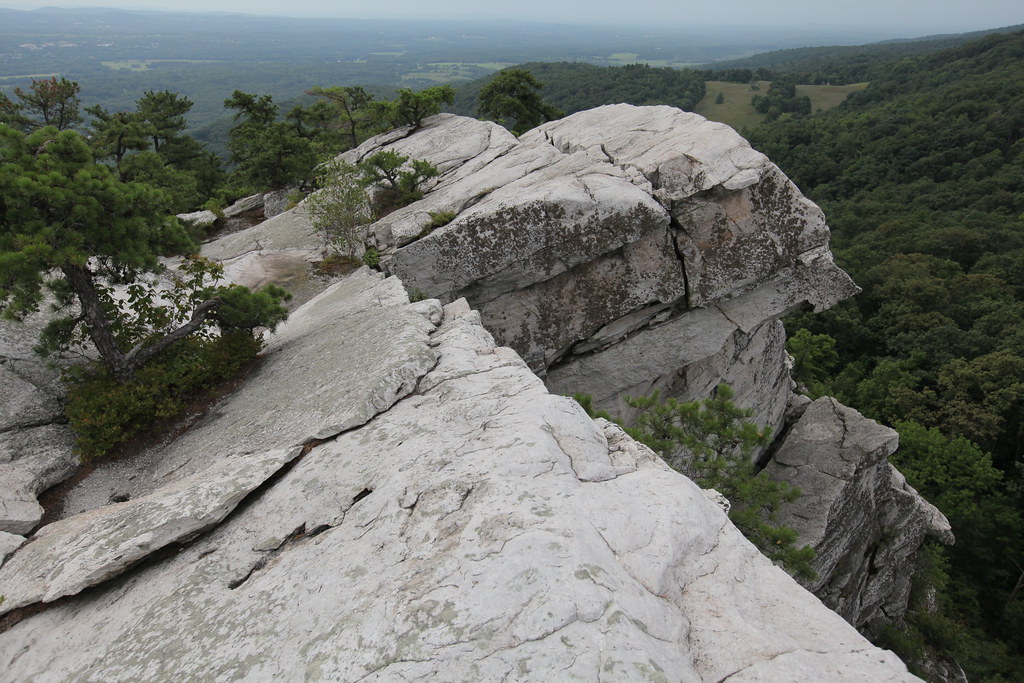
Climbing to the top of Bonticou Crag.
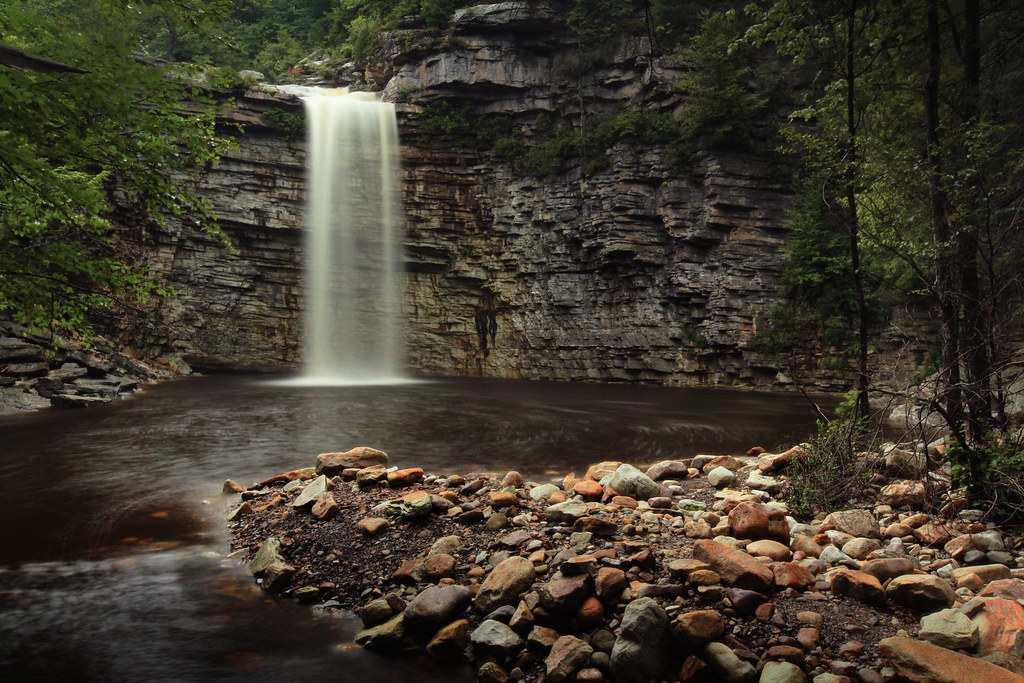
In the nearby Minnewaska State Park, the Awosting Falls swells from a mid-August downpour.
The Yonkers Power Station, Knocking at the “Gates of Hell”
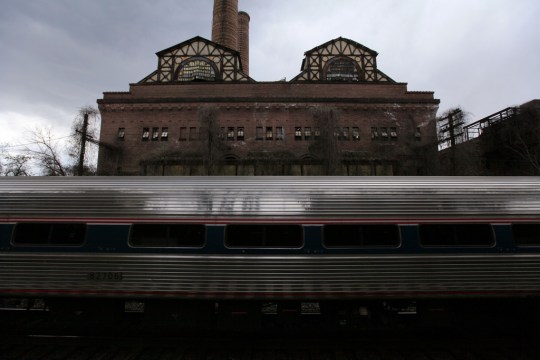
The abandoned Yonkers Power Station looms over a modern MetroNorth stop.
Take a northern train to Yonkers and watch New York City’s urban sprawl give way to the unspoiled undulations of the Hudson River Valley. You’ll be reminded once again that Manhattan is an island, bounded and formed by three rivers, and there is, in fact, a world outside of it.
One of the stranger stops along the Hudson line can’t be missed; it’s dominated by a sight nearly as impressive as the station you came from. Abandoned since the late sixties, the old power plant at Glenwood may be decidedly more ghoulish than Grand Central Terminal, but it’s almost as grand—they were dreamed up by the same architects. Once, the imposing brick edifice embodied New York City’s ever-increasing industrial prowess, but today, the riverside relic stands as a monument to obsolescence, caught in a destructive contest with the tides.
The Yonkers Power Station was completed in 1906 to enable the first electrification of the New York Central Railroad, built in conjunction with the redesign of Grand Central Terminal. The plant served the railroad for thirty years, but it soon became more cost-effective for the company to purchase its electricity rather than generate its own. Con Edison took over in 1936, using the station’s titanic generating capacity to power the surrounding county. By 1968, new technologies had replaced Glenwood’s outdated turbines, and the station was abandoned.
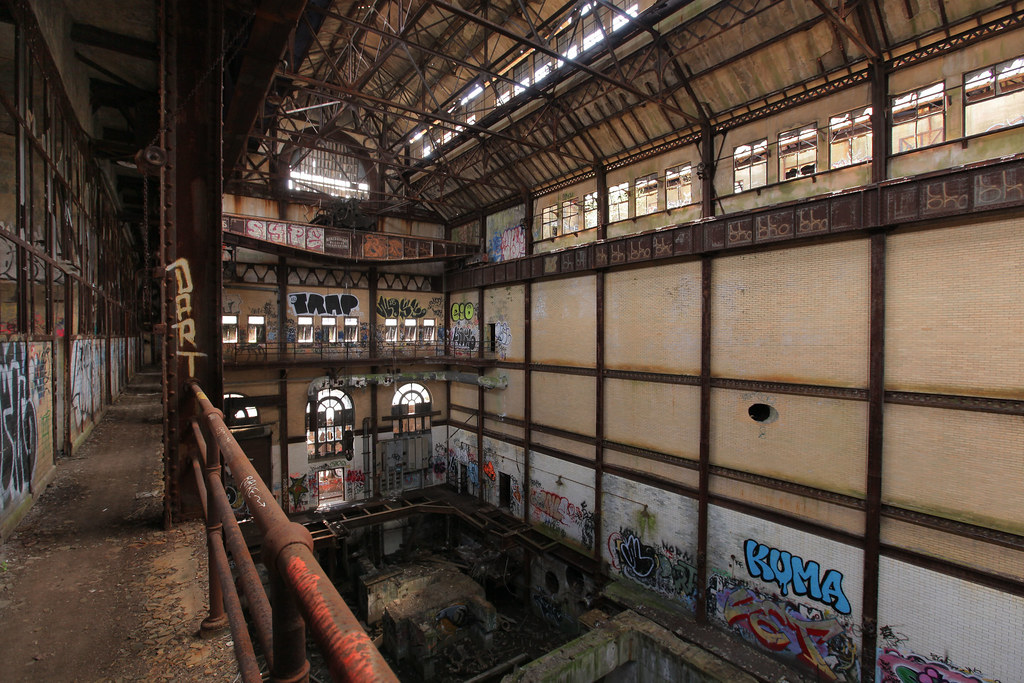
45 years later…
The Hudson River once delivered raw materials to the powerhouse, but now its waters collect in stagnant pools on the lowest level. Rust has consumed the factory from the inside out; in places, the corrosion is almost audible. Joints creak, bricks topple, ceilings drip, commingling with the constant suck of viscous mud underfoot. Most of the machinery was carried out long ago, leaving only a hulking shell rimmed with staircases, walkways, and ladders—harrowing paths to nowhere.

Avant-garde or artsy-fartsy? Aslop’s design for the station’s “preservation.”
Some of the rusted-through steps threaten to crumble at the slightest touch, giving way to a thousand foot drop through decaying metal that could land you muddied and bloodied on the swampy first floor. I can’t say it’s worth the risk, but the Grand Canyon views from the plant’s highest reaches can sure ease your mind after a nail-biting ascent. Photographers, urban explorers, and filmmakers flock here; it’s the grandeur in this decay that draws so many, and makes this place worth saving.
In 2008, Jim Bostic of the Yonkers Gang Prevention Coalition and councilwoman Patricia McDow alleged that the abandoned building was the site of brutal gang initiations, involving some 300 individuals at a time, where savage beatings and sexual deviancy took place on a shocking scale. They called for the immediate demolition of the Glenwood Power Station, referring to it by its well-established nickname, the “Gates of Hell.”

A flyer put out by McDow for a “townhouse” meeting. “Tear them down and build our children.”
The stories were thrilling, hysterical, and ultimately hard to believe. No evidence was found and no witness stepped forward that could verify the widely-publicized allegations, and the Yonkers Police Department denied having knowledge of any gang-related activities at the site.
The initiative gained the support of a number of locals, but many remained skeptical of McDow, who’s been criticized in the past for overlooking the rising tide of violent crime in her district. Demolishing this historic structure would have little to no effect on neighborhood violence, but as a symbolic gesture, it could appeal to voters.
The powerhouse was spared from the whims of city politics, but it’s technically still at risk; landmarking efforts have failed since a proposal was first put forth in 2005.
It’s been four years since the Glenwood Power Station made headlines as the “Gates of Hell,” but not much had changed there until recently. A new owner spruced up the grounds, removing overgrowth on the lot and clearing ivy from the buildings’ exteriors. It’s a sign of good things to come, though no plans for renovation have been released at this time.
I came to Yonkers a few months prior to the cleanup, unaware that the space had already been booked for a post-apocalyptic webseries shoot. The crew was friendly and professional, but their presence proved a distraction. As a buxom actress screamed “There’s no way out!” for the fifth time, the Yonkers Power Station was stripped of its mystery, seeming to wear its decay with reluctant resignation. Today, it’s a creepy backdrop for zombie films, the subject of gruesome rumors, but it was designed to inspire pride, not fear.
Sites like these are quickly becoming a contentious part of the post-industrial American landscape, scattered remnants of a period of enormous change—a revolution that’s led us, for better or worse, to where we are now. In Yonkers, one such building wades on the banks of the Hudson, its skeleton blushing to shades of orange. It’s an eyesore, a piece of history, and a community threat; also a nice spot to play hooky, take pictures, or build a shopping mall. No one can seem to agree on these “Gates.” So what the Hell should we do with them?
–Will Ellis
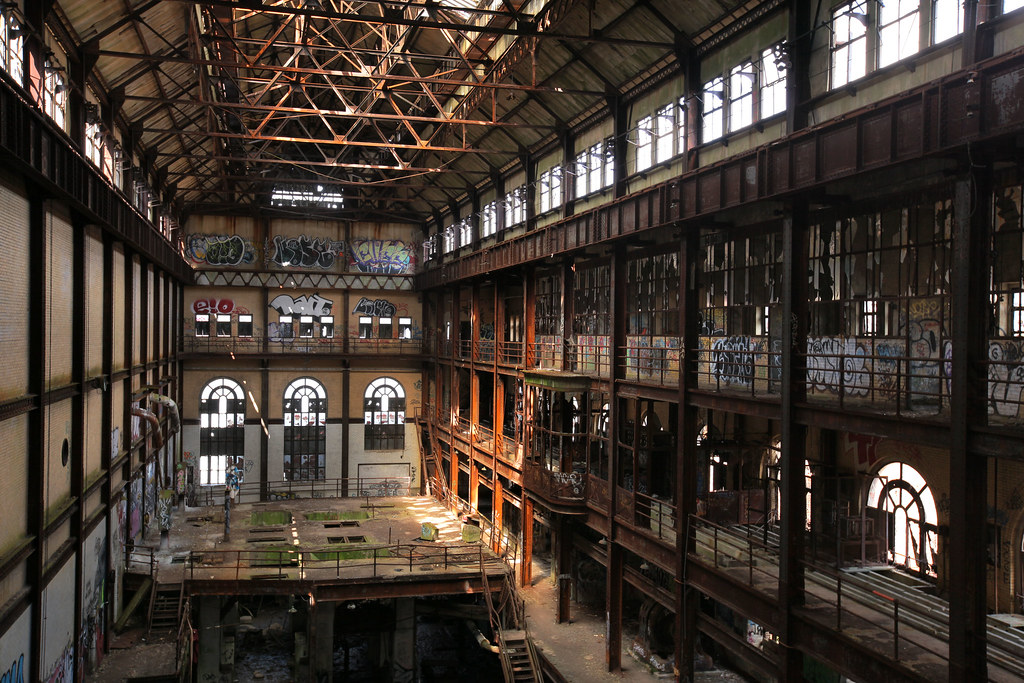
Photos can’t capture the jaw-dropping proportions of the place.
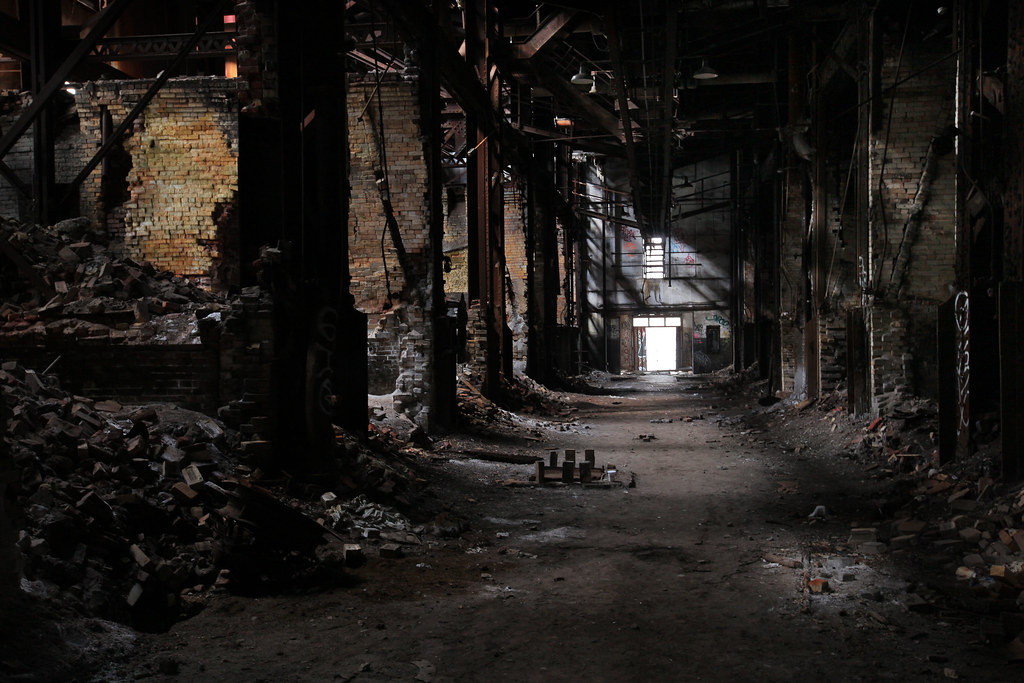
Walls reduced to rubble on the southern half of the generator building.
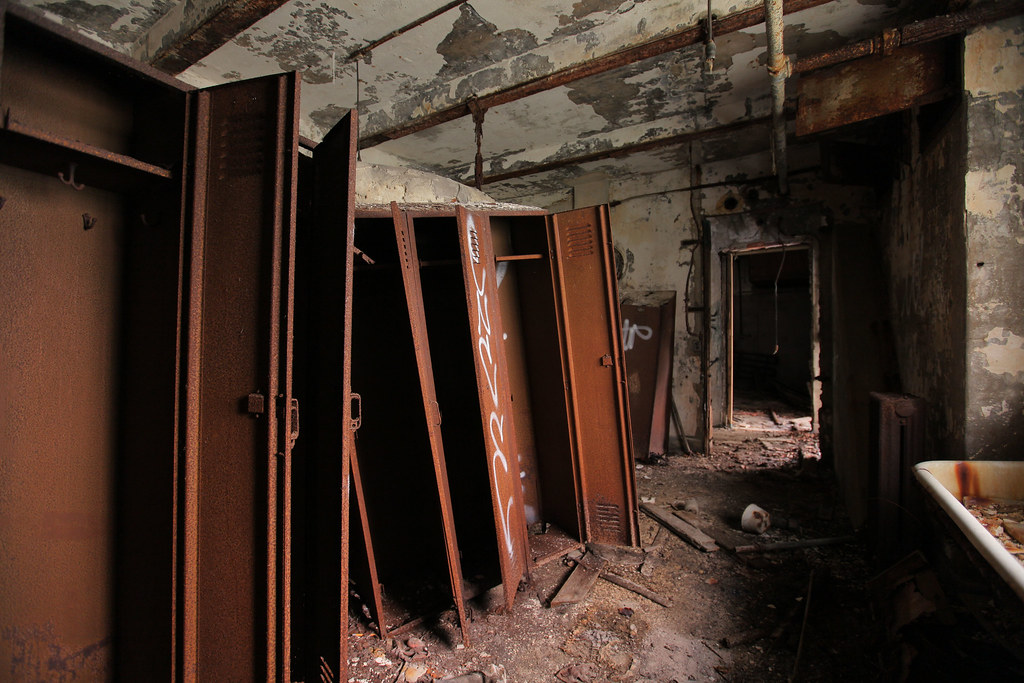
Lockers were the only hint at a human presence.

The switchboard/operating gallery overlooked the turbine room.
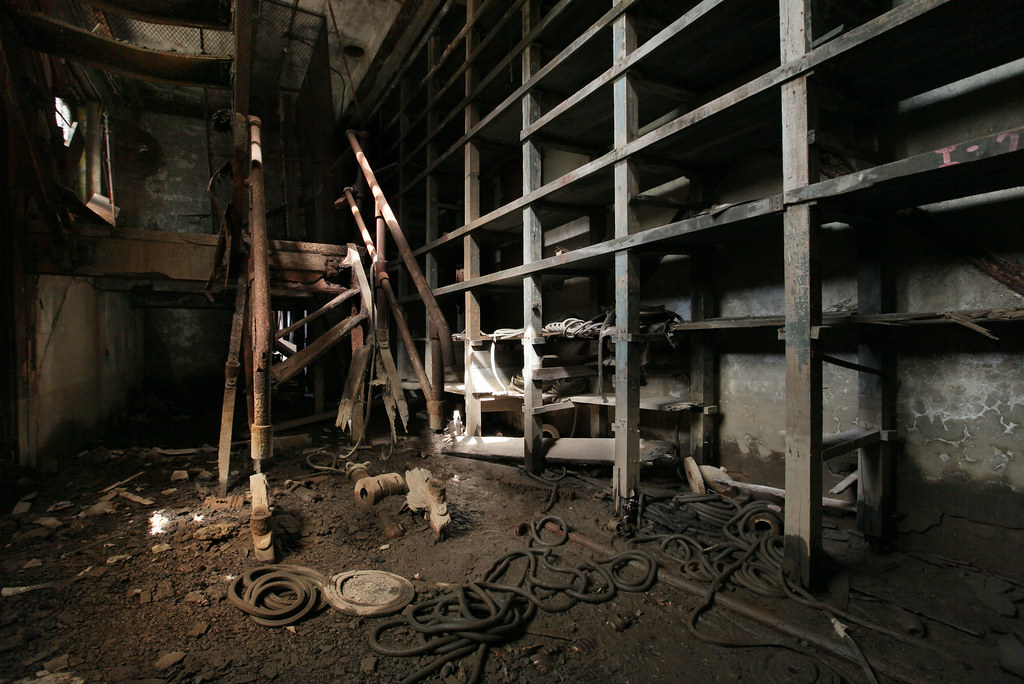
You’re off the train, but you’ve still gotta Watch the Gap on these staircases.

This basement room had the deepest water, anyone for a swim?
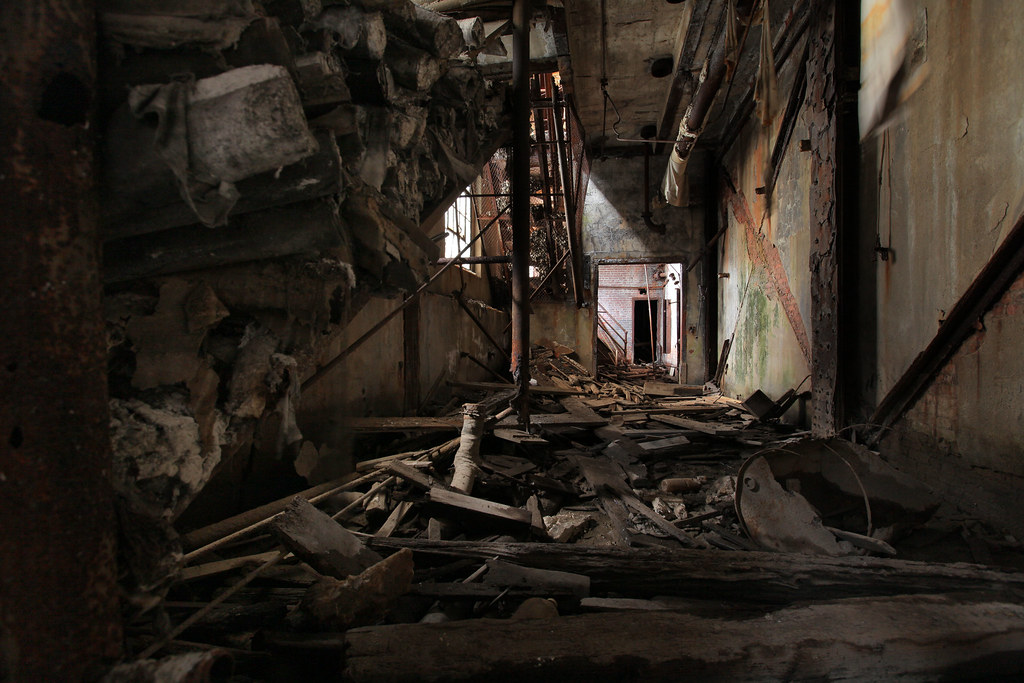
Continuing down the hallway. On the lower right, you can see a metal barrel that’s almost completely rusted through.

Turning a corner into a darkened vault, a row of valves.
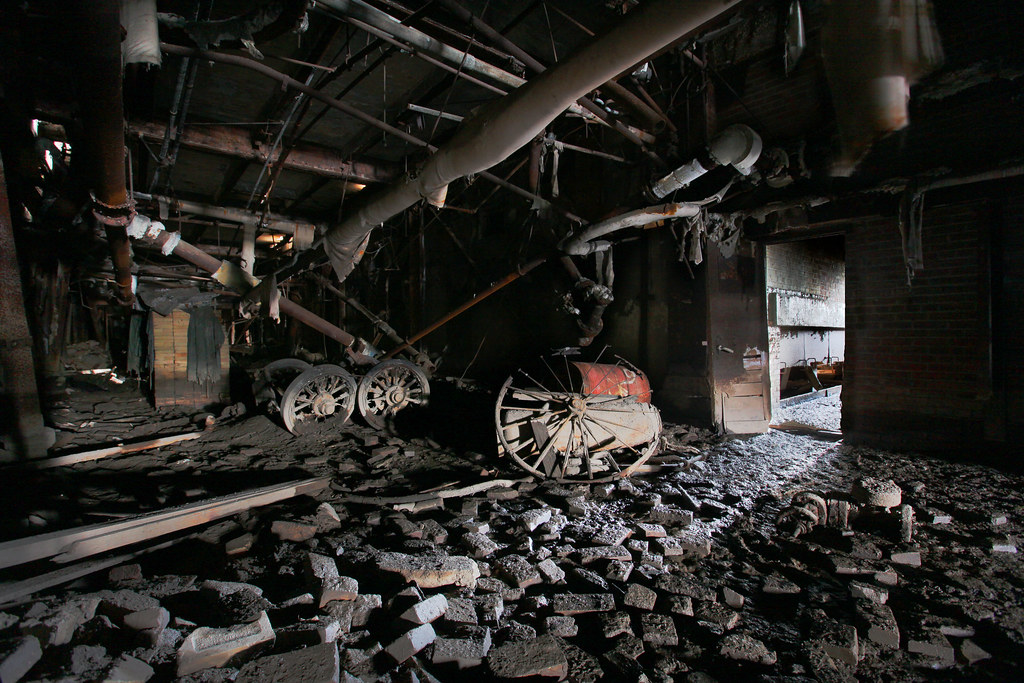
A bicycle wheel found in the deepest recesses of the powerhouse. The mud was thickest here.
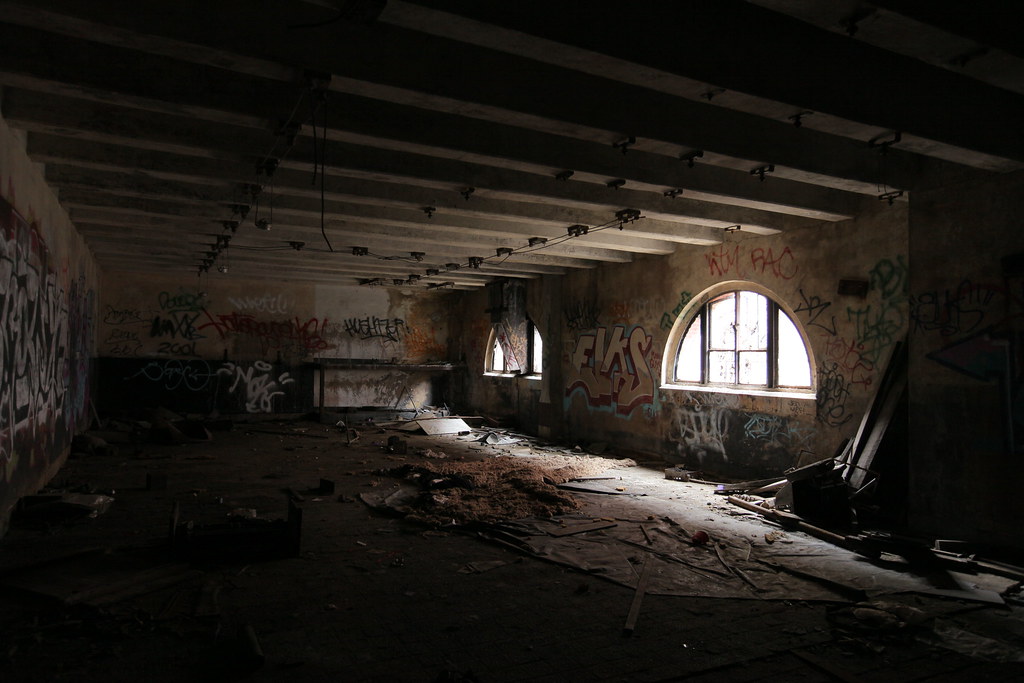
Not much to see in the site’s smaller substation building…
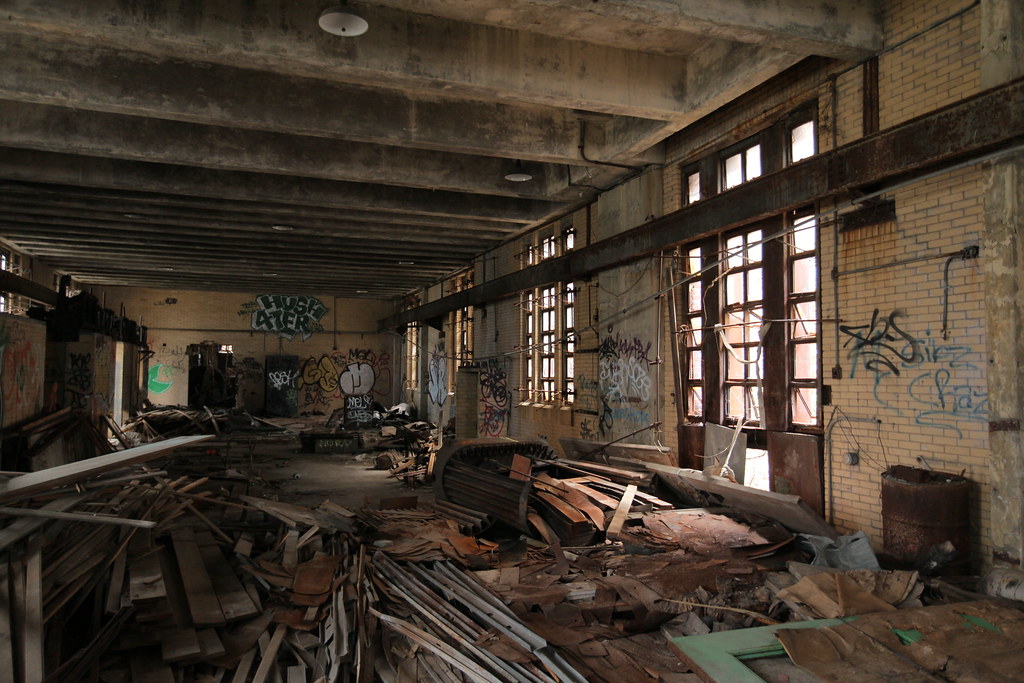
…though this floor was still filled with materials.

A view of the substation and the generating building’s iconic smokestacks.
Legend Tripping in Letchworth Village
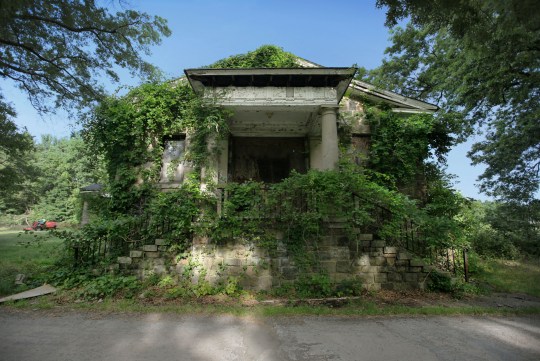
Ruins of Letchworth Village.
Letchworth Village rests on a placid corner of rural Thiells, a hamlet west of Haverstraw set amid the gentle hills and vales of the surrounding Ramapos. A short stretch of modest farmhouses separates this former home for the mentally disabled from the serene Harriman State Park, New York’s second largest. Nature has been quick to reclaim its dominion over these unhallowed grounds, shrouding an unpleasant memory in a thick green veil. Abandonment becomes this “village of secrets,” intended from its inception to be unseen, forgotten, and silent as the tomb.
Owing to its reputed paranormal eccentricities, Letchworth Village has become a well-known subject of local legend. These strange tales had me spooked as I turned the corner onto Letchworth Village Road after a suspenseful two-hour drive from Brooklyn. Rounding a declining bend, I caught my first glimpse of Letchworth’s sprawling decay—some vine-encumbered ruin made momentarily visible through a stand of oak. Down the hazy horseshoe lanes of the boy’s ward, one by one, the ghosts came out.
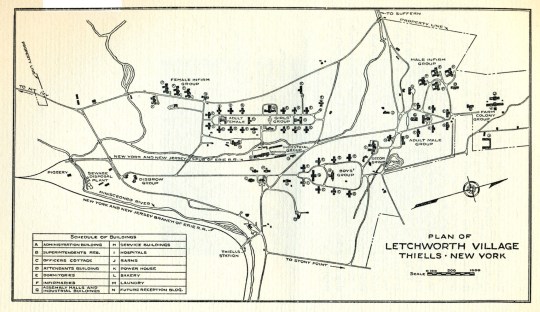
This map gives a sense of scale. Most of these buildings still stand, altered or abandoned.
By the end of 1911, the first phase of construction had completed on this 2,362 acre “state institution for the segregation of the epileptic and feeble-minded.” With architecture modeled after Monticello, the picturesque community was lauded as a model institution for the treatment of the developmentally disabled, a humane alternative to high-rise asylums, having been founded on several guiding principles that were revolutionary at the time.
The Minnisceongo Creek cuts the grounds in two, delineating areas for the two sexes which were meant never to mingle. Separate living and training facilities for children, able-bodied adults, and the infirm were not to exceed two stories or house over 70 inmates. Until the 1960s, the able-bodied labored on communal farms, raising enough food and livestock to feed the entire population.

1933 photo of Letchworth Village’s Girl’s Group
Sinister by today’s standards, the “laboratory purpose” was another essential tenet of the Letchworth plan. Unable to give or deny consent, many children became unwitting test subjects—in 1950, the institution gained notoriety as the site of one of the first human trials of a still-experimental polio vaccine. Brain specimens were harvested from deceased residents and stored in jars of formaldehyde, put on display in the hospital lab. This horrific practice has become a favorite anecdote of ghost-hunters and adolescent explorers.
The well-intentioned plans for Letchworth Village didn’t hold up in practice, and by 1942, the population had swelled to twice its intended occupancy. From here, the severely underfunded facility fell into a lengthy decline. Many of the residents, whose condition necessitated ample time and attention for feeding, became seriously ill or malnourished as a result of overcrowding. At one point, over 500 patients slept on mattresses in hallways and dayrooms of the facility, meagerly attended by a completely overwhelmed staff tasked with the impossible.
Having discontinued the use of the majority of its structures, and relocated most of its charges into group homes, the institution closed down in 1996 as old methods of segregating the developmentally disabled were replaced with a trend toward normalization and inclusion into society. The state has made efforts to sell the property, with mixed results. Most of the dilapidated structures were slated for demolition in 2004 to make way for a 450-unit condo development, but the plan has evidently been put on hold. Ringed with ballfields and parking lots, shiny Fieldstone Middle School makes use of nine buildings of the former girl’s group, an island of promise in a landscape of failure.
Off Call Hollow Road, a new sign has been erected pointing out the “Old Letchworth Village Cemetery.” Down a seldom-traveled path, an unusual crop of T-shaped markers congregate on a dappled clearing. They’re graves, but they bear no names.
Few wished to remember their “defective” relatives, or have their family names inscribed in such a dishonorable cemetery—many family secrets are buried among these 900 deceased. Here, in the presence of so many human lives devalued, displaced, and forgotten, the sorrow of Letchworth Village is keenly felt.
As part of a movement taking place across the country, state agencies and advocates funded the installation of a permanent plaque inscribed with the names of these silent dead, and a fitting epitaph: “To Those Who Shall Not Be Forgotten.”
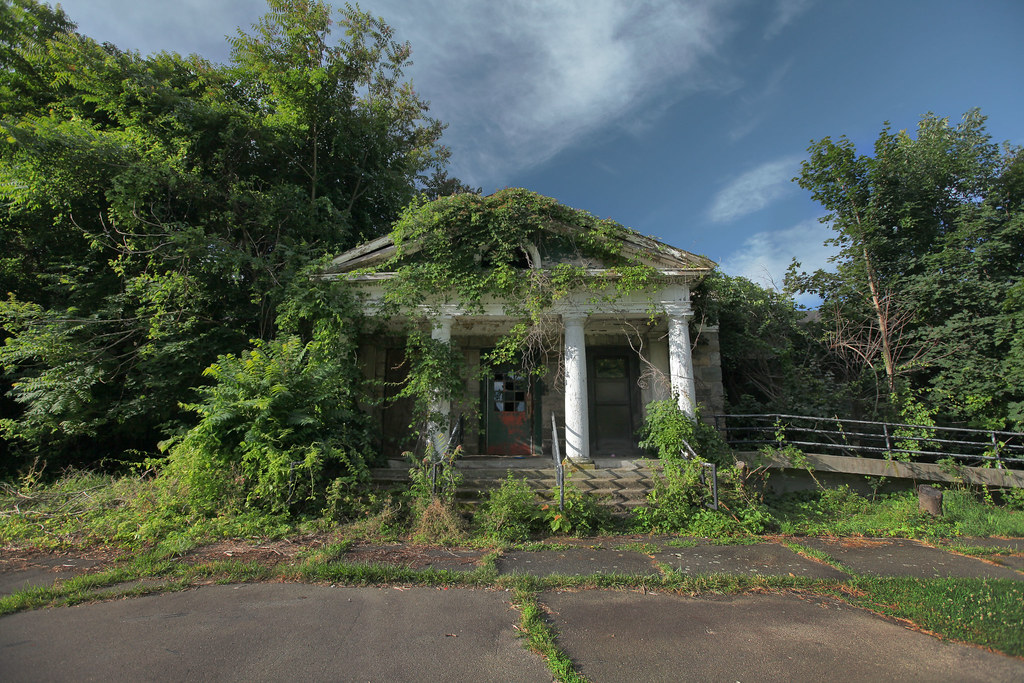
Each of the six groups of buildings included eight small dormitories.

The hospital, north of the boy’s group, is known as Letchworth Village’s most haunted building.

Evidence of last night’s joyride on the hospital lawn.
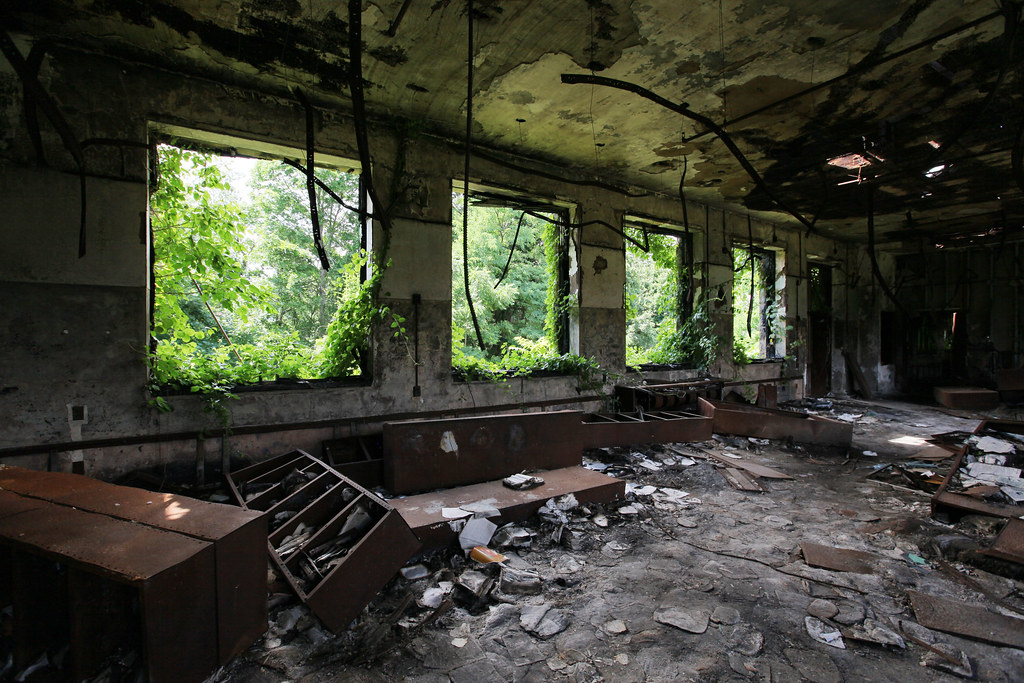
A dayroom library fueled the flames of an arson attempt.
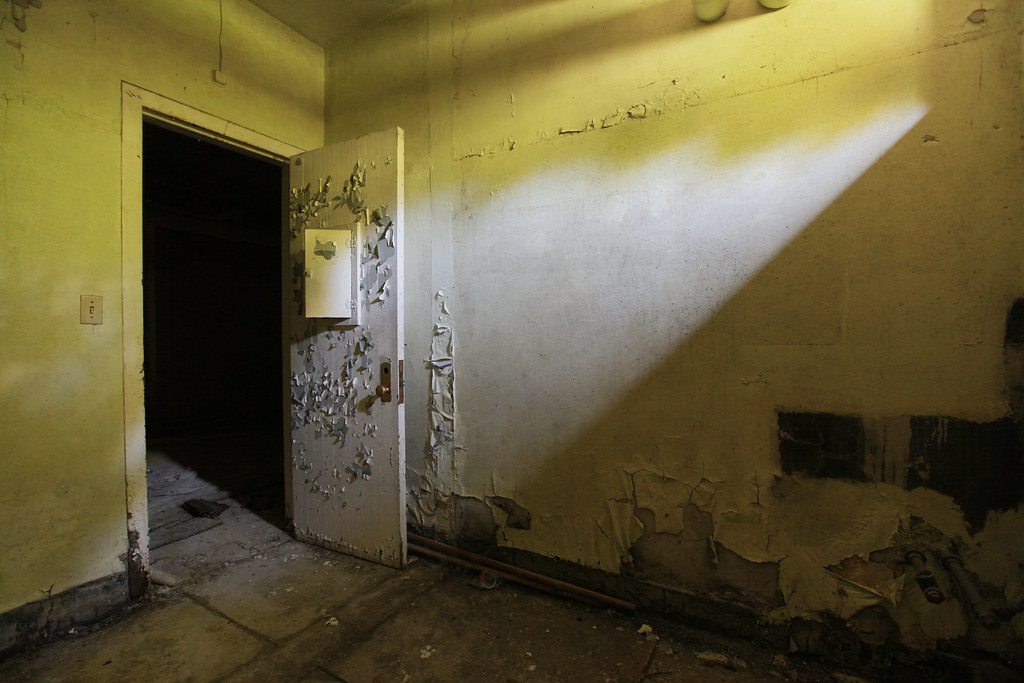
A small basement nook of unknown purpose, this was the only door of its kind.
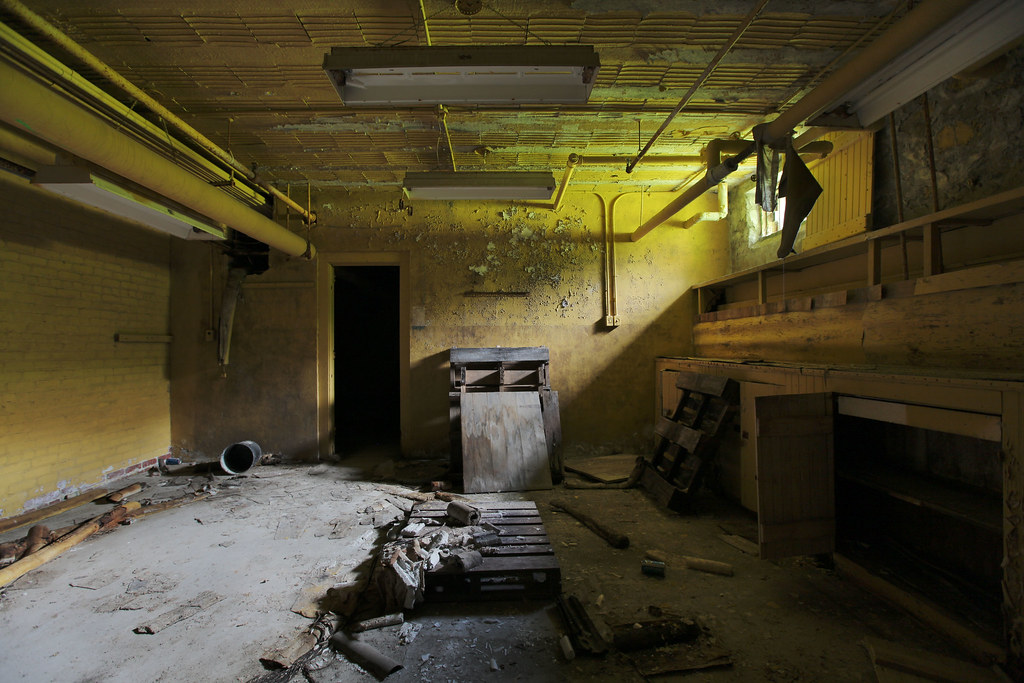
A storage area in the basement of Letchworth Village.
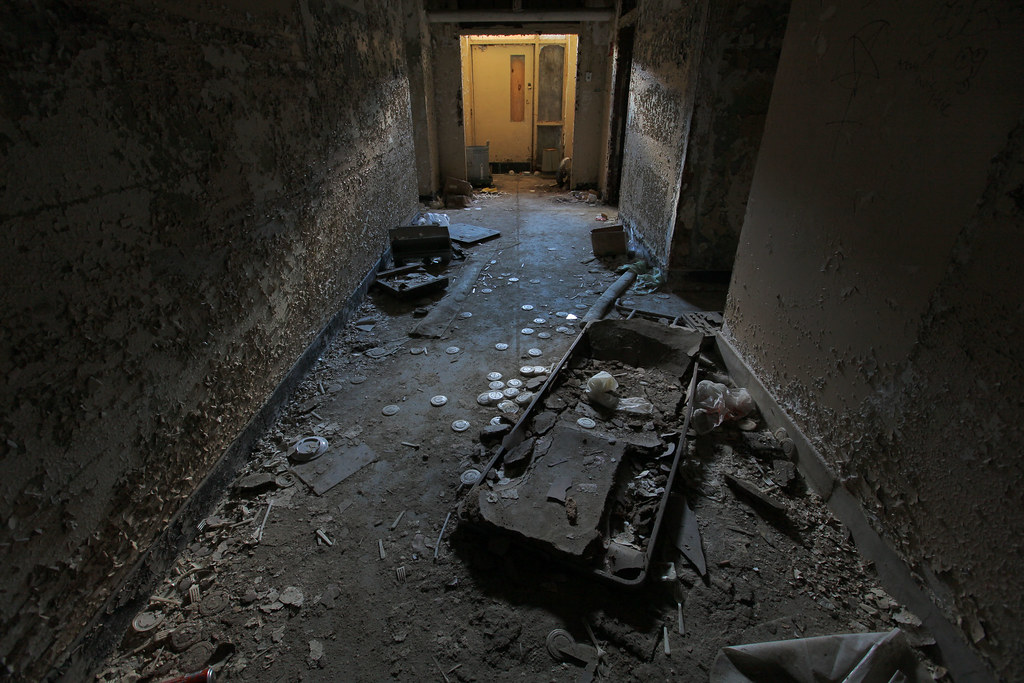
An adjacent room was filled with hospital plasticware, some overflowed into this darkened hallway.

A renegade paintball game left a gruesome mark on this room.
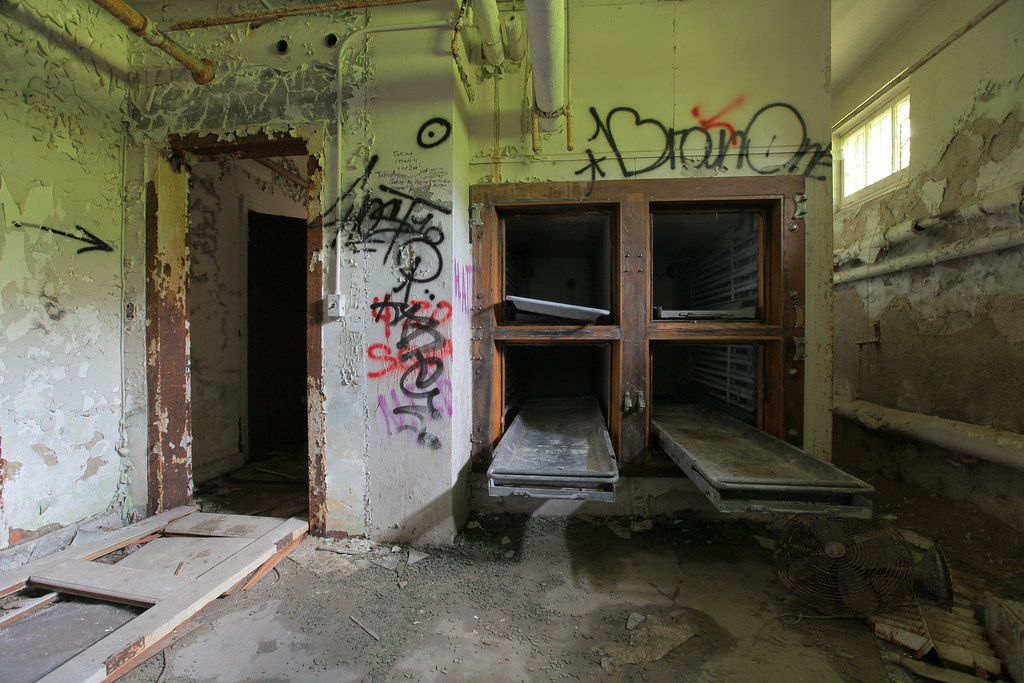
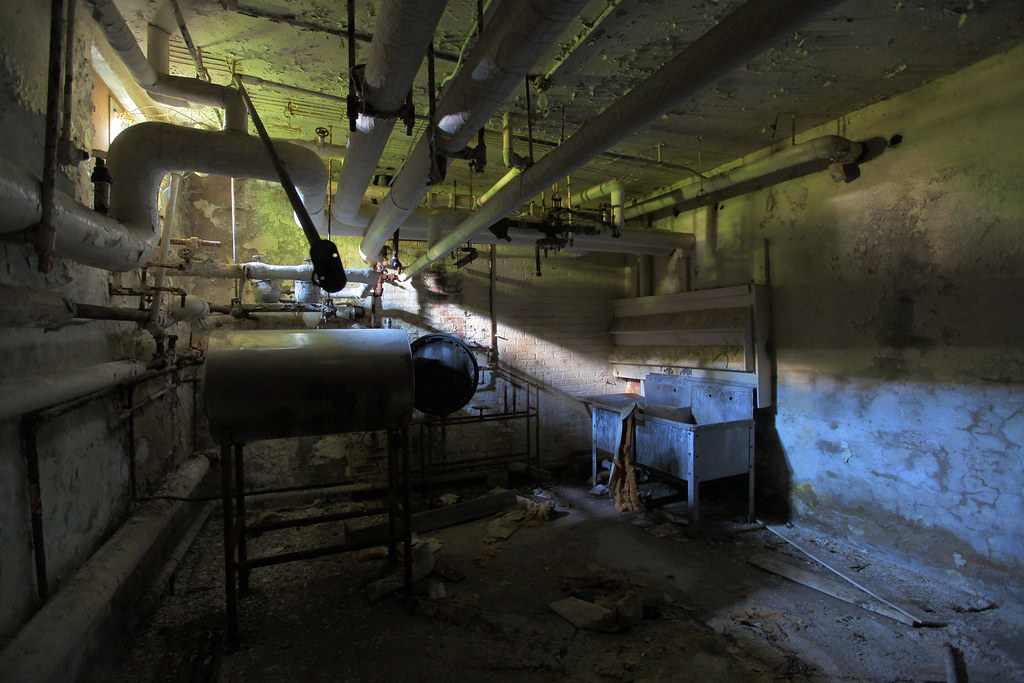
Cold storage. The first room I came across in Letchworth Village, a morbid introduction.
Moments after taking this photo, a group of young explorers entered through a side door. I gave them quite a scare.
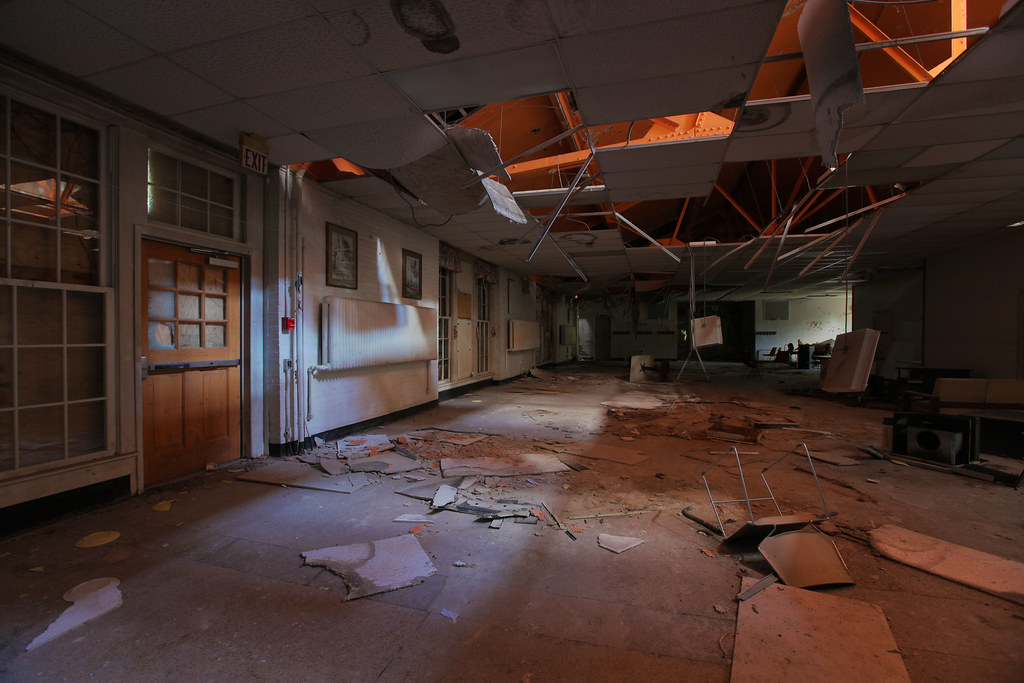
A dining hall is brought to light as its ceiling crumbles.
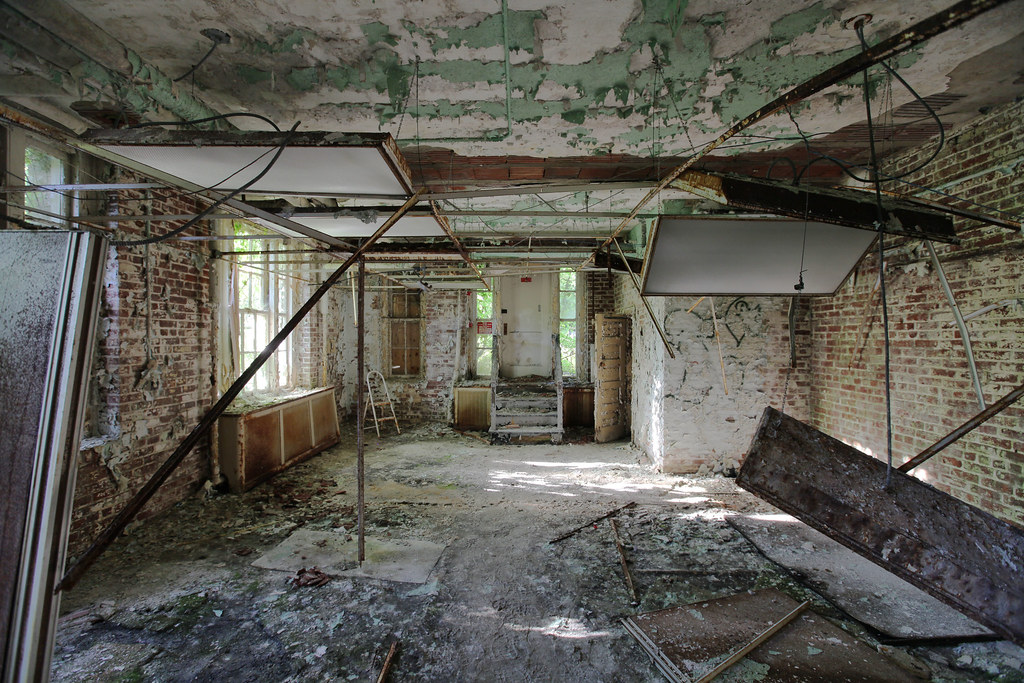
The top floor of Stewart Hall has been thoroughly razed, but the bottom remains mostly intact.
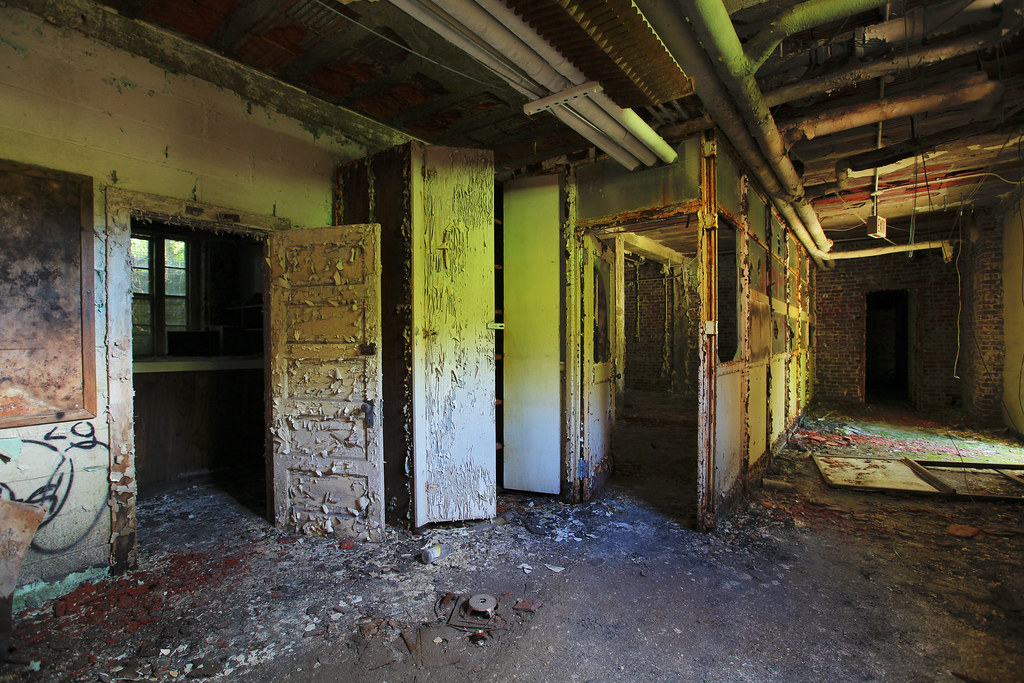
Fire damage visible on the lower floor.
A strange camera malfunction lasted the entire time I was in this building and stopped the moment I stepped out. It’s the closest I came to a paranormal experience.
Many of the cheaply made service buildings were in a similar state.

Even in broad daylight, the place is eerie. Here, an ominous administration building.

Better late than never, a monument to Letchworth’s dead.
Inside Harlem’s P.S. 186
Dawn breaks in a crumbling classroom.
School’s out forever; at least at P.S. 186. This aging beauty has loomed over West Harlem’s 145th Street for 111 years—but it’s been vacant exactly a third of that time. The Italian Renaissance structure was considered dilapidated when it shuttered 37 years ago, and today its interiors feel more sepulchral than scholastic.

Nature reclaims the school’s top floor.
Windows gape on four of its five stories, exposing classrooms to a barrage of elements. Spongy wood flooring, wafer-thin in spots, supports a profusion of weeds. Adolescent saplings reach upward through skylights and arch through windows. They’re stripped of their foliage on this unseasonably warm February morning, lending an atmosphere of melancholy to an already gloomy interior. Infused with an odor not unlike an antiquarian book collection, upper floors harbor a population of hundreds of mummified pigeon carcasses—the overall effect is grim. You’d never guess this building had an owner, but sure enough…
The site was purchased in 1986 by the nonprofit Boys and Girls Club of Harlem for $215,000 under the condition that new development would be completed within three years. After several decades of inactivity, the group introduced a redevelopment plan that called for the demolition of P.S. 186 and the construction of a 200,000 sq. ft. mixed-use facility with affordable housing, commercial and community space, and a new public school…
News of the school’s demolition mobilized area residents to save the structure. A series of local petitions and letter-writing campaigns championed the preservation of P.S. 186, and gained the support of the New York Landmarks Conservancy, though a landmark bid was blocked at a 2010 community board meeting. At the time, owners insisted that rehabilitating the decrepit building was a financial impossibility.
In a surprising turn of events, the BGCH recently downsized the plan in favor of preservation. The school will be renovated into 90 units of affordable housing and a new Boys and Girls Club.
It’s a rare victory for preservationists, and an unlikely one given the school’s history—when the building was last in use, community members wanted nothing more than to see the place razed.

From the New York Times Archives, NEGRO officials take over P.S. 186.
In addition to generally run-down conditions, safety became a major concern at P.S. 186 in its final years. The H-shaped design allegedly had the potential to trap “hundreds of children and teachers” in the event of a fire. Doors on the bottom floor were to remain open at all times to keep the outdated floor plan up to code, leaving the building completely vulnerable to neighborhood crime.
According to the school’s principal at the time, “parents have been robbed in here at knife point, and people…use this building as a through-way.” In a 1972 incident, two youths, including the 17-year-old brother of a 5-year-old P.S. 186 student, broke into room 407 and raped a teacher’s aide at gunpoint.
Increasing community concern reached a boiling point earlier that year when 60 members of the African American empowerment group NEGRO (National Economic Growth and Reconstruction Organization) moved into the school to call for an evacuation of 600 students on the top three floors.
The stunt caught the attention of the Fire Department, who toured the school later that week. A deputy chief “didn’t see any real hazardous problem,” but was forced to evacuate the remaining 900 students when he was unable to activate the fire alarm. Inspectors discovered that wires leading out of the alarm system had been cut, although a school custodian claimed that the alarm system had worked during a routine test at 7:30 that morning.
By 1975, funding was at last approved for a replacement school, and much to the relief of parents, plans were put in place for the immediate demolition of the aging fire trap. Who could predict that thirty-seven years later P.S. 186 would be getting a second chance?

The ground floor.
A few decades ago, this school was described as “antiquated,” “unsafe,” and “plain,” but today, it’s called “historic,” “magnificent,” and “beautifully designed.” This reversal illustrates the complex relationship we New Yorkers have with our buildings, and begs the question: what might the the thousands of old structures we see torn down every year have meant to us in a century?
It’s been a few months since I’ve set foot in the building, and today the visit feels like a half-remembered dream.
To keep vagrants out, cinderblocks had been installed in almost every window and door of the bottom floor. It looked too dark to shoot—but as my eyes started to adjust, I saw that light was finding its way in. Through every masonry crack and plaster aperture, bands of color projected onto decaying classrooms, vibrant variations on a pinhole camera effect. Past a vault inexplicably filled with tree limbs, a hall of camera obscuras each hosting an optical phenomenon more bewitching than the last. P.S. 186 is largely considered an eyesore in its current state, but who could deny that its interior is a thing of beauty?
However photogenic, this decay does little good for its underserved community—it’s the sort of oddity this city doesn’t have room for. Here’s a look inside, before we turn the page on what’s destined to be the most colorful chapter in the controversial, and continuing, history of this unofficial Harlem landmark.
-Will Ellis

Decaying seats in the auditorium.
The view from center stage.
Behind flaking slate chalkboards, pencilled measurements dating to their original installation in the early 1900s.

Buckling floors in this classroom were in relatively good condition.

…Some areas of the top floor nurtured a fledgling arboretum.

The damaging effects of water put on display in a weedy gymnasium.
An exit still clearly marked.
One of hundreds of pigeon carcasses found throughout the building.

From the entrance.

View of the east wing.

A ravaged classroom on the top floor..
…and an identical room 5 stories down.
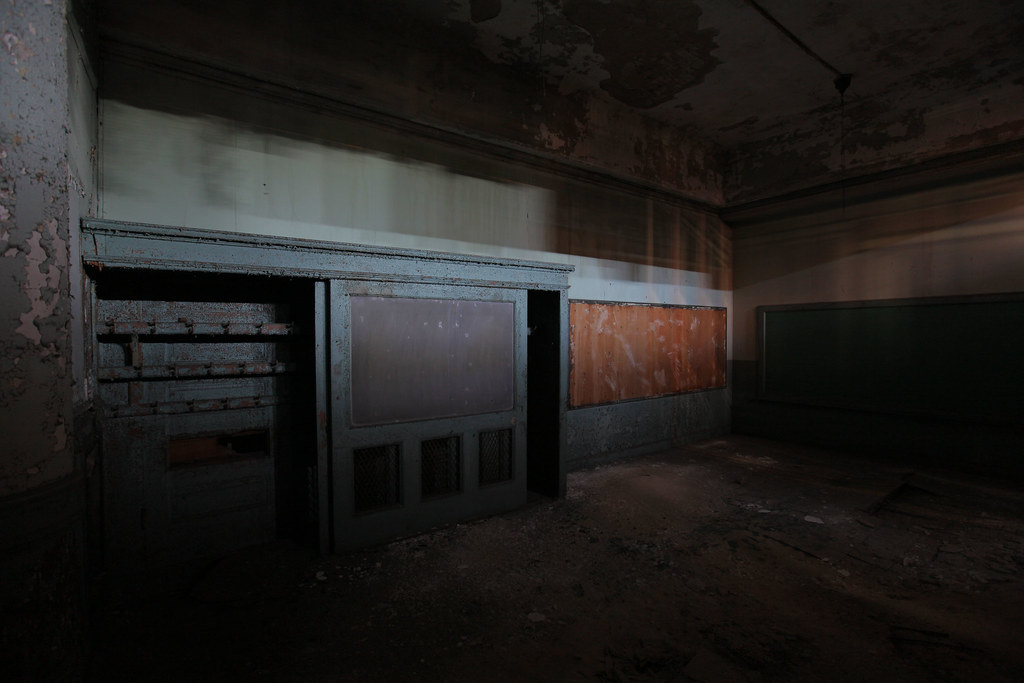
Ominous light on the bottom floor of P.S. 186.

A certain slant of light gives this room the look of an unholy nativity.

Rubble collects on the ground floor.
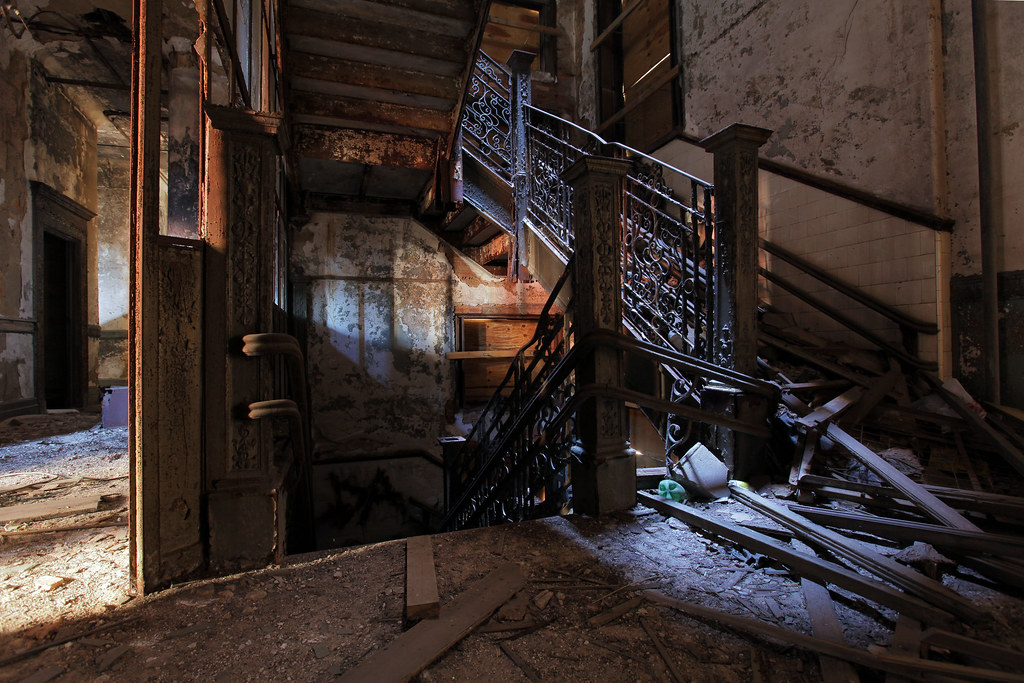
Blue skies reflect three stories down onto a grand staircase littered with debris.
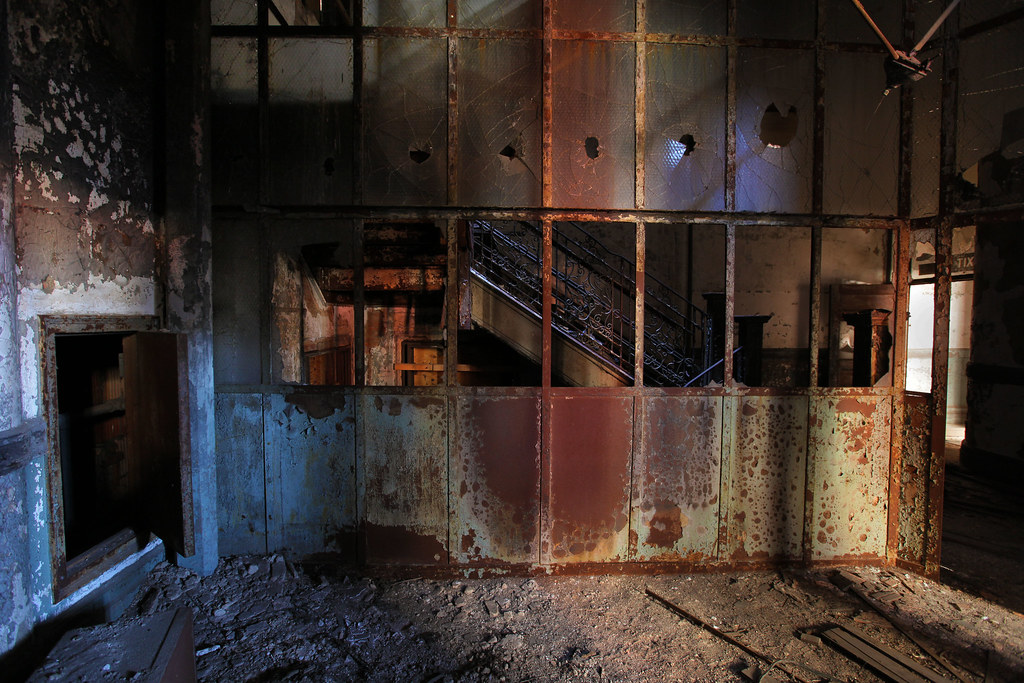
A Rainbow in Harlem.
Inside Fort Totten: Part 1
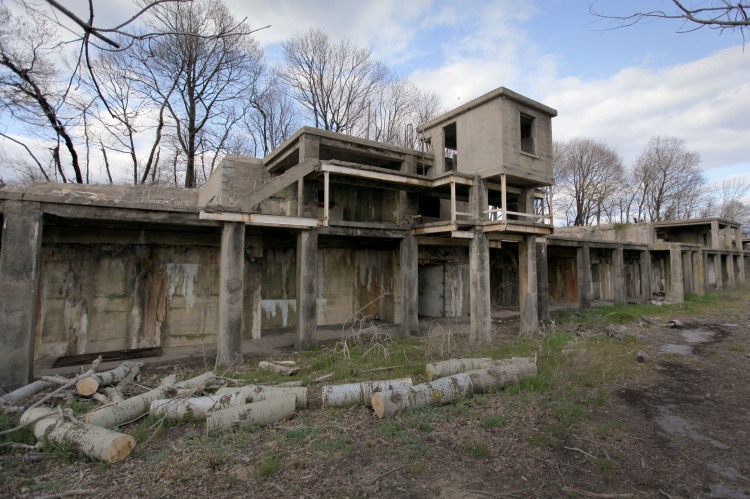
An abandoned battery at Fort Totten
Fort Totten sits on a far-flung peninsula of the Long Island Sound, forming the Northeast corner of Queens. The grounds of this defunct military installation turned underfunded public park are home to over 100 historic buildings representing a series of changes that have taken place over the area’s quiet 200 year history. Unfortunately, the majority of these stuctures have been disused for decades, and many are in a state of progressive collapse. With so much of Fort Totten closed off with caution tape, overtaken with vines, or hidden beneath rusty fences, it makes for an unconventional park, but a fascinating place to wander.
An 1829 farmhouse predating the land’s military use crumbles behind a weedy barricade; out front, a prominent sign bears the inscription: “Please Excuse My Appearance, I am a Candidate for Historical Preservation.” It’s an image that typifies the current state of affairs in the Fort Totten Historic District.
On the northern tip of Willet’s Point, a monumental granite fortification constructed during the Civil War as a key component of the defense of the New York Harbor sits unoccupied, though it’s used as a haunted house on occasion. Clustered on the rest of the grounds, dozens of dilapidated Romanesque Revival and Queen Anne Style officers’ quarters, hospitals, bakeries, movie theatres, and laboratories vie for restoration, but so far the funding has failed to materialize.

The Willet Farmhouse, Fort Totten’s oldest structure, and one of the most at risk.
One such building, a two-story YMCA facility built in 1926, has been abandoned for close to 20 years, but much of what’s left behind lies undisturbed. On a bulletin board in an upstairs landing, a 1995 thank-you letter from a kindergarten class at PS 201 hangs by a crude depiction of Santa Claus, both lovingly dedicated to an Officer Rivera. Steps away, in a rotting book room, an incongruous stash of 80s porno magazines.
Most recently used as a community relations unit of the New York City Police Department, the building is cluttered with mattresses, discarded packaging, and unopened toy donations. The New York City Fire Department, which now operates training facilities in a renovation abutting the hospital building, currently uses the attached gymnasium as a storage space. The basement was filled with rusted-through shelving and ruined equipment, flooded and too dark to shoot.

An overgrown pit in a World War I battery.
On the other side of the peninsula, a series of concrete batteries sit half-submerged in plant life. These were constructed at the turn of the century, but by 1938, they were declared obsolete and subsequently abandoned. The boxy design looks like modern architecture to me, but the battery reveals its true age in other ways.
Pencil-thin stalactites ornament the ceiling wherever the rain gets in, suspended over a crank-operated machine designed to lift heavy weaponry a century ago. The network of maze-like tunnels feature arched hallways with metal doors, winding staircases, and yawning pits, all fit for a dungeon. Guards stationed at the fort were laid off in 2009, and it was unclear on my visit if the area was open to the public or not. A rusty barrier, more hole than fence, didn’t keep out a couple of high school kids, but offered a spot for them to park their bikes.
When the military base changed hands in 2005 and became an official New York City Park, Bloomberg predicted that Fort Totten was “certain to become one of New York’s most popular parks.” Some community members feared that the estimated 450,000 yearly visitors would disrupt parking, increase crime, and change the face of the neighborhood, but ten years later, tourism has yet to pose a problem.
Fort Totten hasn’t lived up to its potential just yet, but the progress that has been made gives hope for improvements to come. The park now offers regular events and educational programs to draw visitors and enrich the surrounding community. Several nonprofit groups have occupied and renovated the decrepit buildings, including the landmarked Officers’ Club, which now serves the Bayside Historical Society as an educational facility and exhibition and event space. These are small but significant victories in the effort to save the historic legacy of a little-known plot that could be the crown jewel of Queens parkland.
(Though in some cases, it may be too little, too late. One look inside the profoundly decayed Fort Totten Army Hospital, in Part 2 of this post, will assure you of that.)
-Will Ellis
Related Links:
- Fort Totten Historic District Designation Report
- Fort Totten History from the Bayside Historical Society
- NYTimes 1999 “Fort Totten’s Old Houses are Tottering”
- NYTimes 2003 “Nearer to a Fort Totten Park but Not to a Consensus”
- Scouting NY—A Snowy Day at Fort Totten

This obscure Queens park doubles as a ghost town.
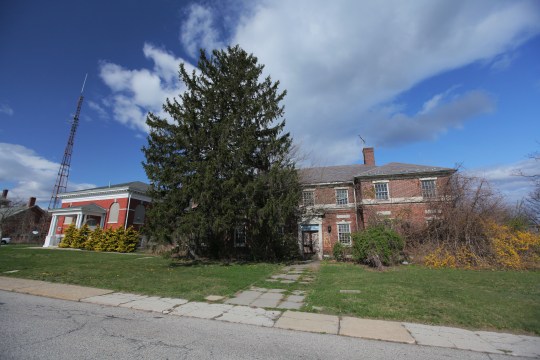
The YMCA building partially obscured by monstrous vegetation. On the left, a new renovation.

Inside, a rusty scale abandoned in the lobby.

An emptied snack bar once served concessions at sporting events and amateur theatre.

A community kitchenette still held pots, pans, and complete place settings.

A bulletin board on the second floor that hadn’t been updated in 17 years.

This room must have provided temporary housing to minors. The floor was littered with clothing and old English projects.

In the opposite corner, a derelict dollhouse. If I had been in the Twilight Zone, I’d have found a miniature me in there.

The remains of a rotting book room, which also housed a store of nudie magazines.

Through the library, a crumbling projection room overlooking the YMCA gymnatorium.

Daylight spills onto the practical planes of an underground battery.

Other areas had vaulted ceilings and arched double doors.

The interiors were almost completely empty, except for a dusting of dirt and leaf litter.

Some rooms held a few remnants…

Like this one: 100-year-old machinery in a dark Fort Totten nook.
Top Posts & Pages


 AbandonedNYC