AbandonedNYC
Abandoned
Houdini’s Grave, in NYC’s Spookiest Cemetery
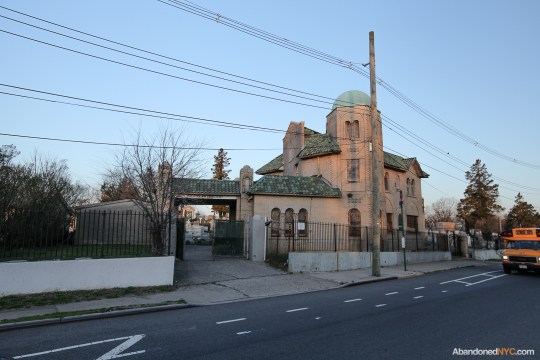
Are we in Queens or Salem’s Lot?
If you pass by a graveyard on the Jackie Robinson Parkway, don’t hold your breath. You’ve got two and half miles of Queens’ Cemetery Belt ahead of you, a burial ground so vast it’s supposedly visible from space. Surrounded on all sides by an ocean of headstones, the modest Machpelah Cemetery makes up only a small fraction of the sprawling necropolis, but its arguably the creepiest graveyard in the city…
Cramped centenarian tombstones muster in rows on the hilly plot—the place is rundown and deserted, but one grave is consistently well-maintained. It’s the monument of Machpelah’s most famous resident, master escape artist Harry Houdini. Only steps from the headstone lurks an eerie cemetery office, abandoned since the late 80s. The cemetery is a dream destination for graveyard ghouls on a chilly October night, especially since Halloween marks the anniversary of Houdini’s untimely death.
The history of the Cemetery Belt can be traced back to the Rural Cemeteries Act of 1847, under which cemeteries became a legitimate commercial enterprise for the first time in New York. Non-profit organizations were authorized to buy up land and sell plots to individuals, replacing the traditional practice of burying the deceased in churchyards and private property.

Conditions at Bayside-Acacia are still less than ideal.
Areas of then-rural Queens quickly became concentrated with new cemetery holdings. A stipulation of the act limited the acreage of land an organization could purchase in a given county, but church groups and land speculators got around this by buying up neighboring plots on the Brooklyn-Queens border, forming the region now known as the Cemetery Belt.
Between 1832 and 1849, a series of cholera outbreaks thoroughly exhausted Manhattan’s remaining burial sites. The common belief at the time was that ground water could become contaminated with the disease when infected corpses were exposed to the soil. As a result, all burials were prohibited on the island of Manhattan in 1852.
As the population swelled, new developments, including the Brooklyn Bridge, often required the displacement of grave sites. Manhattan started evicting its dead people, and sending them to western Queens—tens of thousands of deceased were disinterred and transported to mass graves in the Cemetery Belt. These ghoulish dealings were kept away from the public eye, often carried out in the dead of night.
Today, Queens’ five million “permanent residents” almost triple its living population, but their numbers are at a standstill. Most of these cemeteries reached capacity long ago, leaving many without a source of income. As a result, some have fallen into disrepair, with officials failing to provide the “perpetual care” their patrons are rightfully owed.
At the nearby Bayside Cemetery, conditions were downright shameful, and hair-raising—exposed human remains were identified at several of the overgrown grave sites. Community pressure, litigation, and the effort of volunteers have gotten the place cleaned up, albeit in a cursory fashion. Gaping mausoleums have been closed off with cinderblocks and boards.
At Machpelah, the plots are untidy, but not nearly as egregious as the Bayside grounds. The cemetery’s decline is most apparent in its ramshackle office building. The boarded-up structure is dilapidated now, but its architecture, dating to 1928, continues to impress on the surface.
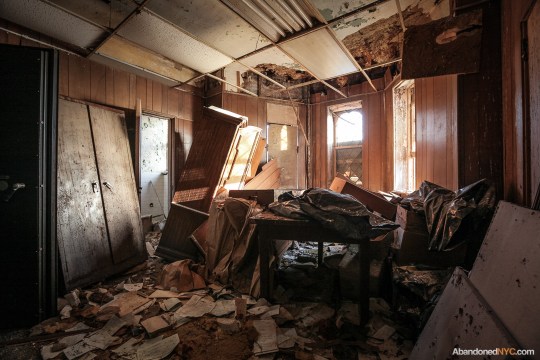
Burial records litter the floor of the Machpelah Cemetery office.
Any semblance of grandeur breaks down on the inside. The striking arched windows visible in the facade are installed in rectangular frames, and their diamond panes are all artifice. The skeleton of a drop ceiling hangs askew, with most panels collapsed and reduced to a yellow paste that covers the ground. The office has apparently fallen victim to vandals over the years, furniture and safe deposit boxes have been ransacked, old burial records lie scattered in the grime. Anything of value has been removed, but a coin bank souvenir from the 1939 New York World’s Fair remains, its most recent deposits dating back to 1988.
“Stuffy” doesn’t begin to describe its suffocating ether. Reception rooms are boxed in with cheap wood paneling, which combines with the dizzying funk of mildew to evoke the interior of a coffin. Secluded in a cockeyed armoire, Nosferatu could feel right at home here.
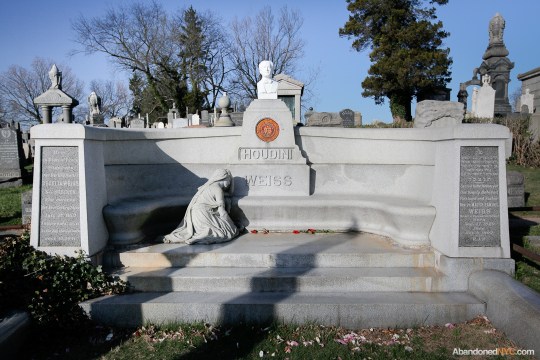
Red roses wilt on Houdini’s grave.
Every Halloween, hundreds of devotees make the yearly pilgrimage to Houdini’s final resting place to pay their respects, party, and make an offering—around the anniversary of his death, pumpkins, broomsticks, and playing cards mount like a cairn on his headstone.
The Society of American Magicians, for which Houdini served as president until his death, was the official caretaker of the site until recently. Between 1975 and 1993, the bust that adorns the Houdini monument was stolen or destroyed four times—it’s thought to be the only graven image in any Jewish Cemetery.
For many years, the likeness was only brought out for yearly ceremonies, but in 2011, a group of magicians from the Scranton Houdini Museum engaged in some guerrilla restoration, installing a new bust with the blessing of Houdini’s family. The group has since taken over responsibilities for the site’s care, and so far the monument remains unscathed.
With no funds to reoccupy, renovate, or demolish the old office building, its likely to stand until it falls down on its own; the same can’t be said of Houdini’s shiny new effigy. Odds are he’ll lose his head again—even though it’s screwed on. So next time you’re traveling down that graveyard highway, be sure to stop by for a look while you can. There’s no need to wait for the witching hour. At Machpelah Cemetery, the gate is always open, and every day is Halloween.
UPDATE: The office was demolished on August 21st, 2013.
-Will Ellis
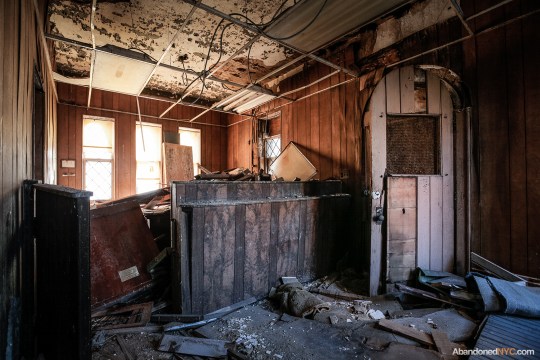
The lobby, with a distinctive arched doorway, bathed in golden morning light.
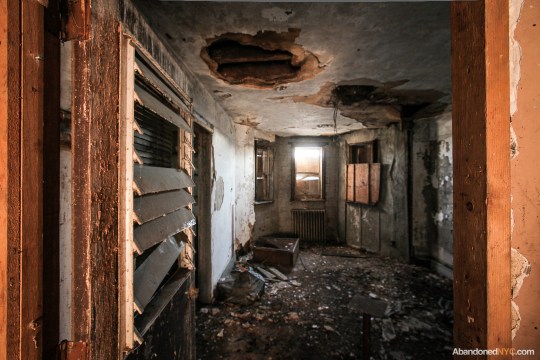
The second floor.
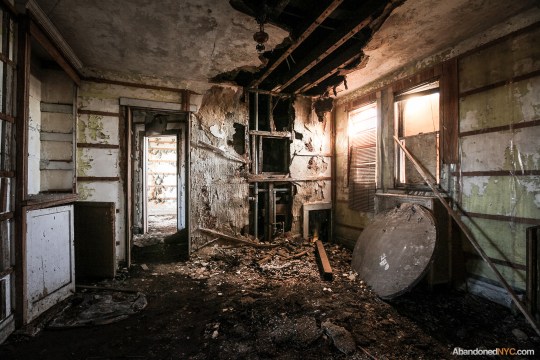
Valuable copper pipes were removed from the upstairs.
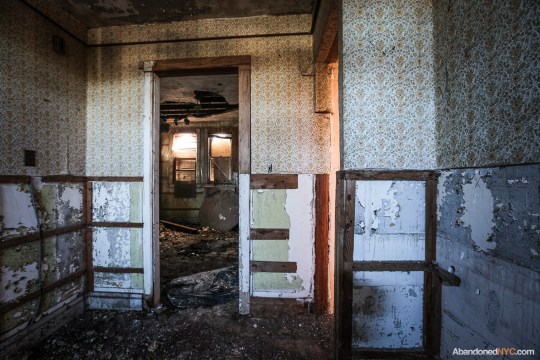
Several rooms feature vintage wallpaper, but wood paneling had been removed.
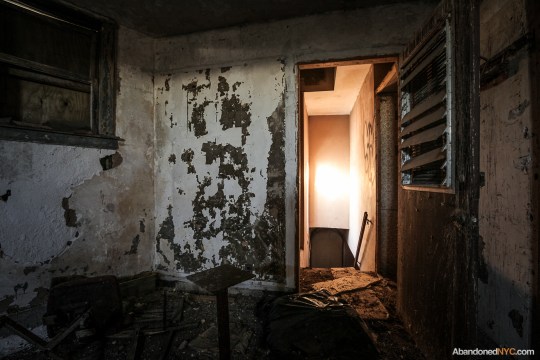
Sunlight illuminates a stairwell.
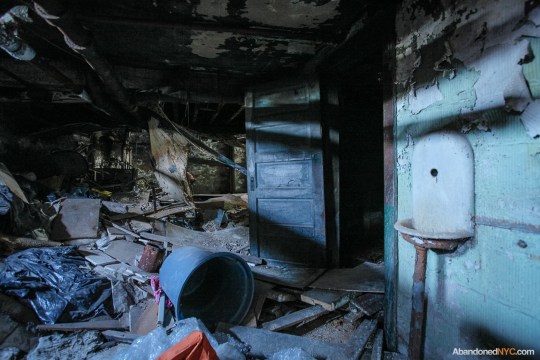
A forbidding basement. The structure could only be accessed through a narrow opening that led to this room.
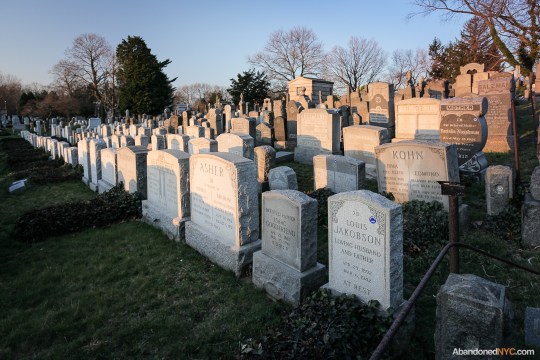
No vacancy.
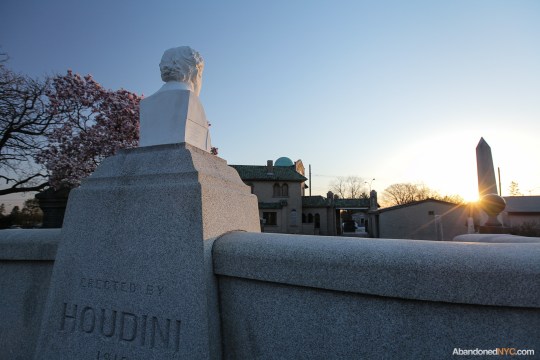
Dawn breaks on Houdini’s grave.
In Gowanus’ Batcave, Broken Teenage Dreams Live on

Not long ago, a pack of teenage runaways lived the dream in Gowanus’ infamous Batcave, shacking up rent-free in an abandoned MTA powerhouse on the shore of the notoriously toxic Gowanus Canal. Out of the grime, in back rooms and crooked halls, the artifacts of this sizable squatter settlement remain to enlighten, amuse, and unnerve the intrepid few that enter the disreputable interior.

You wouldn’t expect to find Superman string art in the Batcave.
The old Central Power Station of the Brooklyn Rapid Transit Company was built in 1896 to serve a rapidly expanding subway system in the outer boroughs, positioned on the banks of the Gowanus Canal to ensure an efficient intake of coal to power an arsenal of 32 boilers and eight 4,000 horsepower steam-driven generators. The plant’s technology couldn’t keep up with the times, and after a brief second life as a paper recycling plant, the powerhouse was abandoned. Today, it’s more commonly known as the “Batcave,” supposedly named for the creatures that once congregated in its broken-down ceiling.
In the early 2000s, a colony of homeless young people settled inside the building, establishing a thriving, peaceable community. At onset, the squat held a positive reputation, kept under the watchful eye of a few individuals who ensured hard drugs and detrimental criminal activities were kept out. After a drunken rooftop incident, authorities were notified and made their first attempt to evict the punk-rock squatters, leaving the colony without its guardians.
Over the next two years, heroin use and overdose grew rampant, and a wave of brutality overwhelmed the Batcave. Drug-induced violence culminated in a series of nightmarish events; one homeless man was thrown from a window, another overdosed and was left on the street for law enforcement to find. Frightened community members saw to it that the Batcave colony was ousted indefinitely in 2006.
The residents are long gone, but most of their humble furnishings remain. Some living quarters, fashioned in old corner offices of the power plant, are generously sized, complete with beds, bookshelves, and lounge chairs. Others are no larger than a closet; album covers, skulls and superheroes, and a general state of chaos are prominent features of these impromptu bedrooms.

An eerie robot toy.
Prized possessions—a VHS copy of the Nightmare Before Christmas, a dogeared paperback edition of Hamlet—molder in the damp with shampoo bottles, plastic toys, and stockpiles of hypodermic needles. Stuffed animals are the most abundant, and telling artifacts. Once treasured, these hulking teddy bears, leather-clad Elmo dolls, and freaky Fisher-Price robots lie mired in filth, decapitated or gutted and hung from strings.
While large-scale pieces by notable graffiti artists dominate the Batcave’s main hall, the more intriguing artworks can be found on the bedroom walls. Always obscene, typically humorous, and occasionally clever, these amateur scrawls portray a community of fun-loving, hard-living, creative youth, although some inscriptions tend toward the dark and morbid, pointing to a deep resentment for society and obsessions with dying and suicide.
It’s no wonder so many lost souls found solace here—just look up. The Batcave’s eye-popping top floor certainly feels like a sanctuary. Light rain filters down from a collapsed ceiling, atomized to a sweeping mist. In a permanent puddle, arched reflections of the clerestory windows tremble. Pleated ceiling panels once muffled the hum and hiss of a mammoth industrial undertaking, but their effect is more visual now. Interweaving supports shimmer like the facets of a diamond as you move through the space—it’s a crustpunk kaleidoscope that constitutes one of the most spectacular abandoned sights in New York City.
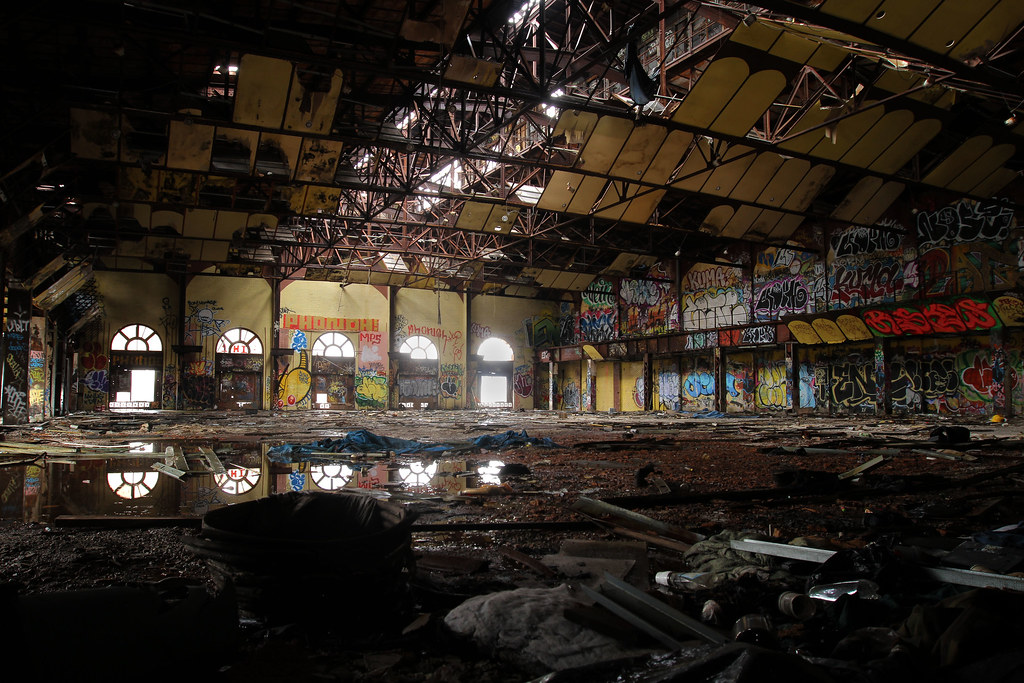
For all the atmosphere of grime and decay, the Batcave gives an impression of a living space that, though not well kept, was certainly well loved. It isn’t difficult to imagine a time when this damp industrial shell was filled with warmth and welcome, or to imagine its occupants, in those first idyllic months, brimming with a sense of ownership and control, invulnerable to the pressures of parents and policemen.
The fate of the Batcave lies in the balance of Gowanus’ contentious transition from industrial wasteland to trendy residential neighborhood. Numerous plans have emerged for the development of the property, but the canal’s recent Superfund designation and an uncertain future for the game-changing Whole Foods development across the street has deterred potential investors from shelling out the millions necessary to renovate the structure and rehabilitate its environmentally hazardous grounds. Through an overgrown lot in the height of Spring, the dilapidated redbrick facade remains a sight to behold, concealing a sordid wonderland within, marking the spot where a youthful dream lived, and died.
-Will Ellis
UPDATE Nov 23, 2012: The Batcave property sold for $7 million to philanthropist Joshua Rechnitz. The building will be saved, and renovated into art studios and exhibition space. Read the New York Times article here.

Open Your Eye, Girl.
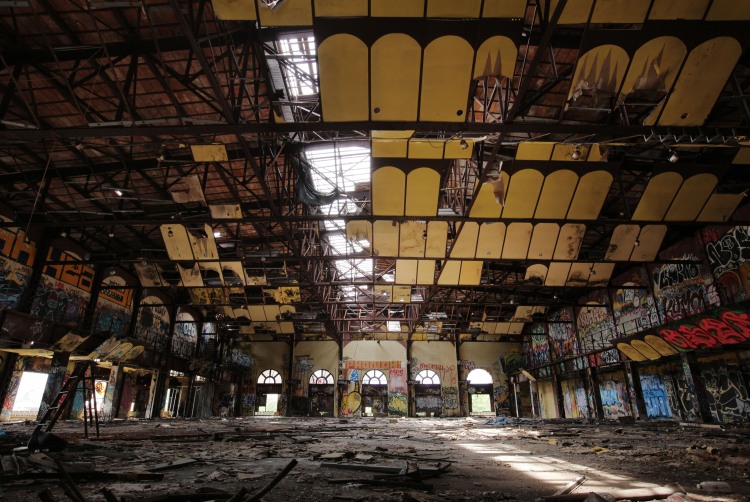
Ceiling of the Engine and Dynamo Room

A chair gives a sense of scale.

Some rooms are relatively undisturbed. Couldn’t resist lighting this candle holder, fashioned out of a beer can.

The residents are “Long Gone,” but it felt like someone could barge in at any moment.

Pallets remedy a flooded entrance to a large squat.

The markers of rebellion decorate a closet-sized residence.

Runes hidden in a jet-black hangout.

A Batcave Hallway

This Bear Jamboree figure was probably frightening long before it went to rot.

Detritus collects on a bedroom floor. Can you spot Buzz Lightyear?

Al Pacino watches over a squatter’s pad.

Hate, Fear, #1 Pizza Junky

A neighboring storage facility reflects its gawdy plastic siding into a Batcave nook, accenting some interiors with splashes of orange and blue.

An arched motif can be found throughout the building. Here, it’s painted in a ground floor nook.

A tree grows in Gowanus.
Inside Creedmoor State Hospital’s Building 25

The first glimpse of Building 25’s fourth floor from the central stairwell. That’s not gravel.
In Queens Village, mere inches of brick and mortar separate the world we know from one of the strangest places in the city. Once a haven for New York’s cast-out mentally ill, Creedmoor Psychiatric Center’s Building 25 has undergone something of a transformation over its 40 years of neglect.
Creedmoor was founded in 1912 as the Farm Colony of Brooklyn State Hospital, one of hundreds of similar psychiatric wards established at the turn of the century to house and rehabilitate those who were ill equipped to function on their own. Rejected by mainstream society, hundreds of thousands of mentally disturbed individuals, many afflicted with psychosis and schizophrenia, were transferred from urban centers across the country to outlying pastoral areas where fresh air, closeness to nature, and the healing power of work was thought to be their best bet for rehabilitation.

A few articles of clothing were left behind.
As the 20th century progressed, asylums across the country became overrun with patients, and many institutions became desperately understaffed and dangerously underfunded. Living conditions at some psychiatric wards grew dire—patient abuse and neglect was not uncommon. Creedmoor State Hospital was habitually under scrutiny during this period, beginning in the 1940s with an outbreak of dysentery that resulted from unsanitary living conditions in the wards.
The hospital had spiraled completely out of control by 1974 when the state ordered an inquiry into an outbreak of crime on the Creedmoor campus. Within 20 months, three rapes were reported, 22 assaults, 52 fires, 130 burglaries, six instances of suicide, a shooting, a riot, and an attempted murder, prompting an investigation into all downstate mental hospitals. As late as 1984, the violent ward of Creedmoor Psychiatric Center was rocked with scandal following the death of a patient, who had been struck in the throat by a staff member while restrained in a straitjacket.
In the late 20th Century, the development of antipsychotic medications and new standards of treatment for the mentally ill accelerated a trend toward deinstitutionalization. A series of dramatic budget cuts and dwindling patient populations led to the closing of farm colonies across the United States, and a marked decline at Creedmoor. The campus continues to operate today, housing only a few hundred patients and providing outpatient services, leaving its turbulent past behind. Many of the buildings have been sold off to new tenants. Others, like Building 25, lie fallow.
The building was an active ward until some time in the 1970s, and retains many mementos from its days as a residence and treatment center for the mentally ill. With peeling paint, dusty furniture, and dark corridors, the lower floors are typical of a long-abandoned hospital, but upstairs, the effect of time has taken a grotesque turn.
The smell alone is enough to drive anyone to the verge of madness, but the visual is even more appalling. For 40 years, generations of pigeons have defecated on the fourth floor of Building 25, far removed from their dim-witted dealings with the human world, assembling a monument all their own. Guano accumulates in grey mounds under popular roosts, with the tallest columns reaching several feet in height. Like the myriad formations of a cavern, Buiding 25’s guano stalagmites are a work in progress—pigeons roost at every turn, and they’re awfully dubious of outsiders. Violent outbursts of flight punctuate an otherworldly soundscape of low, rumbling coos. The filth acts as an acoustic insulator, making every movement impossibly close.
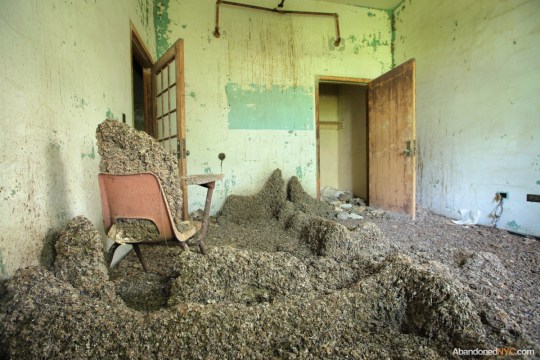
These dropping formations formed under the pipes of a sprinkler system the birds frequented. (Prints Available)
Two levels down and a world away from the top floor, a kitchen is filled with years’ worth of garbage intersected by narrow pathways. A living room, kept relatively tidy, features a sitting area with an array of chairs, including a homemade toilet. Loosely organized objects litter every surface—toiletries, clothing, hundreds of dead D batteries. Some of the belongings looked as if they hadn’t been touched for decades, but a newspaper dated to only a few weeks before confirmed my suspicion that someone was still living here.
I found him snoozing peacefully in a light-filled dayroom, surrounded by a series of patient murals. Once painted over, images of faraway lands, country gardens, and the Holy Mother are coming to light again as time peels back the layers. The image was surprising, unforgettably human, and imprudent to photograph. Declining to introduce myself, I passed once more through the dark, decaying halls of Building 25, leaving its charms, horrors, and mysteries for the birds. Back on solid ground, its impression wouldn’t fade for months—Building 25 has a way of recurring in dreams…

Overgrowth covered most of the windows, casting green light over much of the interior.
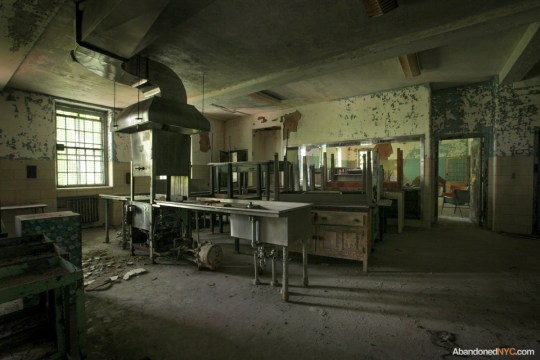
Furniture stacked in a cafeteria on Building 25’s third floor.
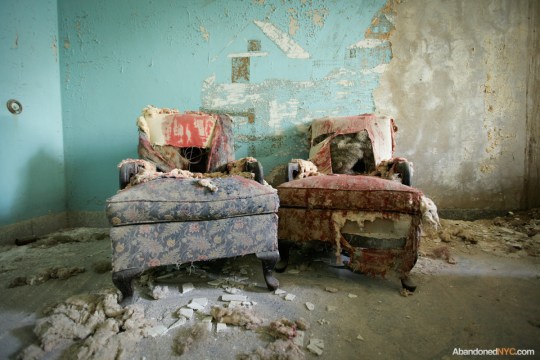
These chairs are popular with urban explorers, one went as far as covering the upholstery with fake blood.
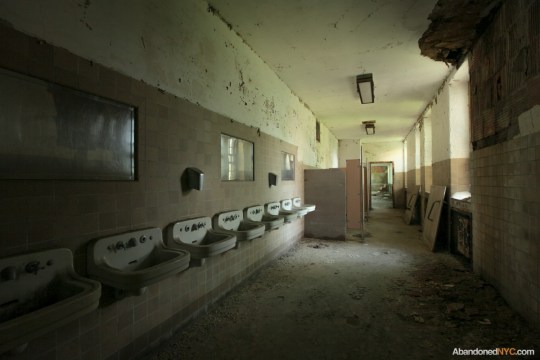
Metallic sheets are bolted to this bathroom wall in lieu of mirrors, which patients could use as a weapon.
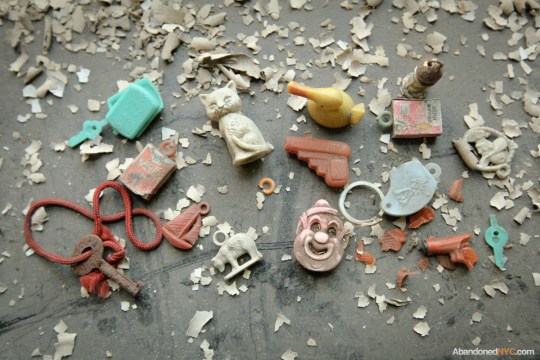
A tiny toy collection arranged on a windowsill. (Prints Available)

Even in the 70s, this equipment was outdated, and left behind.

Did this mural prophesy the current condition of the top floor?

An uninviting hallway on Creedmoor’s fourth floor.
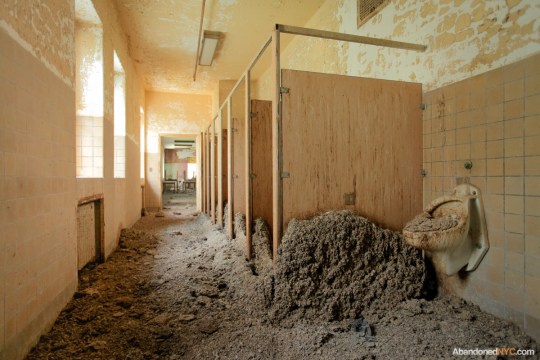
This bathroom held the largest volume of fecal matter. (Prints Available)

The guano gives some rooms the look of an indoor desert.

Anyone for musical chairs?
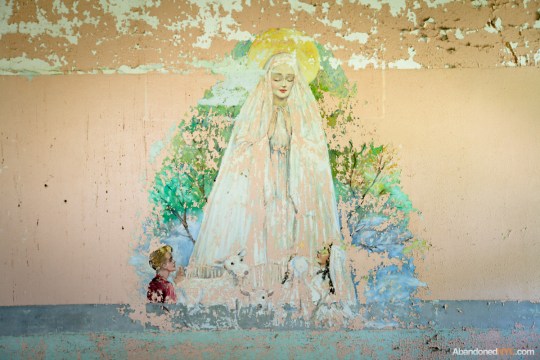
An incongruous Virgin emerges from an infested day room. (Prints Available)

A glimpse at the Creedmoor squat.
The Harlem Renaissance Ballroom
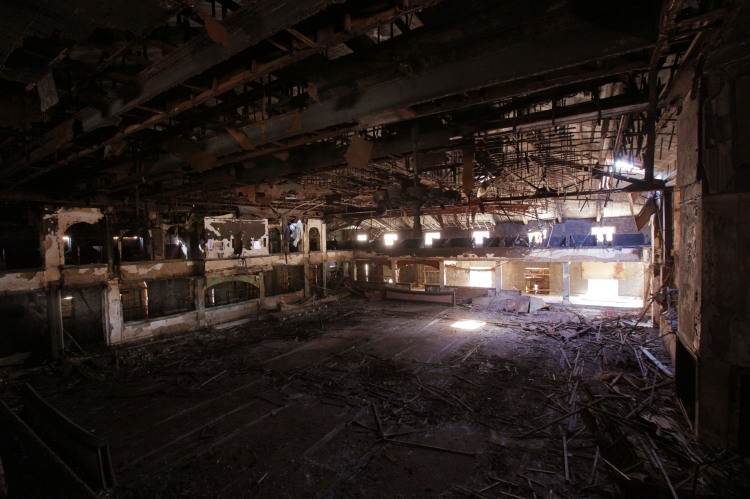
Inside The Harlem Renaissance Ballroom
The dance floor of the Harlem Renaissance Ballroom sprouts mushrooms today, but 80 years ago it quaked with the frenzied rhythms of the Lindy Hop.
The Ballroom was completed in 1924 as part of a larger entertainment hub that included a bustling casino and 900-seat theatre. Built and operated by black businessmen, the “Rennie” was the only upscale reception hall available to African Americans at the time. Prize fights, concerts, dance marathons, film screenings, and stage acts were held at the Renaissance, along with elegant parties and meetings of the most influential social clubs and political organizations in Harlem. The community’s elite gathered to dance the Charleston and the Black Bottom to live entertainment by the most renowned jazz musicians of the age.
The nightspot even played host to the nation’s first all-black professional basketball team, also called the Harlem Renaissance, considered by some to be the best in the world in their day. On game nights, portable hoops were erected on the dance floor, converting the ballroom into a stadium. Following each game, almost invariably a victory for the Rens, a dance was held where players would mingle and jive with the choicest ladies of Harlem. The team barnstormed in towns across the country, playing exhibition games in which coveted matches with white teams drew the largest crowds. In their best season, the Renns set a record with 88 consecutive wins that has yet to be broken.

View of the ballroom’s ruined interior from the bandstand.
A year before construction on the ballroom was completed, the institution that would one day demolish the Renaissance Casino moved in next door. The Abyssinian Baptist Church was once the largest Protestant congregation in the country, and continues to prosper today, both as a religious institution and a driving force of change in the surrounding neighborhood. Established in 1989, its nonprofit arm, the Abyssinian Development Corporation, has invested over $500 million in community development, becoming the most influential social service and housing provider in Harlem.
The corporation currently rents all of its 1,200 units of housing to low-income families, is responsible for constructing Harlem’s first new high school in 50 years, and has attracted numerous supermarkets, department stores, and national retail chains to aid in the development of the neighborhood. Despite their success, Abyssinian’s dealings have brought controversy in recent years. Many of their low-income tenants accuse the organization of neglect, pointing to hundreds of standing violations in their residential buildings. Their vision of the “New Harlem” seems at odds with some long-term community members, who call their “progress” gentrification.
The ADC purchased the Renaissance property in 1991 with plans to renovate the site back to its historical role as a social hall and community space. In the intervening years, they introduced a new plan that diverges sharply from their traditional housing ventures. While a portion of the property will be utilized as a community center, only 20% of the residential units will be “affordable,” the rest of the 19-story construction will be set aside for luxury condominiums. In a Times quote, Executive Director Sheena Wright cites the necessity of bringing “diverse income levels” to the neighborhood as justification for the project; she asserts, convincingly, that “one should not relegate Harlem to housing just for the poor.”
The first stage of development involves the demolition of the theatre structure. Plans call for the preservation of the ballroom’s facade, but the interior is coming down. The project almost hit a roadblock in 2006 when the structure was pegged for a Landmarks Commission review, but the ADC exerted its political muscle to block the designation, enlisting big name supporters like former Mayor Dave Dinkins, Manhattan Borough President Scott Stringer, and the New York Landmarks Conservancy to voice their opposition. In the five years that have passed since the ADC overcame this obstacle, a bleak economic climate has forced them to put the project on hold. Abyssinian is currently pursuing investors for the project.

A spotlight falls on the ballroom once again.
The site of the former theatre is now an empty lot harboring a few disused construction vehicles, but contrary to some reports, the Renaissance Ballroom still stands, for now.
Most of the windows are boarded up, but light finds its way through a caved-in ceiling, exposing the diaphanous remnants of a golden age—colored light bulbs still lodged in the nightclub’s chandeliers, seat numbers pinned in the balcony. Ghostly images of jazz singers and blasting trombones barely cling to the proscenium of the ballroom’s weathered stage, once graced by Duke Ellington, Count Basie, and Ella Fitzgerald. The sense of history here is palpable, and the deterioration absolute. Reduced to mulch, the dance floor supports a thriving green fungal colony. Little points to the existence of a casino on the lower floor, but a coatroom remains largely intact. The rest gives the impression of a war zone—feral cats tread freely over piles of rubble that once delineated rooms. It’s easy to see why Spike Lee used this location as a nightmare crack den in Jungle Fever.
Langston Hughes had the Rennie in mind when he described “a golden girl, in a golden gown, in a melody night, in Harlem town.” It’s been decades since the “mellow magic of dancing sound” has reverberated here, but the Ballroom remains significant through its connection to the cultural and intellectual movement it nurtured.

The floor of the ballroom was significantly decayed.

One of the larger mushroom patches.

Can you spot the face beaming on these faded signs?

Box seats in the balcony of the Harlem Renaissance Ballroom.

Another view from the stage.

Walls collapse in the downstairs lobby.

A dark hallway on the first floor.

The Coat Room
Inside The Domino Sugar Refinery
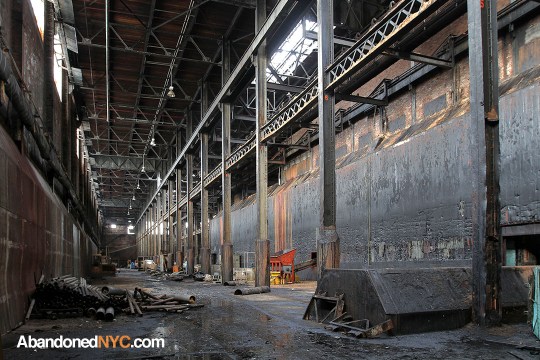
Inside the abandoned Domino Sugar Refinery’s cavernous raw sugar warehouse.
Situated on an eleven-acre parcel of waterfront in the shadow of the Williamsburg Bridge, the derelict Domino Sugar Refinery remains one of the most recognized monuments of Brooklyn’s rapidly disappearing industrial past. Now, after a decade of false starts, new plans for a modern, mixed use megacomplex may put an end to the decaying colossus that was once the largest refinery in the world, marking the final passage of a working-class Williamsburg.
In the late 19th century, Brooklyn was responsible for over half of the country’s sugar production, with Havemeyers & Elders Sugar Company leading the pack of over 20 major refineries that called the borough home. The factory’s signature building—a towering redbrick structure that still stands today—was constructed in 1884 to replace an older sugarhouse that had been destroyed in a catastrophic fire. Three years later, 17 of the largest sugar refiners in the U.S. merged to form the Sugar Refineries Co. Trust, later reorganized as the American Sugar Refining Co., and branded as Domino Sugar in 1902. Domino and its predecessors operated on the waterfront for a total of 148 years; at its peak, the site employed over 5,000 workers, capable of producing over three million pounds of processed sugar a day.

The American Sugar Refinery Processing House shown after its completion in the 1880s.
With the growing use of high fructose corn syrup and artificial sweeteners came a steady decline in demand for old-fashioned cane sugar. Production at the Williamsburg plant ended in the early 2000s with partial packaging operations lingering until 2004. The non-profit Community Preservation Corporation purchased the Domino site the same year for $58 million. Their plan would preserve and renovate the central refinery building, landmarked in 2007, and raise a battalion of architecturally offensive residential high-rises in the footprint of the surrounding industrial complex, razing the Raw Sugar Warehouse, constructed in 1927, and the Packaging House, a 1962 addition, in the process.

The old “New Domino” complex.
Two Trees teamed up with noted NYC firm SHoP Architects—the group is already leaving a lasting impression on the city landscape with the Barclay’s Center and the East River Esplanade. Unveiled Friday, their monumental plans seem tailor-made to appease the new population of Williamsburg, without limiting profits.
The plan is similar in scope to the vision of the CPC, with several key improvements. The buildings rise higher—up to 60 stories—to allow for more park space, including a one-acre “Domino Square,” where builders envision film screenings and outdoor concerts. Some of the structures include open spaces and sky bridges, an innovative solution sought to preserve harbor views for the inland community. The landmarked refinery building would be preserved and converted to office space, and several pieces of machinery would be salvaged for inclusion in a public “artifact walk.” In the face of such monumental changes, this may be of some consolation to New York nostalgics.

The new rendering.
Developers are working with the YMCA to establish a community space on the site, and are also proposing a new public school. Street level retail would favor independent business over chain store tenants. Two Trees also intends to deliver on the previous developer’s promise of 660 units of “affordable” housing, though the condition was never legally binding.
With all these benefits, Two Trees is attempting to pacify a community that is weary of change, and concerned for its future. The Domino development marks a clear and dramatic manifestation of a contentious transition that’s been taking place in Williamsburg for the last decade. The area is well known today as an infamous haven for hipster youth, but 10 years ago the neighborhood was a quiet, working-class community of Jewish, eastern European, and Hispanic immigrants. Now, it won’t be long before the tattooed and the trendy are priced out, leaving room for only the wealthiest New Yorkers. Emerging across formerly affordable areas of Manhattan and Brooklyn, the familiar pattern is destined to change the face of our city. Call it progress or gentrification. Praise the plans, or lament the loss, there’s no stopping the reckless growth of New York City.
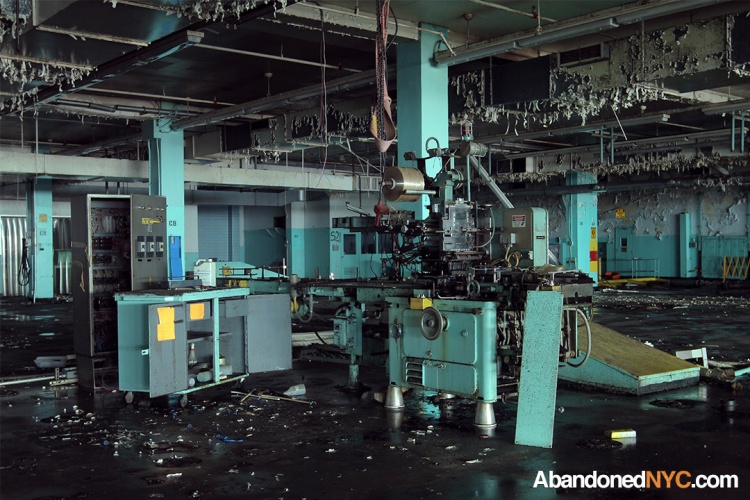
Eerie interiors of the abandoned packaging plant.
In its final moments, the Domino Sugar Refinery slips further into a speedy decay, introducing an element of the exotic to an already unfamiliar environment. Some of the alien interiors are coated with shallow puddles of tar, or dark sugar byproducts rendered the consistency of glue, or apple crisp. Others take on the appearance of an Egyptian temple in the impenetrable darkness, with row upon row of columns supporting the chasm of a vacant warehouse. Tinged aquamarine, the peeling factory floors of the packaging plant might be confused for the barnacled mechanisms of a sunken ship. The complex is unnervingly immense, presenting a seemingly endless series of floors connected by lightless, labyrinthine staircases. Alone in a factory that once employed thousands, up against its unfathomable depths, it felt like being in the belly of the whale—it didn’t take a miracle to get me out of there.
The next time you ride down the FDR or traverse the Williamsburg Bridge, take a good look at the sprawling industrial giant that was the Domino Sugar Refinery; it won’t be long before it’s preened and polished into the marketably modern new New Domino—another of the city’s rough edges, smoothed over in favor of gleaming glass.
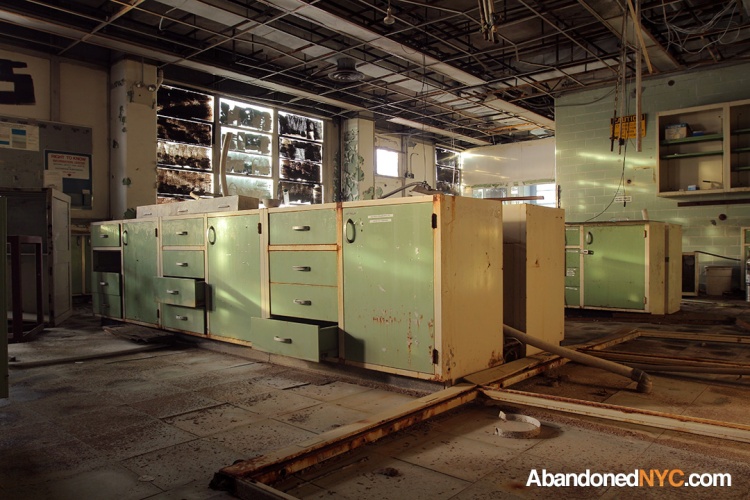
A storage room in the soon to be demolished packaging house.
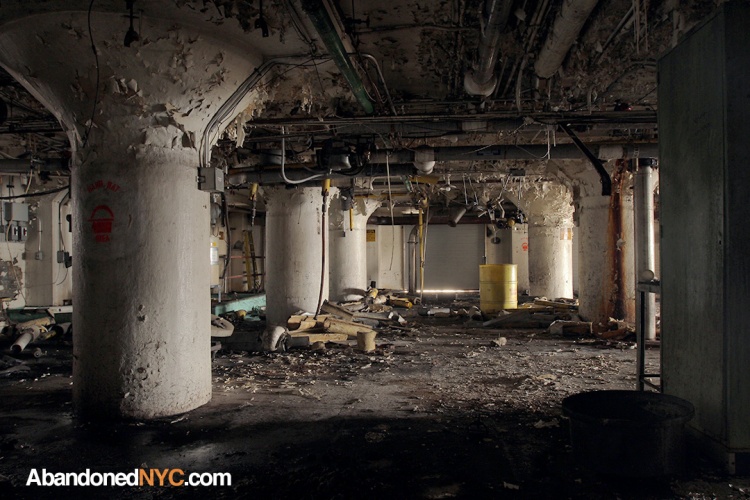
A dilapidated loading bay in the Domino Sugar Refinery.
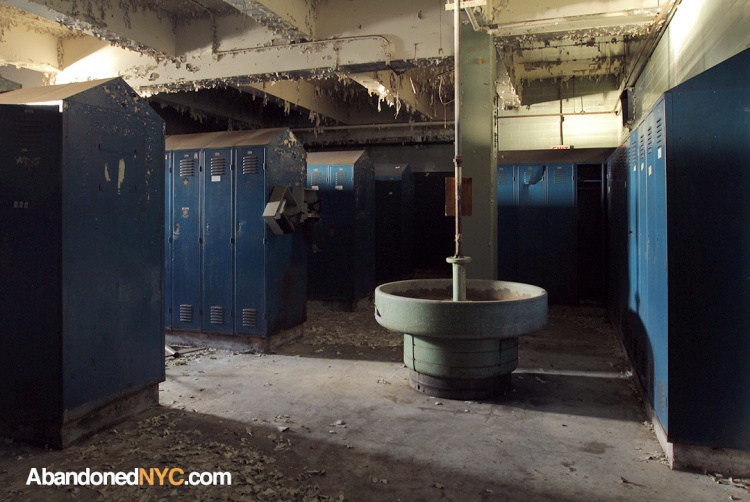
This locker room looked like something out of a horror movie.
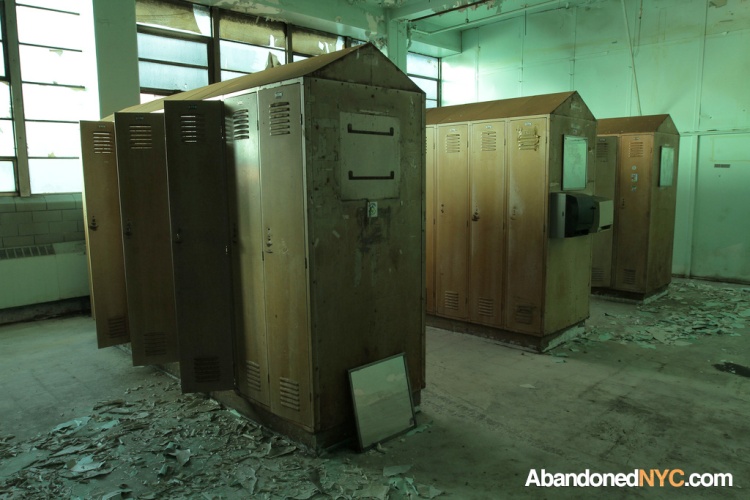
A smaller (women’s?) locker room.
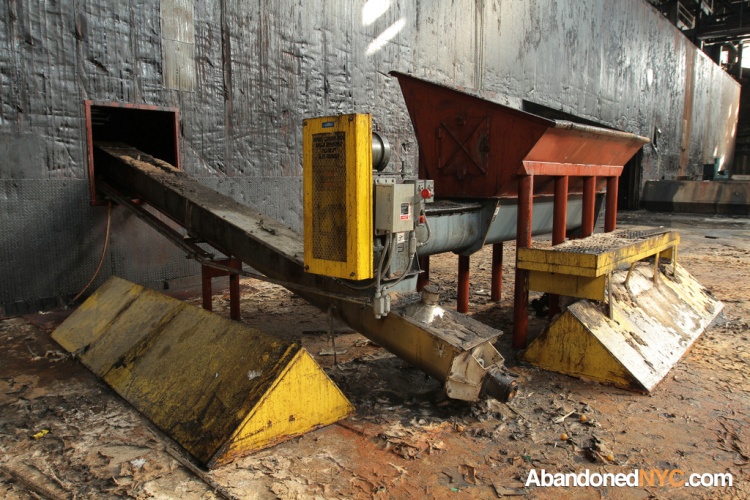
Machinery in the colossal Raw Sugar Warehouse.
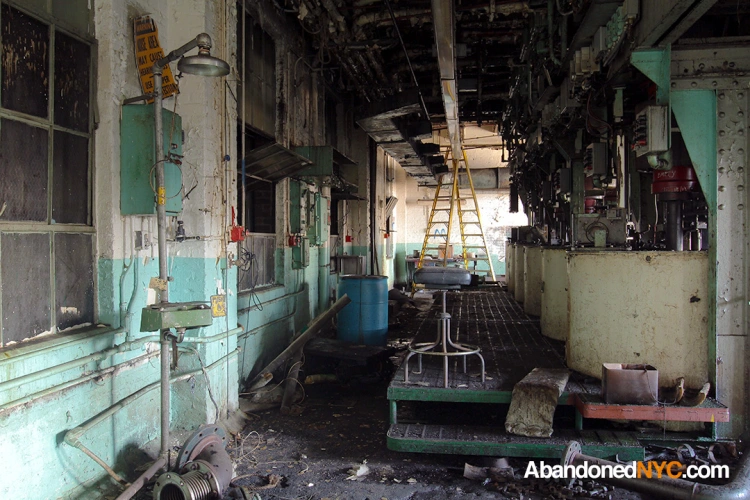
An eyewash station.

The factory interior.
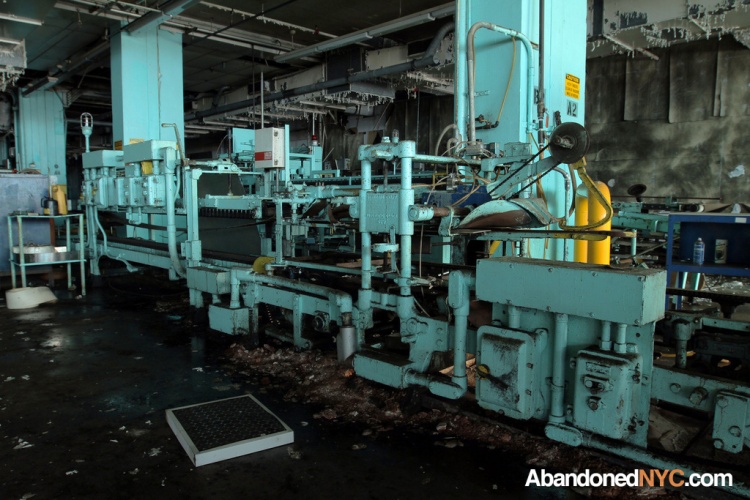
Another view of the packaging plant.
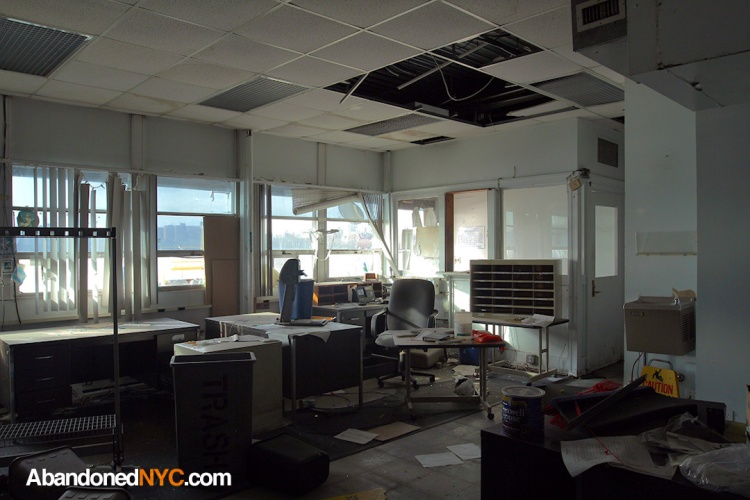
An emptied office overlooking the East River.
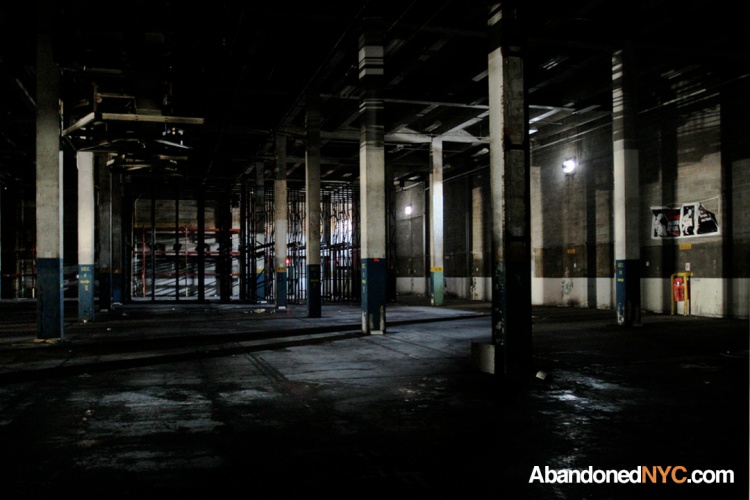
This warehouse was pitch black to the naked eye.
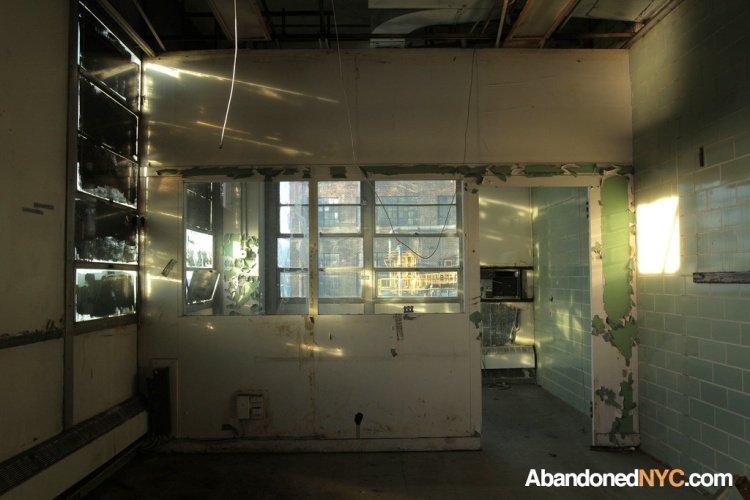
Evening light streaks through a painted window.
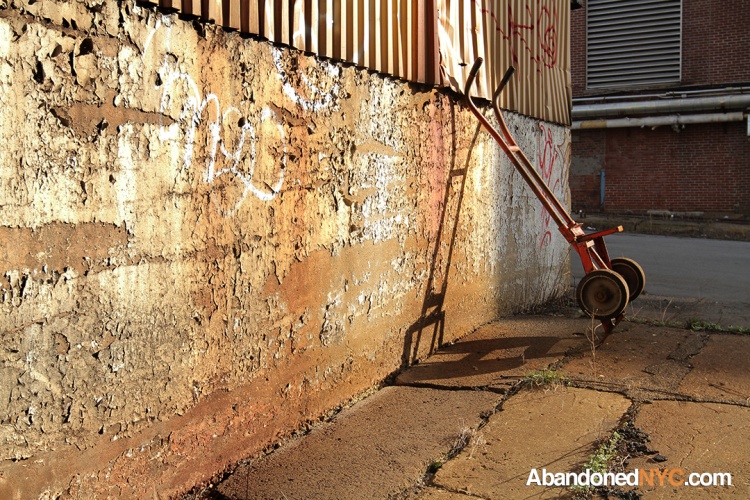
This handtruck might have sat untouched for a decade.
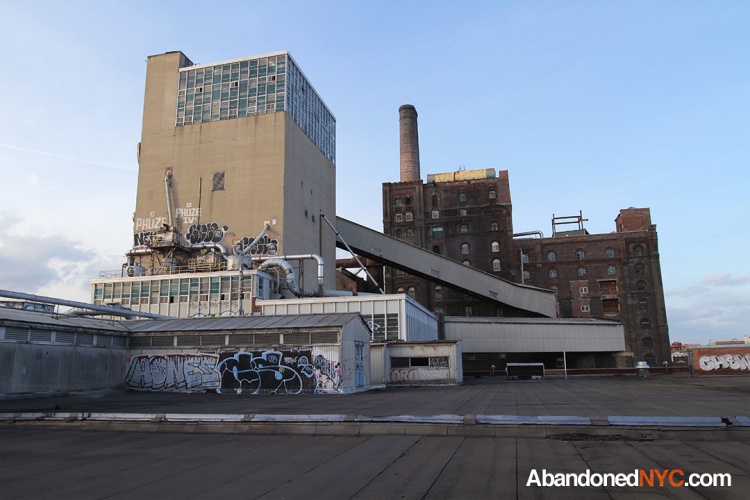
A view of the complex from the roof of the packaging plant.
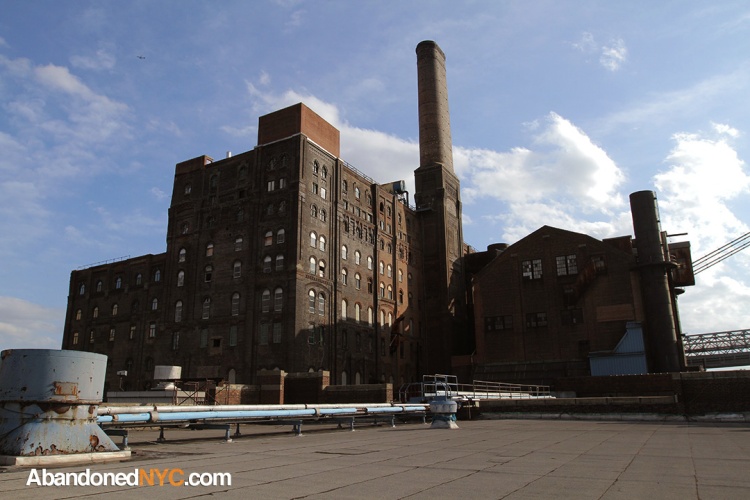
The landmarked refinery building as it stands today.
Bayley Seton Hospital: Part II

Flooded Hall.
I wasn’t able to track down any information on the function of this obscure outbuilding of the Bayley Seton Hospital complex in Stapleton, SI. The austere, three-story edifice is the only abandoned structure within the active section of Bayley Seton, situated on the northeast corner of the grounds behind the main building. The rest are fenced off and awaiting demolition after being sold to make way for a new development—it’s likely that this building may hang on for a bit longer.
For a detailed history of Bayley Seton Hospital, refer to my last post on the Nurses’ Residence.
If you have any information on this building, please enlighten me in the comments below.
- 2009 SI Live Article—”Salvation Army Finalizes Deal…”
- Photoessay by Nathan Kensinger on BSH’s Victim Services building
- Wikipedia entry on Bayley Seton Hospital

My favorite room in Bayley Seton Hospital.

Another view of the Utility Room. This door fell out of the wall when I tried to open it.

Evening light penetrates a dark hallway.

A crumbling passageway.

The floor of this room was covered with a rank, pulpy, mush—apparently the remains of ceiling panels that had gone to rot.

Glass block windows installed on the first floor.

One of several pieces of furniture remaining in the building.

A toilet with a strange weighted contraption.

An examination chair tucked away in the stairwell.

Graffiti in the building was minimal, but this bit stood out.

The building at sunset, just before a security guard asked me to leave…
The Bayley Seton Hospital Nurses’ Residence

Inside the Bayley Seton Hospital Nurses’ Residence
A floundering medical complex sits on a 20-acre campus in Stapleton on the North Shore of Staten Island. Today, eight of Bayley Seton Hospital’s twelve buildings lie abandoned, the largest being the old Nurses’ Residence at its southeast corner.
The grounds of BSH house Staten Island’s first hospital, an historic colonnaded structure built in the 1830s to serve ailing retired naval and merchant sailors, appropriately named “the Seamen’s Retreat.” Change came to the site in 1858 when a mob of 30-40 prominent locals attacked and burned down the Port of New York Quarantine Hospital, located a mile north of the Retreat. Though this horrific incident was incensed by an outbreak of yellow fever the locals blamed on the nearby hospital, flagrant racism was most likely a factor—recent immigrants made up the majority of the hospital’s population.
Some of the quarantine station’s services were transferred to areas of what is now Bayley Seton Hospital, and placed under the jurisdiction of the Marine Hospital Service, which by 1885 controlled the entire complex, and by 1902 had been renamed the US Public Health Service. In the 1930s, President Roosevelt started a campaign to revitalize The Public Health Service Hospitals, resulting in the construction of the main seven-story art-deco building and its offshoot Nurses’ Residence, a winged four-story structure on the southeast corner of the property.

The Nurses’ Residence (right,) pictured with the larger main building (left.)
The hospital was sold to the Sisters of Charity of New York, a Catholic healthcare organization, in 1980. At this point the U.S. Health Service Hospital was renamed after Sisters’ founder Elizabeth Seton and her father Richard Bayley (who coincidentally once headed the ill-fated Thompkinsville Quarantine Hospital.) Under the Sisters of Charity, the hospital was predominantly used to treat mental disorders and substance abuse, and continues to fulfill this role today, albeit at a greatly diminished capacity.
In 2000, The Sisters of Charity turned over Bayley Seton to the related Saint Vincent’s Catholic Medical Center, which faced financial troubles at the Stapleton campus from the beginning. Over half of its services were suspended and the hospital fell into an inexorable decline. Plans to close Bayley Seton emerged in 2004 as Saint Vincent’s, once the largest Catholic Health organization in New York, filed for bankruptcy with a debt of over a billion dollars. At some point during this tumultuous period (artifacts point to the building last being inhabited in 2002,) the former Nurses’ Residence, which had most recently been used as a New York addiction treatment facility, was abandoned as part of an ongoing series of downsizings and closures.

One of many gutted rooms, beginning to show signs of age.
In 2009, The Salvation Army settled on a 7.6 million dollar deal to purchase 7 acres of BSH. Originally, plans called for the construction of a 120,000 square-foot community center in the footstep of the Nurses’ Residence, set to begin in 2011, followed by a two-year period to terminate Bayley Seton’s remaining services, after which the main building would also be converted into senior housing. If it’s ever built, the center will be one of 30 similar complexes across the country funded by a 1.5 billion dollar endowment by the late Joan Kroc, widow of McDonald’s founder Ray Kroc. The Salvation Army failed to raise the 25 million needed to cover the difference between its cut of the Kroc endowment and the projected cost of construction, and ground has yet to be broken.

The Kroc Center in a 2007 rendering.
Twelve foot chain link fences have been placed along the perimeter of the Salvation Army property, but the site is otherwise untouched. Fenced-off and boarded-up, the Nurses’ Home ages in secret. Walls molt through layers of colored paint under tumbledown ceilings. The unrecognizable contents of a half-dozen milk cartons fester in a neglected refrigerator. An upright piano keeps mum in an empty common room while activity slows to a trickle on the rest of the Bayley Seton Hospital campus. Here and there, artifacts remain—painted crafts, motivational posters, hand-drawn cartoons—evoking the human element of the hospital’s better days. With its subtle architectural charms, the Nurses’ Residence has little hope of being saved from the wrecking ball, (though a few conservationists are out to change that.) Those in power seem to agree—despite centuries of convoluted history, it’s time to pull the plug on Bayley Seton Hospital.
For more photos of Bayley Seton Hospital’s abandonments, go on to PART II.
- 1858 NY Times Article on burning of quarantine buildings—”The Staten Island Arson”
- 2009 SI Live Article—”Salvation Army Finalizes Deal…”
- Photoessay by Nathan Kensinger on BSH’s Victim Services building
- Wikipedia entry on Bayley Seton Hospital

The main entrance.

Lettering here once pointed out the “Professional Services” office.

A kitchen on the top floor in the early stages of decay.

The contents of a staff-only refrigerator left long after their expiration dates.

This piano wasn’t worth the difficulty in transporting it.

Cheap ceilings crumble in the reception area.

Fluorescent fixtures dangle by the reception window.

Mold spreads on the walls of a first floor residence.

Another creepy hallway of the former Nurses’ Home.

“Invest in yourself, Share your pain”

Arts and Crafts

An exterior view of the abandoned Nurses’ Home as it stands today.
The Rockaway Beach Branch, Queens’ Forgotten Railroad

A platform still stands at Woodhaven Junction Station over Atlantic Avenue.
New York City’s narrowest jungle stretches across 3.5 miles of Central Queens, concealing the ruins of a rail line that’s been gathering rust for half a century. Abandoned by a bankrupt Long Island Railroad in 1962, the Rockaway Beach Branch is stirring debate today as opposing visions for its future emerge.
A passenger traveling on the Rockaway Beach Branch in the 1920s would board a southbound train at Whitepot Junction, pass through developing neighborhoods in Forest Hills, Glendale, Woodhaven, Richmond Hill, and Ozone Park, and traverse a burgeoning estuarine habitat called Jamaica Bay before arriving in the sandy Rockaways, then a popular vacation destination for privileged Manhattanites known as “New York’s Playground.” Today, the neighborhoods are flourishing, Jamaica Bay is losing 40 acres of marshland a year, and the isolated Rockaways are entering a stage of redevelopment.
The right-of-way was purchased by the city in the 1950s with plans to incorporate the entire line into its subway system, but the NYC Transit Authority ended up linking only the southern portion to the A train, cutting off the 3.5 mile stretch north of Rockaway Blvd. Through its 50 years of disuse, the remaining Rockaway Beach Branch has heard a stream of failed reuse and reactivation proposals as a forest has matured within its borders.
In 2005, community boards from Rego Park, Forest Hills, and other areas intersected by the line passed resolutions in favor of a linear park conversion, encouraged by the success of Manhattan’s High Line—a once abandoned rail line in Chelsea renovated into a futuristic above-ground park. According to the plan, bicycle paths and walkways would replace the derelict railroad, providing a much-needed green recreational space for the public. The Trust for Public Land is seeking private funding for a feasability study as a first step toward making the park, dubbed the “Queensway,” a reality. Beleaguered Rockaway commuters instead call for a reactivation of the line, which would provide a speedy link to Midtown Manhattan and a welcome alternative to the circuitous A-train. In response to this proposal, the MTA cites high operational and construction costs as deterrents to the project.
 Trudging through this palsied limb of the New York City transit system, it’s hard to imagine either plan coming to fruition here, a place where few people venture and fewer have a good reason to. Detritus from teenage excursions and midnight meetings collect in piles along the forgotten spur—scrapped car parts, a coil of barbed wire, scores of bottles, a forsaken shopping cart, and most memorably, a discarded cleaver.
In a different season, the century-old rails would be obscured by vegetation, but they’re clearly visible on this brisk February afternoon. Forty-year-old birch and oak reclaim the soil, shoving aside iron rails assembled in the 1910s. Fallen branches and debris intersect a continuous line of tracks; most electrical towers still stand, others lay mired in the overgrowth. Leaves crunching under my feet alert a chain of backyard sentinels to my presence. Aside from the dogs and the postman, little else stirs in this quiet residential community; change is coming to the Rockaway Beach Branch—but it could take another 50 years to arrive.


A jagged weapon discarded on an overpass.

A nearby substation abandoned by the LIRR.
A Watery Grave for Historic Ships on Staten Island
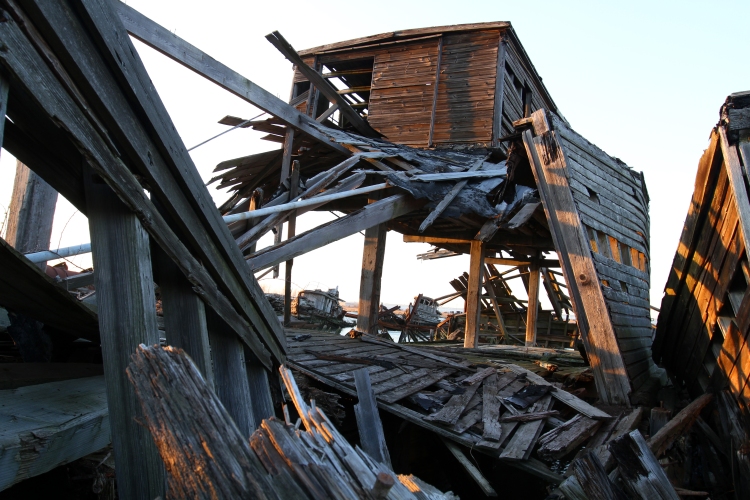
Wooden Shipwreck at Arthur Kill Boat Graveyard.
Do you know how to get to Staten Island’s most remarkable graveyard? First pass through a centuries-old roadside cemetery, (consisting of a handful of horribly eroded grave markers). Follow a barely there garbage-strewn path down to the marshy Arthur Kill (kill is the Dutch word for creek, which explains why creepy names like “Fresh Kills” abound in the Dutch-settled Hudson River Valley.) Once your feet are sinking a few inches into the mud with every step, you’ll start seeing the boats. Some over a century old, steam vessels, warships, ferries, fireboats, the final vestiges of New York’s shipping era, doomed to die here in a catastrophically polluted Staten Island waterway. Welcome to the Arthur Kill Boat Graveyard.

Secluded path from the cemetery down to the Arthur Kill.
Operational since the 1930s, Witte’s Marine Equipment company in Rossville served to dredge, salvage, and resell materials from the wrecked and disused vessels of the New York and New Jersey waterways. Eccentric owner John J. Witte refused to dismantle the majority of the ships that came to rest in the yard, amassing a prodigious collection of over 400 historic watercraft. As the ships slowly decomposed and the area gained a reputation as a mecca for artists and photographers, Witte gained his own reputation as a ferocious defender of his property, known for scaring off unsolicited visitors personally until he passed away in 1980. The yard is now controlled by the Donjon Marine Company, which seems to be taking a more proactive approach to actually salvaging materials from the wrecks and keeping the curious out, erecting 12-foot metal walls around the perimeter of the yard with signs prohibiting any and all photography.
The walls presented an obstacle, but after several muddy minutes I made it to the Arthur Kill Shore. Though the shipyard had lost most of its former glory, the remaining 20-40 wrecks were still an eldritch sight to behold—half submerged in years of muck, leaning at odd angles, corroded in streaks of rust, putrefying elbow to elbow with massive skeleton hulls. These wade out their final days in the boneyard before being stripped and recycled into automobiles and refrigerators. So see them while you can, if you dare, what was once the city’s premiere collection of nautical artifacts is sinking fast.

Rotting hulls jut from their shallow graves at the Arthur Kill Ship Graveyard.

Rusty Boats pile up on the shore.

Oxidized machinery adorns this decaying watercraft.

A salvaged wheelhouse moulders in the marsh.
Shedding Light on a Forgotten Red Hook Warehouse

Two stark, imposing sister buildings at 160 and 62 Imlay St. tower over the industrial wastes of Red Hook, Brooklyn. One recently renovated into a high-tech Christie’s storage facility for multi-million dollar works of art, the other a hulking, empty shell, waiting for a second life.
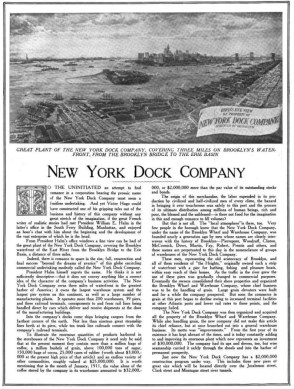
Constructed in 1911-13, the identical twin loft buildings on 160 and 62 Imlay St. began their lives as storehouses for the New York Dock Company. They made up a small part of a “globe-encircling commercial undertaking,” which included a sprawling network of 200 warehouses, 39 piers, and three ship-to-rail freight terminals extending over three miles of the Brooklyn Waterfront.
Rapidly declining profits and outdated infrastructure resulted in a cessation of operations in 1983. The buildings were purchased by a developer in 2000 and 2002 for a combined 22 million. In 2003, plans for a residential overhaul of 160 Imlay fell through as a result of a lawsuit from the local Chamber of Commerce, which sought to retain an industrial use for the property.
Now at 62 Imlay St, floors once flooded with tobacco and cotton are welcoming a new set of residents—multimillion dollar works of art by the likes of Van Gogh, Brancusi, and Pollack. The facility is leased by the high-profile auction house Christie’s and is equipped with “infrared video cameras, biometric readers and motion-activated monitors, as well as smoke-, heat- and water-detection systems.”
Adjacent sits the other sister with an uncertain future, its broad, vacant interiors shielded with plastic and shrouded in black netted scaffolding, gutted in preparation for a rumored second attempt at a residential conversion.


Top Posts & Pages


 AbandonedNYC